. 2011 Jan 1;20(1):165-75.
doi: 10.1093/hmg/ddq455. Epub 2010 Oct 11.

Protein kinase A regulates caspase-1 via Ets-1 in bone stromal cell-derived lesions: a link between cyclic AMP and pro-inflammatory pathways in osteoblast progenitors

Affiliations

Protein kinase A regulates caspase-1 via Ets-1 in bone stromal cell-derived lesions: a link between cyclic AMP and pro-inflammatory pathways in osteoblast progenitors

Madson Q Almeida et al. Hum Mol Genet. .

Abstract

Patients with genetic defects of the cyclic (c) adenosine-monophosphate (AMP)-signaling pathway and those with neonatal-onset multisystem inflammatory disease (NOMID) develop tumor-like lesions of the long bones. The molecular basis of this similarity is unknown. NOMID is caused by inappropriate caspase-1 activity, which in turn activates the inflammasome. The present study demonstrates that NOMID bone lesions are derived from the same osteoblast progenitor cells that form fibroblastoid tumors in mice and humans with defects that lead to increased cAMP-dependent protein kinase A (PKA) signaling. NOMID tumor cells showed high PKA activity, and an increase in their cAMP signaling led to PKA-specific activation of caspase-1. Increased PKA led to inflammation-independent activation of caspase-1 via over-expression of the proto-oncogene (and early osteoblast factor) Ets-1. In NOMID tumor cells, as in cells with defective PKA regulation, increased prostaglandin E2 (PGE2) led to increased cAMP levels and activation of Wnt signaling, like in other states of inappropriate PKA activity. Caspase-1 and PGE2 inhibition led to a decrease in cell proliferation of both NOMID and cells with abnormal PKA. These data reveal a previously unsuspected link between abnormal cAMP signaling and defective regulation of the inflammasome and suggest that caspase-1 and PGE2 inhibition may be therapeutic targets in bone lesions associated with defects of these two pathways.


Figures
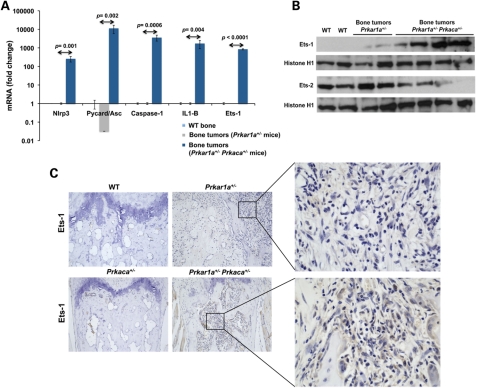
Figure 1.
Figure 1.
Ets-1 and caspase-1 inflammasome up-regulation in bone tumors from Prkar1a+/ Prkaca+/ mice. (A) Quantitative RT–PCR analysis showing Nlrp3, ASC, Casp1, IL1b and Ets-1 over-expression in Prkar1a+/− Prkaca+/− bone tumors (n = 3) compared with Prkar1a+/− bone tumors (n = 3) and WT bone (n = 3). (B) Western blot analysis showing high Ets-1 protein levels and Ets-2 down-regulation in Prkar1a+/− Prkaca+/− bone tumors. Western blot analysis was performed in triplicate. (C) Strong positive staining for Ets-1 in bone tumor from Prkar1a+/− Prkaca+/− mice. Prkar1a+/− bone tumor and bone tissue from Prkaca+/− and WT mice displayed a negative staining (magnification, ×10 and ×40). Gene expression analysis is presented as mean ± SD.
Figure 2.
Figure 2.
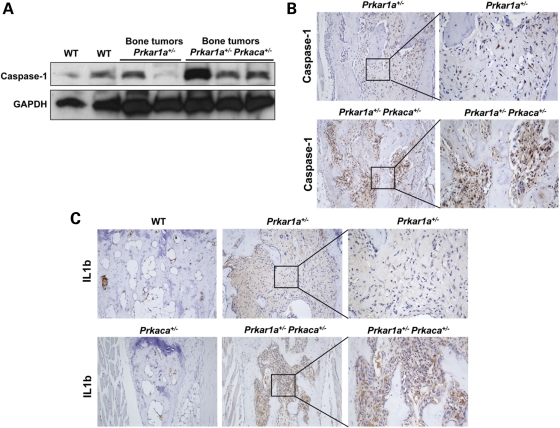
Caspase-1 and IL1B over-expression at the protein level in Prkar1a+/ Prkaca+/ bone tumors. (A) Caspase-1 protein levels were higher in bone tumors from Prkar1a+/− Prkaca+/− mice than from Prkar1a+/−- and WT mice (western blot analysis was performed in triplicate). (B) Stronger caspase-1 immunoreactivity in Prkar1a+/− Prkaca+/− bone tumor when compared with Prkar1a+/− bone lesion (magnification, ×10 and ×20). (C) Prkar1a+/− Prkaca+/− bone tumor cells inside the bone marrow cavity displayed a high staining for IL1B (magnification, ×10 and ×40).
Figure 3.
Figure 3.
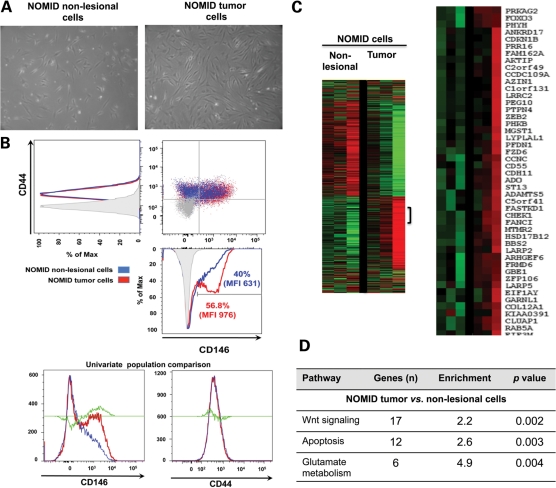
Molecular characterization of NOMID cells . (A) NOMID cells have a fibroblastoid and spindle-shaped appearance at phase contrast microscopy (magnification, ×10). (B) The BSC marker CD146 was increased in NOMID tumor cells compared with NOMID non-lesional cells. (C) Heatmap visualization of gene expression data from NOMID non-lesional and tumor cells. (D) Functional analysis of whole-genome transcriptome profiling showing up-regulation of Wnt signaling and apoptosis pathways in NOMID tumor cells. BSC, bone stem cell; MFI, median fluorescent intensity.
Figure 4.
Figure 4.
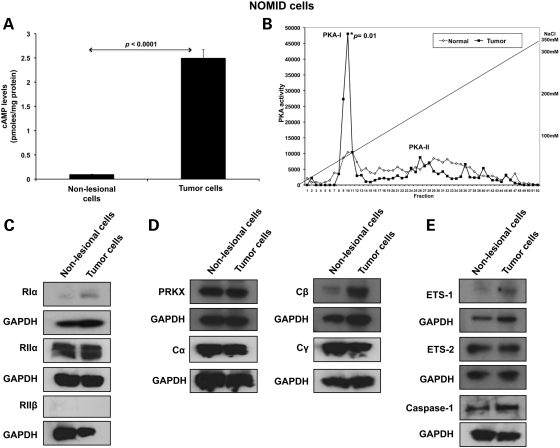
High PKA activity, cAMP levels and β catalytic subunit (Cβ) expression in NOMID tumor cells. (A) NOMID tumor cells presented high cAMP levels when compared with NOMID non-lesional cells. (B) PKA-I activity after cAMP stimulus was significantly higher in NOMID tumor cells than in non-lesional cells (P = 0.01). (C) RIα and RIIα protein levels were similar in NOMID non-lesional and tumor cells. (D) NOMID tumor cells showed a remarkable induction in the expression of Cβ subunit. Expression levels of the other catalytic subunits (Cα, Cγ and Prkx) were similar in NOMID non-lesional and tumor cells. (E) NOMID tumor cells presented higher expression levels of Ets-1 and caspase-1. All the experiments (cAMP and PKA assays and western blot analysis) were performed in triplicate. cAMP levels are presented as mean ± SD.
Figure 5.
Figure 5.
Protein kinase A regulates caspase-1 via Ets-1 proto-oncogene activation . (A) Ets-1 and caspase-1 expression had a significant down-regulation after transient transfection with Cα siRNA. (B) Western blot analysis showed a reduction in caspase-1 expression in MC3T3 cells transfected with Ets-1 siRNA. Ets-2 down-regulation had no effect on caspase-1 protein expression. (C) PRKACA-expressing vector promoted a significant increase in the Ets-1 and caspase-1 protein expression. Simultaneous transfection with Ets-1 siRNA and PRKACA-expressing vector blocked caspase-1 up-regulation induced by Cα subunit. Western blot analysis was confirmed in three independent experiments.
Figure 6.
Figure 6.
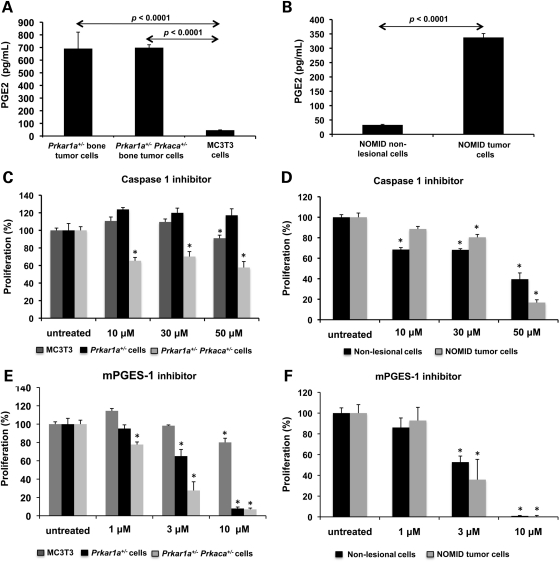
Mouse and NOMID tumor cells secret PGE2 and show high sensibility to caspase-1 and mPGES-1 inhibition. (A) PGE2 levels were significantly higher in Prkar1a+/− and Prkar1a+/− Prkaca+/− bone tumor cells when compared with MC3T3 cells. (B) NOMID tumor cells also showed higher PGE2 levels than NOMID non-lesional cells. (C) Caspase-1 inhibition significantly reduced proliferation of Prkar1a+/− Prkaca+/− bone tumor cells. The caspase inhibitor had no effect on MC3T3 cells and Prkar1a+/− bone tumor cells. (D) NOMID cells showed a significant decrease in proliferation after caspase-1 inhibition. (E) The inhibition of PGE2 production by a selective inhibitor of mPGES-1 significantly reduced viability of Prkar1a+/− and Prkar1a+/− Prkaca+/− bone tumor cells. (F) NOMID non-lesional and tumor cells also had a progressive reduction on proliferation after mPGES-1 blockage. PGE2 levels and cell proliferation are shown as mean ± SD. All the experiments were performed in triplicate. PGE2, prostaglandin E2; mPGES1, microsomal prostaglandin E synthase-1.
Figure 7.
Figure 7.
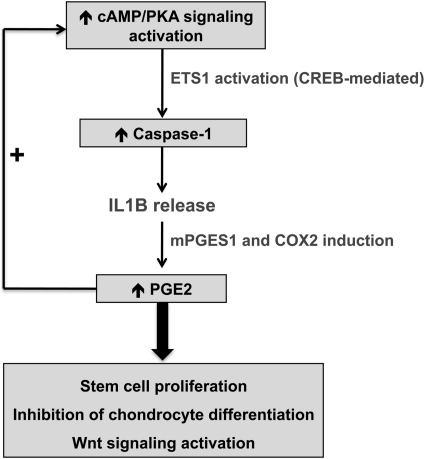
Schematic representation of pro-inflammatory pathway induction by cAMP/PKA signaling in BSC-derived lesions. PGE2, prostaglandin E2; mPGES1, microsomal prostaglandin E synthase-1; COX2, cyclooxygenase-2; CREB, cAMP-responsive element-binding protein.

References

    1. Kirschner L.S., Kusewitt D.F., Matyakhina L., Towns W.H., II, Carney J.A., Westphal H., Stratakis C.A. A mouse model for the Carney complex tumor syndrome develops neoplasia in cyclic AMP-responsive tissues. Cancer Res. 2005;65:4506–4514. - PubMed
    1. Carney J.A., Boccon-Gibod L., Jarka D.E., Tanaka Y., Swee R.G., Unni K.K., Stratakis C.A. Osteochondromyxoma of bone: a congenital tumor associated with lentigines and other unusual disorders. Am. J. Surg. Pathol. 2001;25:164–176. - PubMed
    1. Stratakis C.A., Kirschner L.S., Carney J.A. Clinical and molecular features of the Carney complex: diagnostic criteria and recommendations for patient evaluation. J. Clin. Endocrinol. Metab. 2001;86:4041–4046. - PubMed
    1. Pavel E., Nadella K., Towns W.H., II, Kirschner L.S. Mutation of Prkar1a causes osteoblast neoplasia driven by dysregulation of protein kinase A. Mol. Endocrinol. 2008;22:430–440. - PMC - PubMed
    1. Tsang K.M., Starost M.F., Nesterova M., Boikos S.A., Watkins T., Almeida M.Q., Harran M., Li A., Collins M.T., Cheadle C., et al. Alternate protein kinase A activity identifies a unique population of stromal cells in adult bone. Proc. Natl Acad. Sci. USA. 2010;107:8683–8688. - PMC - PubMed

Publication types

MeSH terms