


Impact of sex, age, race, ethnicity and aspirin use on bleeding symptoms in healthy adults
- PMID: 20942847
- PMCID: PMC3017649
- DOI: 10.1111/j.1538-7836.2010.04105.x
Impact of sex, age, race, ethnicity and aspirin use on bleeding symptoms in healthy adults
Abstract
Background: Comparing a patient's bleeding symptoms with those of healthy individuals is an important component of the diagnosis of bleeding disorders, but little is known about whether bleeding symptoms in healthy individuals vary by sex, race, ethnicity, age, or aspirin use. OBJECTIVES, PATIENTS/METHODS: We developed a comprehensive, ontology-backed, Web-based questionnaire to collect bleeding histories from 500 healthy adults. The mean age was 43 years (range 19-86 years), 63% were female, 19% were Hispanic, 37% were African-American, 43% were Caucasian, 8% were Asian, and 4% were multiracial.
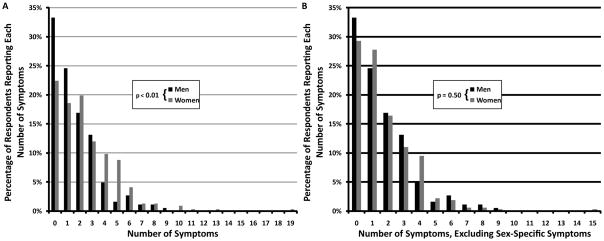
Results: 18 of the 36 symptoms captured occurred with < 5% frequency, and 26% of participants reported no bleeding symptoms (range 0-19 symptoms). Differences in sex, race, ethnicity, aspirin use and age accounted for only 6-13% of the variability in symptoms. Although men reported fewer symptoms than women (median 1 vs. 2, P < 0.01), there was no difference when sex-specific questions were excluded (median 1 for both men and women, P = 0.50). However, women reported more easy bruising (24% vs. 7%, P < 0.01) and venipuncture-related bruising (10% vs. 3%, P = 0.02). The number of symptoms did not vary by race or age, but epistaxis was reported more frequently by Caucasians than by African-Americans (29% vs. 18%, P = 0.02), and epistaxis frequency decreased with age (odds ratio 0.97 per year, P < 0.01). Paradoxically, infrequent aspirin users reported more bruising and heavy menses than frequent users (21% vs. 8%, P = 0.01, and 56% vs. 38%, P = 0.03, respectively).
Conclusions: Our findings provide a contemporaneous and comprehensive description of bleeding symptoms in a diverse group of healthy individuals. Our Web-based system is freely available to other investigators.
© 2010 International Society on Thrombosis and Haemostasis.
Figures
References
-
- Coller BS, Schneiderman PI. Clinical evaluation of hemorrhagic disorders: The bleeding history and differential diagnosis of purpura. In: Hoffman R, Benz EJ, Shattil SJ, Furie B, Silberstein LE, McGlave P, et al., editors. Hematology: Basic Principles and Practice. 5. New York: Churchill Livingstone; 2004. pp. 1851–76.
-
- Chee YL, Crawford JC, Watson HG, Greaves M. Guidelines on the assessment of bleeding risk prior to surgery or invasive procedures. British Committee for Standards in Haematology. Br J Haematol. 2008;140:496–504. - PubMed
-
- Eckman MH, Erban JK, Singh SK, Kao GS. Screening for the risk for bleeding or thrombosis. Ann Intern Med. 2003;138:W15–W24. - PubMed
-
- Rodeghiero F, Castaman G, Tosetto A, Batlle J, Baudo F, Cappelletti A, Casana P, De Bosch N, Eikenboom JC, Federici AB, Lethagen S, Linari S, Srivastava A. The discriminant power of bleeding history for the diagnosis of type 1 von Willebrand disease: an international, multicenter study. J Thromb Haemost. 2005;3:2619–26. - PubMed
-
- Tosetto A, Rodeghiero F, Castaman G, Goodeve A, Federici AB, Batlle J, Meyer D, Fressinaud E, Mazurier C, Goudemand J, Eikenboom J, Schneppenheim R, Budde U, Ingerslev J, Vorlova Z, Habart D, Holmberg L, Lethagen S, Pasi J, Hill F, et al. A quantitative analysis of bleeding symptoms in type 1 von Willebrand disease: results from a multicenter European study (MCMDM-1 VWD) J Thromb Haemost. 2006;4:766–73. - PubMed
MeSH terms
Substances
Grants and funding
LinkOut - more resources
Full Text Sources
Medical
