


The differential activity of interferon-α subtypes is consistent among distinct target genes and cell types
- PMID: 20943413
- PMCID: PMC3020287
- DOI: 10.1016/j.cyto.2010.09.006
The differential activity of interferon-α subtypes is consistent among distinct target genes and cell types
Abstract
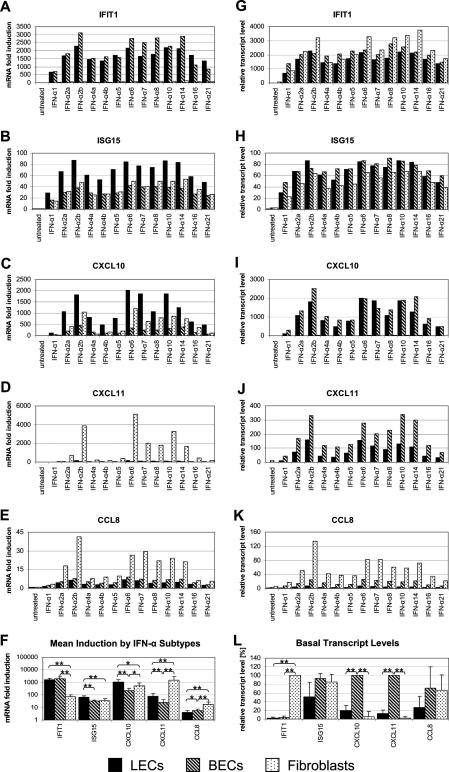
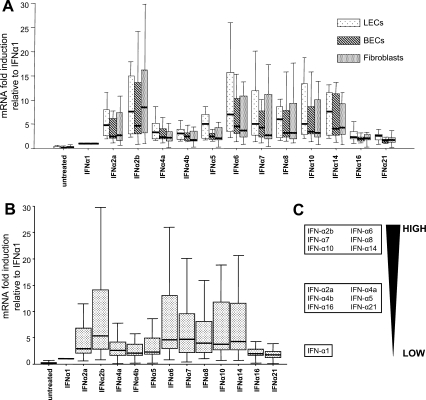
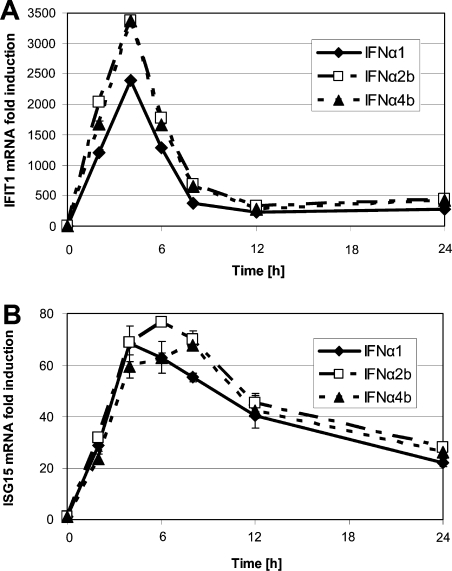
IFN-α proteins have been described to originate from 14 individual genes and allelic variants. However, the exceptional diversity of IFN-α and its functional impact are still poorly understood. To characterize the biological activity of IFN-α subtypes in relation to the cellular background, we investigated the effect of IFN-α treatment in primary fibroblasts and endothelial cells of vascular or lymphatic origin. The cellular response was evaluated for 13 distinct IFN-α proteins with respect to transcript regulation of the IFN-stimulated genes (ISGs) IFIT1, ISG15, CXCL10, CXCL11 and CCL8. The IFN-α proteins displayed a remarkably consistent potency in gene induction irrespective of target gene and cellular background which led to the classification of IFN-α subtypes with low (IFN-α1), intermediate (IFN-α2a, -4a, -4b, -5, -16, -21) and high (IFN-α2b, -6, -7, -8, -10, -14) activity. The differential potency of IFN-α classes was confirmed at the ISG protein level and the functional protection of cells against influenza virus infection. Differences in IFN activity were only observed at subsaturating levels of IFN-α proteins and did not affect the time course of ISG regulation. Cell-type specific responses were apparent for distinct target genes independent of IFN-α subtype and were based on different levels of basal versus inducible gene expression. While fibroblasts presented with a high constitutive level of IFIT1, the expression in endothelial cells was strongly induced by IFN-α. In contrast, CXCL10 and CXCL11 transcript levels were generally higher in endothelial cells despite a pronounced induction by IFN-α in fibroblasts. In summary, the divergent potency of IFN-α proteins and the cell-type specific regulation of individual IFN target genes may allow for the fine tuning of cellular responses to pathogen defense.
Copyright © 2010 Elsevier Ltd. All rights reserved.
Figures


References
-
- Isaacs A., Lindenmann J. Virus interference. I. The interferon. Proc R Soc Lond B Biol Sci. 1957;147:258–267. - PubMed
-
- Pestka S., Krause C.D., Walter M.R. Interferons, interferon-like cytokines, and their receptors. Immunol Rev. 2004;202:8–32. - PubMed
-
- Diaz M.O., Pomykala H.M., Bohlander S.K., Maltepe E., Malik K., Brownstein B. Structure of the human type-I interferon gene cluster determined from a YAC clone contig. Genomics. 1994;22:540–552. - PubMed
-
- Chen J., Baig E., Fish E.N. Diversity and relatedness among the type I interferons. J Interferon Cytokine Res. 2004;24:687–698. - PubMed
-
- Platanias L.C. Mechanisms of type-I- and type-II-interferon-mediated signalling. Nat Rev Immunol. 2005;5:375–386. - PubMed
Publication types
MeSH terms
Substances
Grants and funding
LinkOut - more resources
Full Text Sources
Other Literature Sources
Research Materials
Miscellaneous
