


FTO is increased in muscle during type 2 diabetes, and its overexpression in myotubes alters insulin signaling, enhances lipogenesis and ROS production, and induces mitochondrial dysfunction
- PMID: 20943749
- PMCID: PMC3012179
- DOI: 10.2337/db10-0281
FTO is increased in muscle during type 2 diabetes, and its overexpression in myotubes alters insulin signaling, enhances lipogenesis and ROS production, and induces mitochondrial dysfunction
Abstract
Objective: A strong association between genetic variants and obesity was found for the fat mass and obesity-associated gene (FTO). However, few details are known concerning the expression and function of FTO in skeletal muscle of patients with metabolic diseases.
Research design and methods: We investigated basal FTO expression in skeletal muscle from obese nondiabetic subjects and type 1 and type 2 diabetic patients, compared with age-matched control subjects, and its regulation in vivo by insulin, glucose, or rosiglitazone. The function of FTO was further studied in myotubes by overexpression experiments.
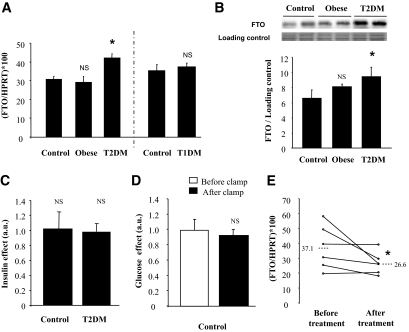
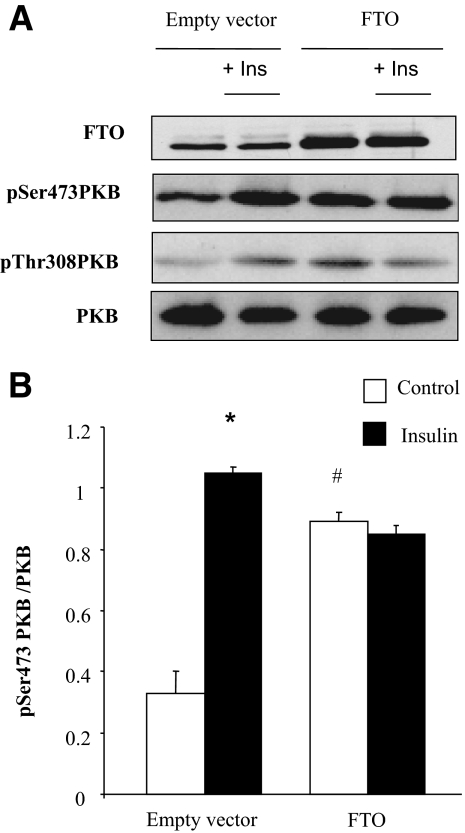
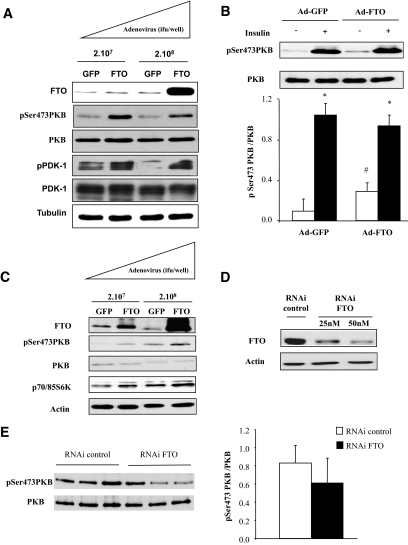
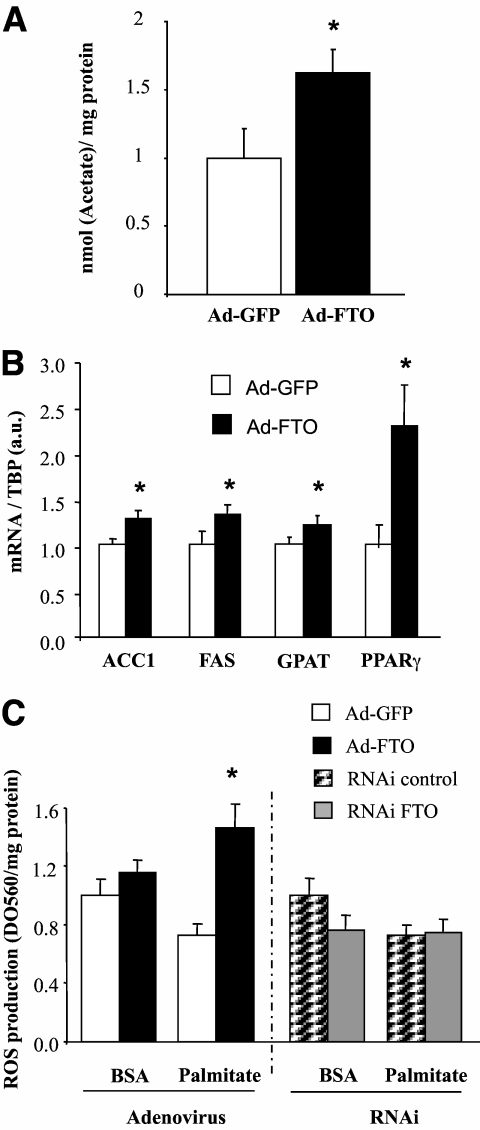
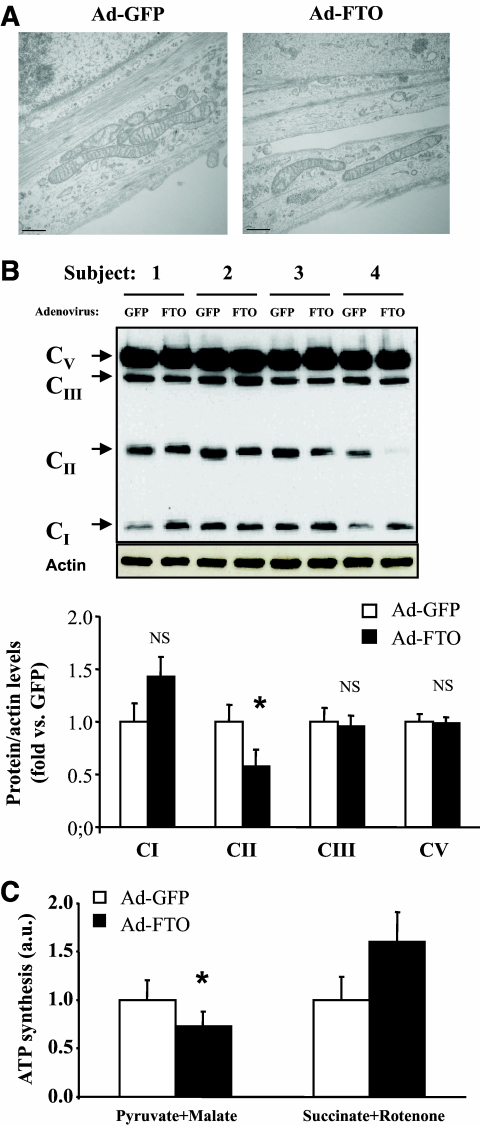
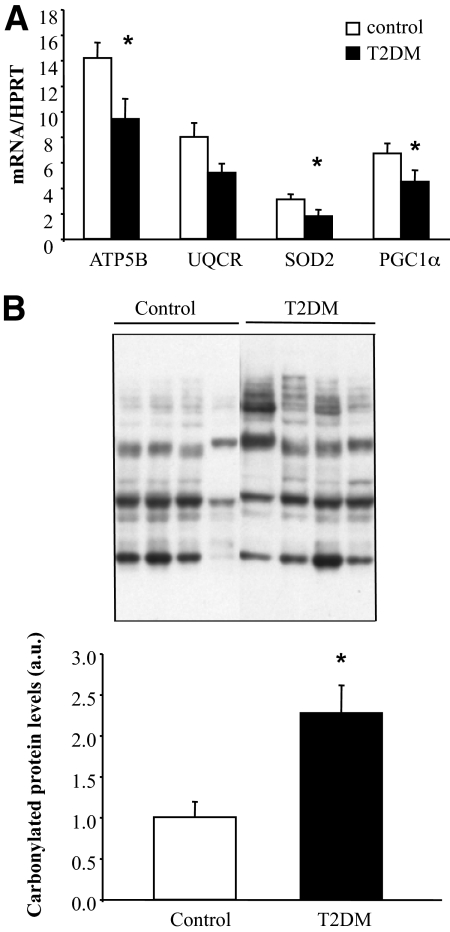
Results: We found a significant increase of FTO mRNA and protein levels in muscle from type 2 diabetic patients, whereas its expression was unchanged in obese or type 1 diabetic patients. Moreover, insulin or glucose infusion during specific clamps did not regulate FTO expression in skeletal muscle from control or type 2 diabetic patients. Interestingly, rosiglitazone treatment improved insulin sensitivity and reduced FTO expression in muscle from type 2 diabetic patients. In myotubes, adenoviral FTO overexpression increased basal protein kinase B phosphorylation, enhanced lipogenesis and oxidative stress, and reduced mitochondrial oxidative function, a cluster of metabolic defects associated with type 2 diabetes.
Conclusions: This study demonstrates increased FTO expression in skeletal muscle from type 2 diabetic patients, which can be normalized by thiazolidinedione treatment. Furthermore, in vitro data support a potential implication of FTO in oxidative metabolism, lipogenesis and oxidative stress in muscle, suggesting that it could be involved in the muscle defects that characterize type 2 diabetes.
Figures
References
-
- Frayling TM, Timpson NJ, Weedon MN, Zeggini E, Freathy RM, Lindgren CM, Perry JR, Elliott KS, Lango H, Rayner NW, Shields B, Harries LW, Barrett JC, Ellard S, Groves CJ, Knight B, Patch AM, Ness AR, Ebrahim S, Lawlor DA, Ring SM, Ben-Shlomo Y, Jarvelin MR, Sovio U, Bennett AJ, Melzer D, Ferrucci L, Loos RJ, Barroso I, Wareham NJ, Karpe F, Owen KR, Cardon LR, Walker M, Hitman GA, Palmer CN, Doney AS, Morris AD, Smith GD, Hattersley AT, McCarthy MI: A common variant in the FTO gene is associated with body mass index and predisposes to childhood and adult obesity. Science 2007;316:889–894 - PMC - PubMed
-
- Dina C, Meyre D, Gallina S, Durand E, Körner A, Jacobson P, Carlsson LM, Kiess W, Vatin V, Lecoeur C, Delplanque J, Vaillant E, Pattou F, Ruiz J, Weill J, Levy-Marchal C, Horber F, Potoczna N, Hercberg S, Le Stunff C, Bougnères P, Kovacs P, Marre M, Balkau B, Cauchi S, Chèvre JC, Froguel P: Variation in FTO contributes to childhood obesity and severe adult obesity. Nat Genet 2007;39:724–726 - PubMed
-
- Scuteri A, Sanna S, Chen WM, Uda M, Albai G, Strait J, Najjar S, Nagaraja R, Orrú M, Usala G, Dei M, Lai S, Maschio A, Busonero F, Mulas A, Ehret GB, Fink AA, Weder AB, Cooper RS, Galan P, Chakravarti A, Schlessinger D, Cao A, Lakatta E, Abecasis GR: Genome-wide association scan shows genetic variants in the FTO gene are associated with obesity-related traits. PLoS Genet 2007;3:e115. - PMC - PubMed
-
- Wåhlén K, Sjölin E, Hoffstedt J: The common rs9939609 gene variant of the fat mass- and obesity-associated gene FTO is related to fat cell lipolysis. J Lipid Res 2008;49:607–611 - PubMed
-
- Klöting N, Schleinitz D, Ruschke K, Berndt J, Fasshauer M, Tönjes A, Schön MR, Kovacs P, Stumvoll M, Blüher M: Inverse relationship between obesity and FTO gene expression in visceral adipose tissue in humans. Diabetologia 2008;51:641–647 - PubMed
Publication types
MeSH terms
Substances
LinkOut - more resources
Full Text Sources
Other Literature Sources
Medical
Molecular Biology Databases
