


High rates of denitrification and nitrate removal in cold seep sediments
- PMID: 20944683
- PMCID: PMC3105719
- DOI: 10.1038/ismej.2010.134
High rates of denitrification and nitrate removal in cold seep sediments
Abstract
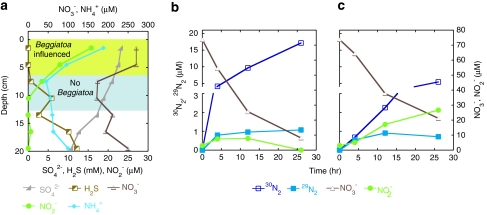
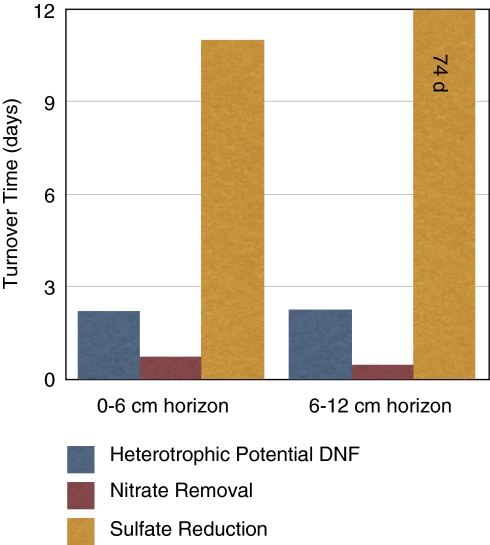
We measured denitrification and nitrate removal rates in cold seep sediments from the Gulf of Mexico. Heterotrophic potential denitrification rates were assayed in time-series incubations. Surficial sediments inhabited by Beggiatoa exhibited higher heterotrophic potential denitrification rates (32 μM N reduced day(-1)) than did deeper sediments (11 μM N reduced day(-1)). Nitrate removal rates were high in both sediment horizons. These nitrate removal rates translate into rapid turnover times (<1 day) for the nitrate pool, resulting in a faster turnover for the nitrate pool than for the sulfate pool. Together, these data underscore the rigorous nature of internal nitrogen cycling at cold seeps and the requirement for novel mechanisms to provide nitrate to the sediment microbial community.
Figures
References
-
- Arvidson RS, Morse JW, Joye SB. The sulfur biogeochemistry of chemosynthetic cold seep communities, Gulf of Mexico, USA. Mar Chem. 2004;87:97–119.
-
- Bowles MW, Samarkin VA, Bowles KM, Joye SB. Weak coupling between sulfate reduction and the anaerobic oxidation of methane in methane-rich seafloor sediments. Geochim Cosmochim Acta. in press.
-
- Burgin AJ, Hamilton SK. Have we overemphasized the role of denitrification in aquatic ecosystems? A review of nitrate removal pathways. Front Ecol Environ. 2007;5:89–96.
-
- Joye SB, Boetius A, Orcutt BN, Montoya JP, Schulz HN, Erickson MJ, et al. The anaerobic oxidation of methane and sulfate reduction in sediments from Gulf of Mexico cold seeps. Chem Geol. 2004;205:219–238.
-
- Joye SB, Bowles MW, Samarkin VA, Hunter KS, Niemann H.2010Biogeochemical signatures and microbial activity of different cold seep habitats along the Gulf of Mexico lower slope Deep Sea Res,doi: 10.1016/j.dsr2.2010.06.001 - DOI
