


Statin therapy for the prevention of atrial fibrillation trial (SToP AF trial)
- PMID: 20946227
- PMCID: PMC3022954
- DOI: 10.1111/j.1540-8167.2010.01925.x
Statin therapy for the prevention of atrial fibrillation trial (SToP AF trial)
Abstract
Background: Inflammation and oxidative stress are associated with atrial fibrillation (AF). Statins have antioxidant and anti-inflammatory properties. We tested if atorvastatin reduced AF recurrence after DC cardioversion (CV) by modifying systemic oxidative stress and inflammation (NCT00252967).
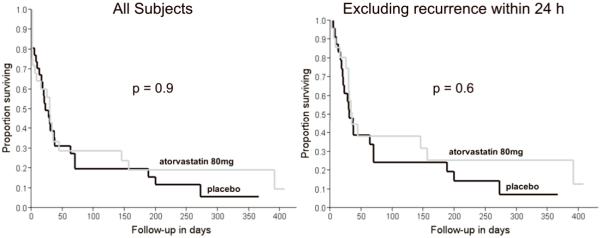
Methods and results: In a randomized, double-blinded, placebo-controlled trial, patients with atrial fibrillation/flutter (AF) were randomized to receive either atorvastatin 80 mg (n = 33) or placebo (n = 31) before CV. Treatment was continued for 12 months or until AF recurred. Serum oxidative stress markers (ratios of oxidized to reduced glutathione and cysteine, derivatives of reactive oxygen species, isoprostanes) and inflammatory markers (high-sensitivity C- reactive protein [hs-CRP], interleukin-6 [IL-6], interleukin-1β[IL-1β], tumor necrosis factor alpha [TNFα]) were measured at baseline and on follow-up. AF recurred in 22 (66.7%) of atorvastatin and 26 (83.9%) of placebo group (P = 0.2). The adjusted hazard ratio of having recurrence on atorvastatin versus on placebo was 0.99 (95% CI: 0.98-1.01, P = 0.3). There was no significant difference in the time to recurrence using Kaplan-Meier survival estimates (median [IR]: 29 [2-145] days versus 22 [7-70] days, P = 0.9). Although no significant effect was seen on oxidative stress, 2 of 4 inflammatory markers, IL-6 (adjusted OR: 0.59, 95% CI: 0.35-0.97, P = 0.04) and hs-CRP (adjusted OR: 0.59, 95% CI: 0.37-0.95, P = 0.03) were significantly lowered with atorvastatin. Cholesterol levels significantly decreased with atorvastatin (P = 0.03).
Conclusions: High-dose atorvastatin did not reduce the recurrence of AF after CV. It reduced selective markers of inflammation without affecting systemic oxidative stress. Failure of atorvastatin to prevent AF recurrence may be due to its failure to affect oxidative stress.
© 2010 Wiley Periodicals, Inc.
Figures
Comment in
-
Statins, inflammation, oxidative stress, and atrial fibrillation.J Cardiovasc Electrophysiol. 2011 Apr;22(4):420-1. doi: 10.1111/j.1540-8167.2010.01946.x. Epub 2010 Nov 23. J Cardiovasc Electrophysiol. 2011. PMID: 21091967 No abstract available.
References
-
- ACC/AHA/ESC 2006 Guidelines for the management of patients with atrial fibrillation: a report of the American College of Cardiology/American Heart Association Task Force on practice guidelines and the European Society of Cardiology Committee for Practice Guidelines. Circulation. 2006;114:e257–e354. - PubMed
-
- Feinberg WM, Blackshear JL, Laupacis A, Kronmal R, Hart RG. Prevelance, age, distribution, and gender of patients with atrial fibrillation: analysis and implication. Arch Intern Med. 1995;155:469–73. - PubMed
-
- Wijffels MC, Kircchof CJ, Dorland R, Allessie MA. Atrial fibrillation begets atrial fibrillation. A study in awake chronically instrumented goats. Circulation. 1995;92:1954–68. - PubMed
-
- Anyukhovsky EP, Sosunov EA, Chandra P, Rosen TS, Boyden PA, Danilo P, Jr, Rosen MR. Age-associated changes in electrophysiologic remodeling: a potential contributor to initiation of atrial fibrillation. Cardiovasc Res. 2005;66:353–63. - PubMed
-
- Mihm MJ, Yu F, Carnes CA, Reiser PJ, McCarthy PM, Van Wagoner DR, Bauer JA. Impaired myofibrillar energetics and oxidative injury during human atrial fibrillation. Circulation. 2001;104:174–80. - PubMed
Publication types
MeSH terms
Substances
Associated data
Grants and funding
LinkOut - more resources
Full Text Sources
Medical
Research Materials
Miscellaneous
