


Clinical predictors of conduction disease progression in type I myotonic muscular dystrophy
- PMID: 20946286
- PMCID: PMC3035751
- DOI: 10.1111/j.1540-8159.2010.02905.x
Clinical predictors of conduction disease progression in type I myotonic muscular dystrophy
Abstract
Background: Patients with type I myotonic muscular dystrophy (DM1) are at risk for sudden death due to atrioventricular conduction block. We sought to characterize the trends and predictors of time-dependent electrocardiographic (ECG) variations in patients with DM1.
Methods: Seventy patients with DM1 underwent standard electrocardiography at first evaluation and routine and symptom prompted follow-up. Individual variations in ECG conduction intervals were assessed using spaghetti plots. Clinical predictors of conduction disease progression were assessed using multivariate random effects regression models of panel data clustered by patient and adjusted for heart rate.
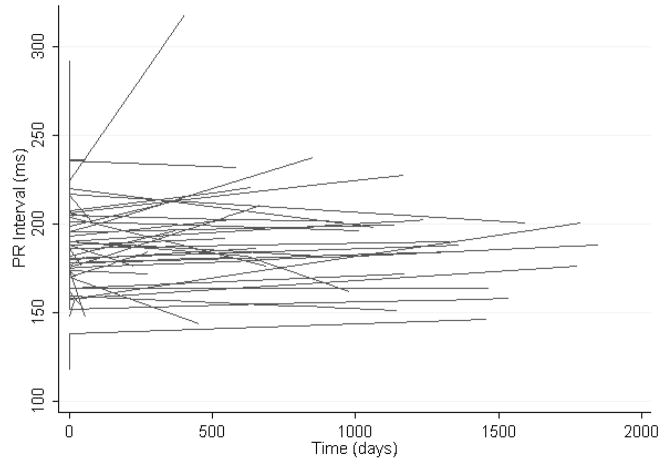
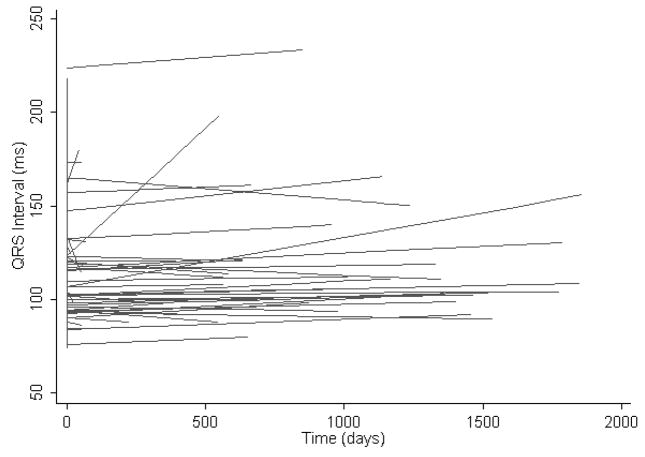
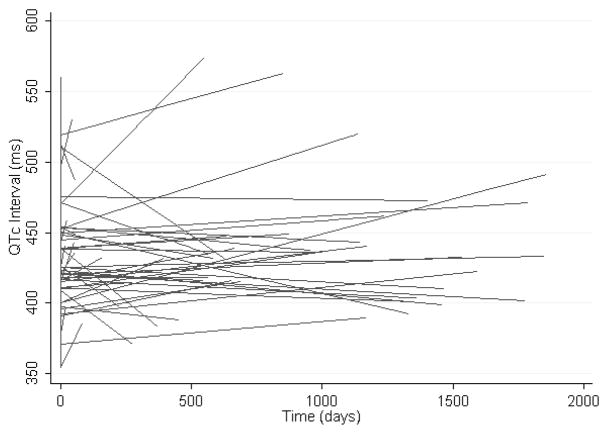
Results: Substantial individual variability was noted in time-dependent changes in PR, QRS, and QTc intervals of patients with DM1. Changes in the QTc interval were closely associated with prolongation of the QRS interval. Age, the presence of paroxysmal atrial flutter or fibrillation, and the number of cytosine-thymine-guanine (CTG) repeats were independent positive predictors of time-dependent PR and QRS prolongation during long-term follow-up. Female sex was negatively associated with PR prolongation but positively associated with QTc prolongation. Lower left ventricular ejection fraction was associated with greater QRS interval progression during long-term follow-up but was not predictive of PR interval progression.
Conclusions: Patients with DM1 can develop rapid changes in cardiac conduction intervals. Paroxysmal atrial flutter or fibrillation, older age, and larger CTG expansions predict greater time-dependent PR and QRS interval prolongation and warrant particular attention in the arrhythmic evaluation of this high risk patient subset.
©2010, The Authors. Journal compilation ©2010 Wiley Periodicals, Inc.
Conflict of interest statement
Figures
References
-
- Ashizawa T, Epstein HF. Ethnic distribution of myotonic dystrophy gene. Lancet. 1991;338(8767):642–3. - PubMed
-
- Groh WJ, Groh MR, Saha C, Kincaid JC, Simmons Z, Ciafaloni E, Pourmand R, et al. Electrocardiographic abnormalities and sudden death in myotonic dystrophy type 1. N Engl J Med. 2008;358(25):2688–97. - PubMed
-
- Brook JD, McCurrach ME, Harley HG, Buckler AJ, Church D, Aburatani H, Hunter K, et al. Molecular basis of myotonic dystrophy: expansion of a trinucleotide (CTG) repeat at the 3′ end of a transcript encoding a protein kinase family member. Cell. 1992;68(4):799–808. - PubMed
-
- Moorman JR, Coleman RE, Packer DL, Kisslo JA, Bell J, Hettleman BD, Stajich J, et al. Cardiac involvement in myotonic muscular dystrophy. Medicine (Baltimore) 1985;64(6):371–87. - PubMed
Publication types
MeSH terms
Grants and funding
LinkOut - more resources
Full Text Sources
Medical
Research Materials
