


Changing malaria intervention coverage, transmission and hospitalization in Kenya
- PMID: 20946689
- PMCID: PMC2972305
- DOI: 10.1186/1475-2875-9-285
Changing malaria intervention coverage, transmission and hospitalization in Kenya
Abstract
Background: Reports of declining incidence of malaria disease burden across several countries in Africa suggest that the epidemiology of malaria across the continent is in transition. Whether this transition is directly related to the scaling of intervention coverage remains a moot point.
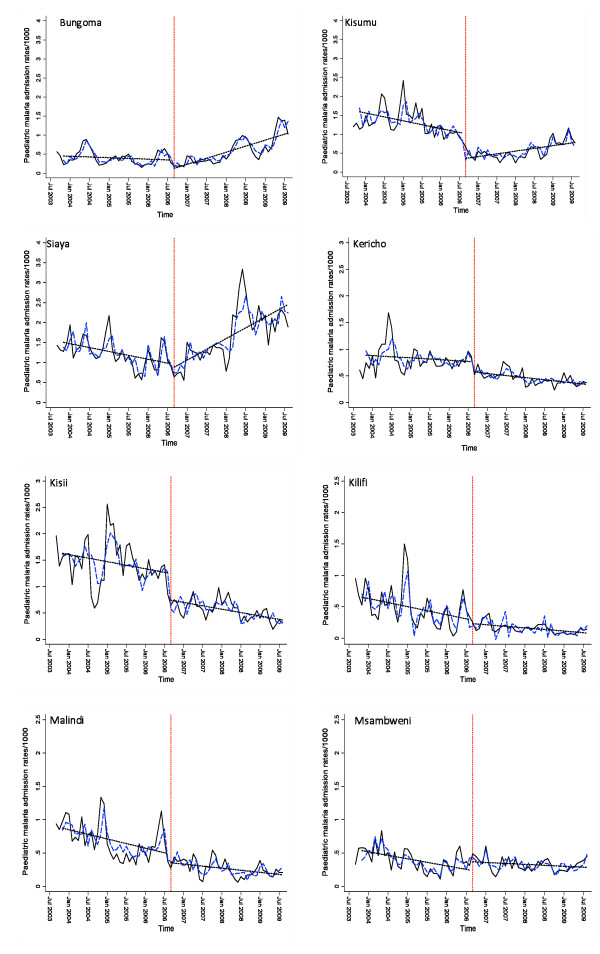
Methods: Paediatric admission data from eight Kenyan hospitals and their catchments have been assembled across two three-year time periods: September 2003 to August 2006 (pre-scaled intervention) and September 2006 to August 2009 (post-scaled intervention). Interrupted time series (ITS) models were developed adjusting for variations in rainfall and hospital use by surrounding communities to show changes in malaria hospitalization over the two periods. The temporal changes in factors that might explain changes in disease incidence were examined sequentially for each hospital setting, compared between hospital settings and ranked according to plausible explanatory factors.
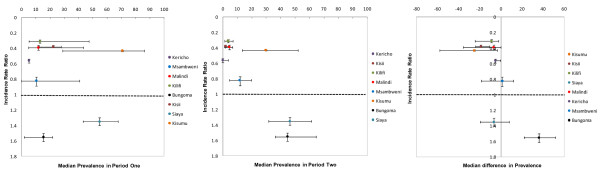
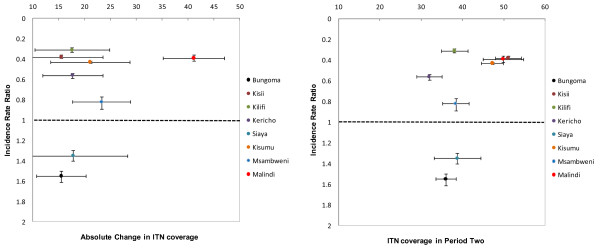
Results: In six out of eight sites there was a decline in Malaria admission rates with declines between 18% and 69%. At two sites malaria admissions rates increased by 55% and 35%. Results from the ITS models indicate that before scaled intervention in September 2006, there was a significant month-to-month decline in the mean malaria admission rates at four hospitals (trend P < 0.05). At the point of scaled intervention, the estimated mean admission rates for malaria was significantly less at four sites compared to the pre-scaled period baseline. Following scaled intervention there was a significant change in the month-to-month trend in the mean malaria admission rates in some but not all of the sites. Plausibility assessment of possible drivers of change pre- versus post-scaled intervention showed inconsistent patterns however, allowing for the increase in rainfall in the second period, there is a suggestion that starting transmission intensity and the scale of change in ITN coverage might explain some but not all of the variation in effect size. At most sites where declines between observation periods were documented admission rates were changing before free mass ITN distribution and prior to the implementation of ACT across Kenya.
Conclusion: This study provides evidence of significant within and between location heterogeneity in temporal trends of malaria disease burden. Plausible drivers for changing disease incidence suggest a complex combination of mechanisms, not easily measured retrospectively.
Figures
References
-
- Barnes KI, Durrheim DN, Little F, Jackson A, Mehta U, Allen E, Dlamini SS, Tsoka J, Bredenkamp B, Mthembu DJ, White NJ, Sharp BL. Effect of artemether-lumefantrine policy and improved vector control on malaria burden in KwaZulu-Natal, South Africa. PLoS Med. 2005;2:e330. doi: 10.1371/journal.pmed.0020330. - DOI - PMC - PubMed
-
- Bhattarai A, Ali AS, Kachur SP, Martensson A, Abbas AK, Khatib R, Al-Mafazy AW, Ramsan M, Rotllant G, Gerstenmaier JF, Molteni F, Abdulla S, Montgomery SM, Kaneko A, Bjorkman A. Impact of artemisinin-based combination therapy and insecticide-treated nets on malaria burden in Zanzibar. PLoS Med. 2007;4:e309. doi: 10.1371/journal.pmed.0040309. - DOI - PMC - PubMed
-
- Kleinschmidt I, Sharp B, Benavente LE, Schwabe C, Torrez M, Kuklinski J, Morris N, Raman J, Carter J. Reduction in infection with Plasmodium falciparum one year after the introduction of malaria control interventions on Bioko Island, Equatorial Guinea. Am J Trop Med Hyg. 2006;74:972–978. - PubMed
-
- Nyarango PM, Gebremeskel T, Mebrahtu G, Mufunda J, Abdulmumini U, Ogbamariam A, Kosia A, Gebremichael A, Gunawardena D, Ghebrat Y, Okbaldet Y. A steep decline of malaria morbidity and mortality trends in Eritrea between 2000 and 2004: the effect of combination of control methods. Malar J. 2006;5:33. doi: 10.1186/1475-2875-5-33. - DOI - PMC - PubMed
Publication types
MeSH terms
Grants and funding
LinkOut - more resources
Full Text Sources
Medical
