. 2011 Mar;39(4):1336-50.
doi: 10.1093/nar/gkq895. Epub 2010 Oct 14.

Rapamycin increases rDNA stability by enhancing association of Sir2 with rDNA in Saccharomyces cerevisiae

Affiliations

Rapamycin increases rDNA stability by enhancing association of Sir2 with rDNA in Saccharomyces cerevisiae

Cheol Woong Ha et al. Nucleic Acids Res. 2011 Mar.

Abstract

The target of rapamycin (TOR) kinase is an evolutionarily conserved key regulator of eukaryotic cell growth and proliferation. Recently, it has been reported that inhibition of TOR signaling pathway can delay aging and extend lifespan in several eukaryotic organisms, but how lifespan extension is mediated by inhibition of TOR signaling is poorly understood. Here we report that rapamycin treatment and nitrogen starvation, both of which cause inactivation of TOR complex 1 (TORC1), lead to enhanced association of Sir2 with ribosomal DNA (rDNA) in Saccharomyces cerevisiae. TORC1 inhibition increases transcriptional silencing of RNA polymerase II-transcribed gene integrated at the rDNA locus and reduces homologous recombination between rDNA repeats that causes formation of toxic extrachromosomal rDNA circles. In addition, TORC1 inhibition induces deacetylation of histones at rDNA. We also found that Pnc1 and Net1 are required for enhancement of association of Sir2 with rDNA under TORC1 inhibition. Taken together, our findings suggest that inhibition of TORC1 signaling stabilizes the rDNA locus by enhancing association of Sir2 with rDNA, thereby leading to extension of replicative lifespan in S. cerevisiae.


Figures
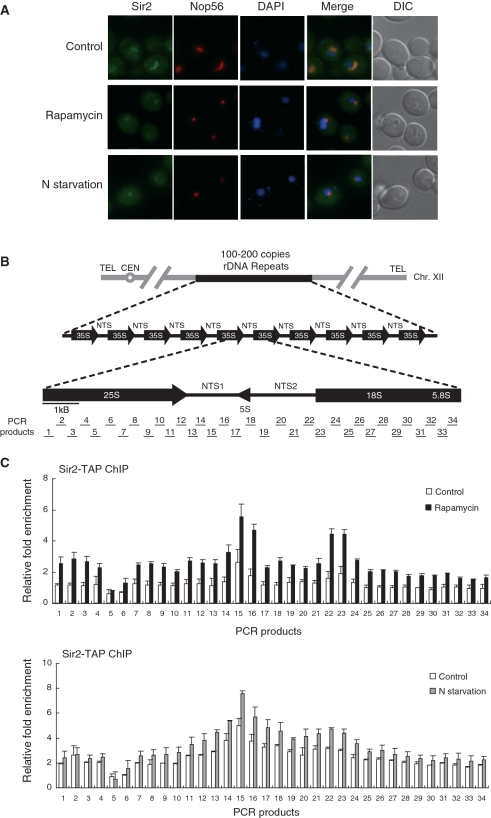
Figure 1.
Figure 1.
TORC1 inhibition leads to condensation of the nucleolus and enhancement of association of Sir2 with rDNA. (A) Rapamycin treatment and nitrogen starvation cause reduction of the nucleolar size and condensation of the Sir2-GFP signal. Subcellular localization of Sir2-GFP (green) and Nop56-RFP (red) was analyzed after treatment with 200 ng/ml rapamycin or incubation in nitrogen-depleted medium for 1 h. DAPI staining for visualization of the nucleus (blue) and differential interference contrast (DIC) images are also shown. (B) The structure of the tandemly repeating rDNA of S. cerevisiae is shown above, and a single 9.1-kb rDNA unit is shown expanded below. PCR products analyzed in the ChIP assays are indicated below the rDNA unit. (C) Rapamycin treatment and nitrogen starvation enhance association of Sir2 with rDNA. The degree of Sir2 binding to rDNA was measured using the ChIP assay after treatment with 200 ng/ml rapamycin (upper panel) or incubation in nitrogen-depleted medium for 1 h (lower panel). For control, cells were treated with DMSO only (upper panel) or grown in SC medium (lower panel). Relative fold enrichment refers to the relative ratio of PCR products amplified from immunoprecipitated DNA to products from whole-cell extract DNA. Values represent the average of three independent experiments and error bars indicate standard deviations.
Figure 2.
Figure 2.
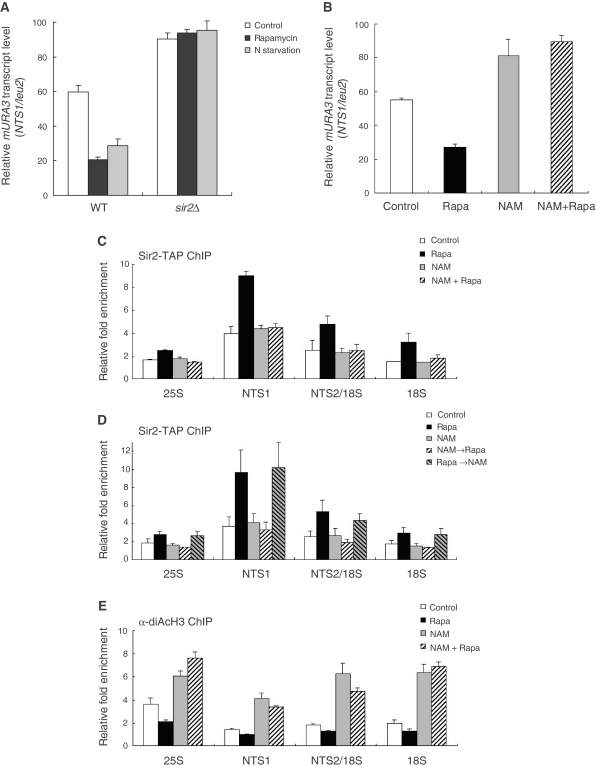
Inhibition of TORC1 signaling enhances rDNA silencing and histone deacetylation at rDNA in a Sir2-dependent manner. (A) Rapamycin treatment and nitrogen starvation promotes transcriptional silencing of the mURA3 reporter gene at the rDNA locus in a Sir2-dependent manner. Total RNA was extracted from wild-type (WT) and sir2Δ cells after treatment with 200 ng/ml rapamycin or incubation in nitrogen-depleted medium for 1 h. Quantitative real-time reverse transcription–PCR analysis was performed to measure the transcript levels of the mURA3 reporter gene inserted either inside the NTS1 region or outside the rDNA array. Amplification efficiencies were validated and normalized against ACT1. Relative mURA3 transcript levels were calculated as the ratio of the normalized transcript level of the mURA3 reporter gene inside the NTS1 region to that outside the rDNA array. (B) Nicotinamide abolishes silencing of the mURA3 reporter gene at the rDNA locus. Total RNA was extracted from wild-type cells after treatment with 200 ng/ml rapamycin (Rapa), 5 mM nicotinamide (NAM), or both (NAM + Rapa) for 1 h. Relative mURA3 transcript levels were calculated as described above. (C) Association of Sir2 with rDNA is not enhanced by rapamycin under nicotinamide treatment. The degree of Sir2 binding to four representative regions in the rDNA (25S, NTS1, NTS2/18S and 18S regions) was measured using the ChIP assay after treatment with 200 ng/ml rapamycin (Rapa), 5 mM nicotinamide (NAM), or both (NAM + Rapa) for 1 h. (D) Nicotinamide does not disturb the already-established association of Sir2 with rDNA. The degree of Sir2 binding to rDNA was measured using the ChIP assay after the following treatments: 200 ng/ml rapamycin for 1 h (Rapa), 5 mM nicotinamide for 1 h (NAM), 5 mM nicotinamide for 1 h and then 200 ng/ml rapamycin for 1 h (NAM→Rapa), 200 ng/ml rapamycin for 1 h and then 5 mM nicotinamide for 1 h (Rapa→NAM). (E) The acetylation level of histone H3 at rDNA is reciprocally proportional to the enzymatic activity of Sir2. The acetylation level of histone H3 associated with the rDNA regions was measured using the ChIP assay after treatment with 200 ng/ml rapamycin (Rapa), 5 mM nicotinamide (NAM), or both (NAM + Rapa) for 1 h. For control, cells were treated with DMSO only. Values represent the average of three independent experiments and error bars indicate standard deviations.
Figure 3.
Figure 3.
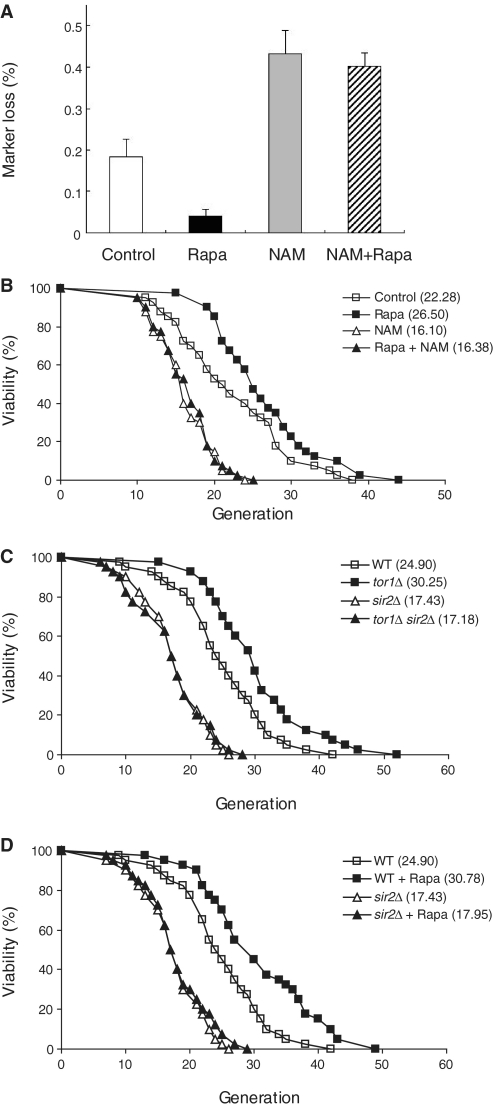
TORC1 inhibition promotes rDNA stability and extends lifespan in yeast. (A) Inhibition of TORC1 signaling suppresses rDNA recombination. rDNA recombination is represented by the rate of loss of the ADE2 marker gene integrated at the rDNA locus, which was calculated as the ratio of half-sectored colonies to the total number of colonies (‘Materials and Methods’ section). Exponentially growing cells were treated with or without 200 ng/ml rapamycin for 1 h and plated on SC plates containing 5 mM nicotinamide or not. After color development, the number of half-red/half-white colonies was counted and divided by the total number of colonies. Entirely red colonies have lost the marker prior to plating and thus were excluded from the total number of colonies. Values represent the average of three independent experiments and error bars indicate standard deviations. (B) Rapamycin extends replicative lifespan of cells, whereas nicotinamide accelerates aging of cells. The P-values for 10 ng/ml rapamycin (Rapa), 5 mM nicotinamide (NAM) and both treatment (Rapa + NAM) versus DMSO only (Control) are 3.7 × 10−3, 3.3 × 10−6 and 7.8 × 10−6, respectively. (C) Deletion of TOR1 fails to increase the lifespan of sir2Δ cells. The P-values for tor1Δ, sir2Δ, and tor1Δ sir2Δ cells versus wild-type cells (WT) are 5.8 × 10−4, 2.7 × 10−7, and 4.3 × 10−7, respectively. (D) Rapamycin fails to increase the lifespan of sir2Δ cells. The P-values for wild-type cells treated with 10 ng/ml rapamycin (WT + Rapa), sir2Δ, and sir2Δ cells treated with 10 ng/ml rapamycin (sir2Δ + Rapa) versus wild-type cells (WT) are 4.8 × 10−4, 2.7 × 10−7 and 2.3 × 10−6, respectively. Replicative lifespan was determined by scoring the number of daughter cells produced by each mother cell. Mean lifespans are shown in parentheses.
Figure 4.
Figure 4.
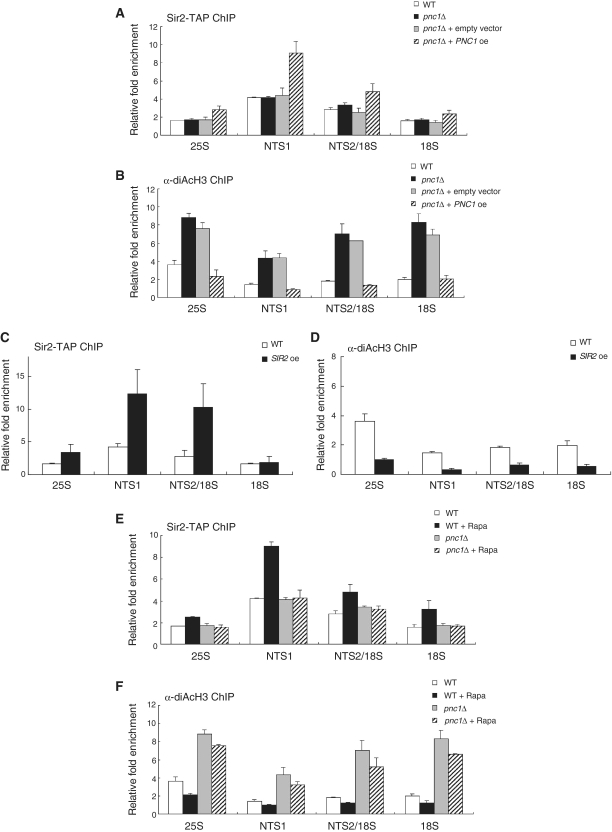
Pnc1 is required for enhancement of Sir2 binding to rDNA under TORC1 inhibition. (A) PNC1 overexpression enhances association of Sir2 with rDNA. The degree of Sir2 binding to rDNA was measured using the ChIP assay in wild-type, pnc1Δ, pnc1Δ cells containing an empty vector and pnc1Δ cells expressing Pnc1-GFP on the p416GPD vector. (B) PNC1 overexpression lowers the H3 acetylation level at rDNA. The acetylation level of histone H3 at the rDNA regions was measured using the ChIP assay in wild-type, pnc1Δ, pnc1Δ cells containing an empty vector and pnc1Δ cells expressing Pnc1-GFP on the p416GPD vector. (C) SIR2 overexpression enhances association of Sir2 with rDNA. The degree of Sir2 binding to rDNA was measured using the ChIP assay in wild-type and sir2Δ cells expressing Sir2-TAP on the p416GPD vector. (D) SIR2 overexpression lowers the H3 acetylation level at rDNA. The acetylation level of histone H3 at the rDNA regions was measured using the ChIP assay in wild-type and sir2Δ cells expressing Sir2-TAP on the p416GPD vector. (E) Rapamycin does not enhance association of Sir2 with rDNA in pnc1Δ cells. The degree of Sir2 binding to rDNA was measured using the ChIP assay in wild-type and pnc1Δ cells after treatment with or without 200 ng/ml rapamycin for 1 h. (F) Rapamycin does not lower the H3 acetylation level at rDNA in pnc1Δ cells. The acetylation level of histone H3 at the rDNA regions was measured using the ChIP assay in wild-type and pnc1Δ cells after treatment with or without 200 ng/ml rapamycin for 1 h. Values represent the average of three independent experiments and error bars indicate standard deviations.
Figure 5.
Figure 5.
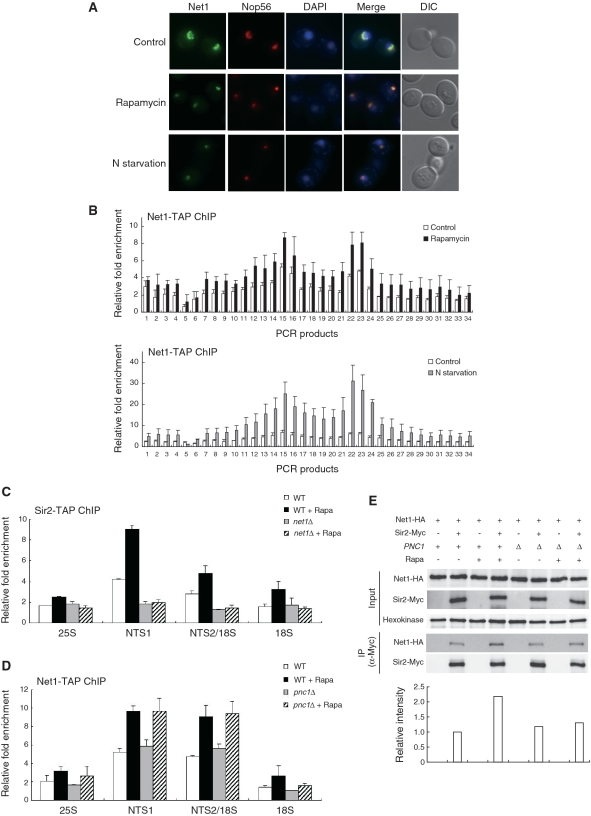
Net1 is required for enhancement of association of Sir2 with rDNA under TORC1 inhibition. (A) Rapamycin treatment and nitrogen starvation cause condensation of the Net1-GFP signal. Subcellular localization of Net1-GFP (green) and Nop56-RFP (red) was analyzed after treatment with 200 ng/ml rapamycin or incubation in nitrogen-depleted medium for 1 h. DAPI staining for visualization of the nucleus (blue) and DIC images are also shown. (B) Rapamycin treatment and nitrogen starvation enhance association of Net1 with rDNA. The degree of Net1 binding to rDNA was measured using the ChIP assay after treatment with 200 ng/ml rapamycin (upper panel) or incubation in nitrogen-depleted medium for 1 h (lower panel). For control, cells were treated with DMSO only (upper panel) or grown in SC medium (lower panel). (C) Rapamycin does not enhance association of Sir2 with rDNA in net1Δ cells. The degree of Sir2 binding to rDNA was measured using the ChIP assay in wild-type and net1Δ cells after treatment with or without 200 ng/ml rapamycin for 1 h. (D) Association of Net1 with rDNA is not affected by Pnc1. The degree of Net1 binding to rDNA was measured using the ChIP assay in wild-type and pnc1Δ cells after treatment with or without 200 ng/ml rapamycin for 1 h. Values represent the average of three independent experiments and error bars indicate standard deviations. (E) TORC1 inhibition enhances interaction between Net1 and Sir2. Interaction between Net1 and Sir2 was analyzed by coimmunoprecipitation in wild-type and pnc1Δ cells after treatment with or without 200 ng/ml rapamycin for 1 h. Hexokinase was used as a loading control. The levels of Net1-HA coimmunoprecipitated with Sir2-Myc were quantified and indicated below the respective lanes.

References

    1. Johnston M, Hillier L, Riles L, Albermann K, Andre B, Ansorge W, Benes V, Bruckner M, Delius H, Dubois E, et al. The nucleotide sequence of Saccharomyces cerevisiae chromosome XII. Nature. 1997;387:87–90. - PMC - PubMed
    1. Warner JR. The economics of ribosome biosynthesis in yeast. Trends Biochem. Sci. 1999;24:437–440. - PubMed
    1. Moss T. At the crossroads of growth control; making ribosomal RNA. Curr. Opin. Genet. Dev. 2004;14:210–217. - PubMed
    1. Rudra D, Warner JR. What better measure than ribosome synthesis? Genes Dev. 2004;18:2431–2436. - PubMed
    1. Sinclair DA, Guarente L. Extrachromosomal rDNA circles–a cause of aging in yeast. Cell. 1997;91:1033–1042. - PubMed

Publication types

MeSH terms