


Comment
doi: 10.1182/blood-2010-07-296426.
A WHIM-sical zebrafish
Affiliations
- PMID: 20947686
- PMCID: PMC6276504
- DOI: 10.1182/blood-2010-07-296426
Item in Clipboard
Comment
A WHIM-sical zebrafish
Blood.
.
Abstract
In this issue of Blood, Walters and colleagues describe an elegant model of WHIM syndrome in the zebrafish embryo. By allowing the movement of WHIM neutrophils to be observed in live animals, this model dramatically illustrates the dynamics of the interaction between the neutrophil chemokine receptor CXCR4 and its receptor ligand (stromal-derived factor-1 [SDF-1], also known as CXCL12) in th hallmark of WHIM-excessive neutrophil adhesion to the marrow stroma.
Conflict of interest statement
Figures
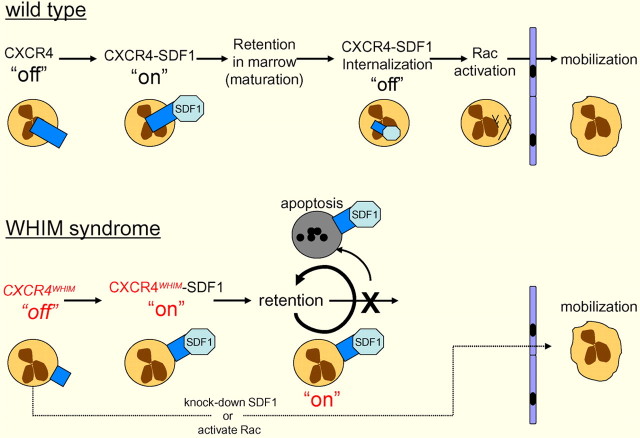
Wild-type neutrophils in the bone marrow express CXCR4 and interact with stromal cells expressing SDF1. This interaction activates CXCR4 (“on”), sending a blocking signal to the cells' motility apparatus, which prevents egress from the marrow. As the neutrophils mature, CXCR4-SDF1 is internalized and degraded (“off”), which leads to Rac activation, allowing the cells to migrate out of the marrow. WHIM syndrome patients express a dominant gain-of-function C-terminal truncation of CXCR4. Walters and colleagues have shown that CXCR4WHIM nonetheless requires the binding of SDF-1 to activate CXCR4WHIM (“on”), blocking motility. CXCR4WHIM is not internalized, so the “on” signal persists, resulting in retention of neutrophils in the marrow, and ultimately apoptosis. This retention can be bypassed, either by knocking down SDF-1, or activating Rac, the G-protein that drives actin polymerization and neutrophil motility.
Comment on
-
Live imaging of neutrophil motility in a zebrafish model of WHIM syndrome.Blood. 2010 Oct 14;116(15):2803-11. doi: 10.1182/blood-2010-03-276972. Epub 2010 Jun 30. Blood. 2010. PMID: 20592249 Free PMC article.
References
-
- Doitsidou M, Reichman-Fried M, Stebler J, et al. Guidance of primordial germ cell migration by the chemokine SDF-1. Cell. 2002;111(5):647–659. - PubMed
-
- Gelmini S, Mangoni M, Serio M, Romagnani P, Lazzeri E. The critical role of SDF-1/CXCR4 axis in cancer and cancer stem cells metastasis. J Endocrinol Invest. 2008;31(9):809–819. - PubMed
Publication types
LinkOut - more resources
Full Text Sources
