


Review
doi: 10.1152/ajpgi.00343.2010.
Epub 2010 Oct 14.
Random mutagenesis of the mouse genome: a strategy for discovering gene function and the molecular basis of disease
Affiliations
- PMID: 20947703
- PMCID: PMC3774088
- DOI: 10.1152/ajpgi.00343.2010
Item in Clipboard
Review
Random mutagenesis of the mouse genome: a strategy for discovering gene function and the molecular basis of disease
Am J Physiol Gastrointest Liver Physiol.
2011 Jan.
Abstract
Mutagenesis of mice with N-ethyl-N-nitrosourea (ENU) is a phenotype-driven approach to unravel gene function and discover new biological pathways. Phenotype-driven approaches have the advantage of making no assumptions about the function of genes and their products and have been successfully applied to the discovery of novel gene-phenotype relationships in many physiological systems. ENU mutagenesis of mice is used in many large-scale and more focused projects to generate and identify novel mouse models for the study of gene functions and human disease. This review examines the strategies and tools used in ENU mutagenesis screens to efficiently generate and identify functional mutations.
Figures
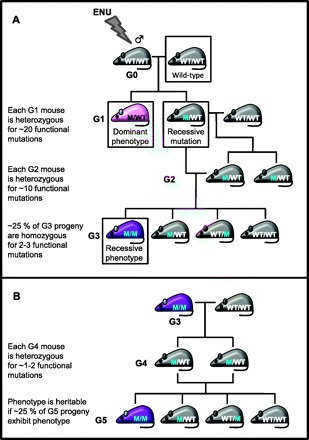
Breeding strategies for genomewide screening of dominant and recessive mutations. A: a G0 male is treated with N-ethyl-N-nitrosourea (ENU) and mated to a wild-type female. The G0 male will carry ∼1,000 ENU-induced mutations. The genotype for a particular ENU-mutated gene is shown with “WT” denoting a wild-type allele and “M” denoting a mutant allele that influences function. G1 progeny carrying a dominant functional mutation will exhibit a variant phenotype. G1 progeny not exhibiting a variant phenotype may carry recessive mutations and are crossed to a wild-type mouse. A G2 mouse is backcrossed to its G1 parent to generate G3 progeny. If ∼25% of G3 mice exhibit a common variant phenotype, they are homozygous for a recessive functional mutation. B: heritability of the variant phenotype is tested by crossing an affected G3 mouse to a wild-type mouse. G4 siblings are then intercrossed to generate G5 progeny. The variant phenotype is heritable if ∼25% of G5 mice exhibit the phenotype.
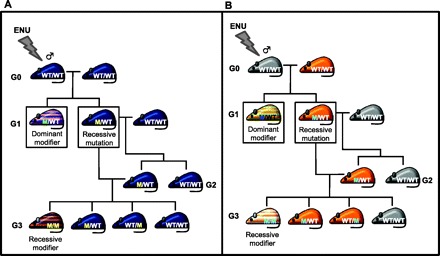
Breeding strategy for modifier screens in mice with an existing gene mutation. In modifier screens, mice that exhibit a disorder of interest are used to find ENU-induced mutations that suppress or enhance the development of the disorder. Two different strategies for modifier screens are shown. A: in this approach, homozygous knockout mice displaying a disorder of interest (blue-colored mice) are screened. A G0 knockout male treated with ENU is mated to an untreated knockout female. G1 progeny showing altered development or severity of the disorder carry a dominant functional mutation that modifies the phenotype (blue and pink striped mouse). G1 progeny not exhibiting any alterations in the disorder may carry recessive ENU-induced mutations and are mated to an untreated knockout mouse. G2 progeny are then backcrossed to the G1 parent carrying ENU-induced mutations. If ∼25% of G3 mice exhibit altered development or severity of the disorder, they are homozygous for a recessively acting mutation that modifies the disorder (blue and orange striped mouse). B: in this approach, mice displaying the disorder of interest are heterozygous for a gene-targeted allele (orange-colored mice). A G0 wild-type male is treated with ENU and mated to a heterozygous female exhibiting a disorder of interest. G1 progeny showing altered development or severity of the disorder carry a dominant modifier (orange and green striped mouse). Heterozygous G1 progeny not exhibiting any alterations in the disorder may carry recessive ENU-induced mutations and are mated to a wild-type mouse. Heterozygous G2 progeny are backcrossed to the G1 parent carrying ENU-induced mutations. If ∼25% of G3 mice exhibit altered development or severity of the disorder, they are homozygous for a recessive modifier (orange and white striped mouse). Note that some mice in the G3 generation may be homozygous for the predisposing mutation and are not shown here.
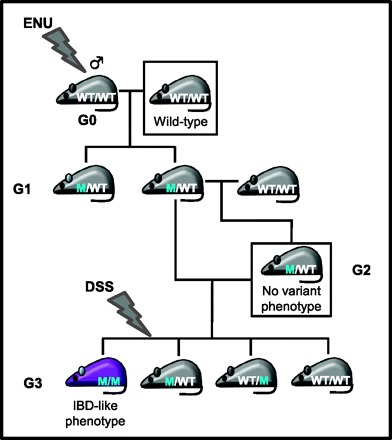
A breeding strategy for a dextran sodium sulfate (DSS) sensitizer screen. The DSS sensitizer screen shown here uses lethal histopathological analysis to assess inflammatory bowel disease (IBD)-like phenotypes, so the screening strategy involves treating G3 progeny to assess whether their parents are carriers of functional ENU-induced mutations causing IBD-like phenotypes. G2 progeny are backcrossed to their G1 parent to generate G3 progeny, which are treated with 1% DSS. If ∼25% of a G3 litter develop an IBD-like phenotype their parents are heterozygous for a recessive functional mutation. If more than 50% of a G3 litter develop an IBD-like phenotype then one or both parents carry a dominant functional mutation.
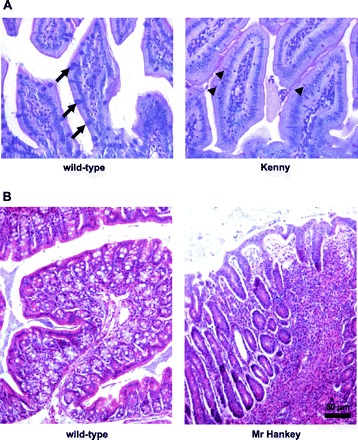
IBD-like phenotypes in Kenny and Mr Hankey mice. A: mucin production by goblet cells in the small intestine is disrupted in Kenny mice. Alcian blue/periodic acid-Schiff (PAS) stain of ileum sections show goblet cells stain dark blue with Alcian blue in wild-type ileum (arrows) whereas only smaller cells that stain pink with PAS can be observed in Kenny ileum (arrow heads). B: hematoxylin and eosin stain of colon sections showing wild-type colon with no inflammation and Mr Hankey colon with transmural colonic inflammation.
References
-
- Abuin A, Hansen GM, Zambrowicz B. Gene trap mutagenesis. Handb Exp Pharmacol: 129–147, 2007 - PubMed
-
- Acevedo-Arozena A, Wells S, Potter P, Kelly M, Cox RD, Brown SD. ENU mutagenesis, a way forward to understand gene function. Annu Rev Genomics Hum Genet 9: 49–69, 2008 - PubMed
-
- Aigner B, Rathkolb B, Herbach N, Hrabe de Angelis M, Wanke R, Wolf E. Diabetes models by screen for hyperglycemia in phenotype-driven ENU mouse mutagenesis projects. Am J Physiol Endocrinol Metab 294: E232–E240, 2008 - PubMed
-
- Augustin M, Sedlmeier R, Peters T, Huffstadt U, Kochmann E, Simon D, Schoniger M, Garke-Mayerthaler S, Laufs J, Mayhaus M, Franke S, Klose M, Graupner A, Kurzmann M, Zinser C, Wolf A, Voelkel M, Kellner M, Kilian M, Seelig S, Koppius A, Teubner A, Korthaus D, Nehls M, Wattler S. Efficient and fast targeted production of murine models based on ENU mutagenesis. Mamm Genome 16: 405–413, 2005 - PubMed
Publication types
MeSH terms
Substances
Grants and funding
LinkOut - more resources
Full Text Sources
Medical
