


Nature and lability of northern Adriatic macroaggregates
- PMID: 20948901
- PMCID: PMC2953397
- DOI: 10.3390/md8092480
Nature and lability of northern Adriatic macroaggregates
Abstract
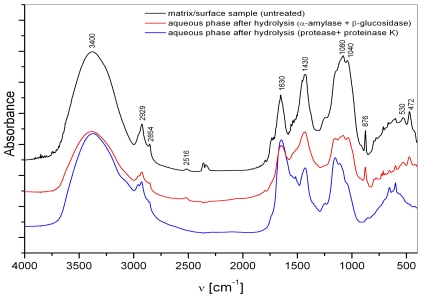
The key organic constituents of marine macroaggregates (macrogels) of prevalently phytoplankton origin, periodically occurring in the northern Adriatic Sea, are proteins, lipids and especially polysaccharides. In this article, the reactivity of various macroaggregate fractions in relation to their composition in order to decode the potentially »bioavailable« fractions is summarized and discussed. The enzymatic hydrolysis of the macroaggregate matrix, using α-amylase, β-glucosidase, protease, proteinase and lipase, revealed the simultaneous degradation of polysaccharides and proteins, while lipids seem largely preserved. In the fresh surface macroaggregate samples, a pronounced degradation of the α-glycosidic bond compared to β-linkages. Degradation of the colloidal fraction proceeded faster in the higher molecular weight (MW) fractions. N-containing polysaccharides can be important constituents of the higher MW fraction while the lower MW constituents can mostly be composed of poly- and oligosaccharides. Since the polysaccharide component in the higher MW fraction is more degradable compared to N-containing polysaccharides, the higher MW fraction represents a possible path of organic nitrogen preservation. Enzymatic hydrolysis, using α-amylase and β-glucosidase, revealed the presence of α- and β-glycosidic linkages in all fractions with similar decomposition kinetics. Our results indicate that different fractions of macroaggregates are subjected to compositional selective reactivity with important implications for macroaggregate persistence in the seawater column and deposition.
Keywords: lability; marine macroaggregates; northern Adriatic.
Figures

References
-
- Cozzi S, Ivančić I, Catalano G, Djakovac T, Degobbis D. Dynamics of the oceanographic properties during mucilage appearance in the Northern Adriatic Sea: Analysis of the 1997 event in comparison to earlier events. J. Mar. Syst. 2004;50:223–241.
-
- Penna N, Kovac N, Ricci F, Penna A, Capellacci S, Faganeli J. The role of dissolved carbohydrates in the northern Adriatic macroaggregate formation. Acta Chim. Slov. 2009;56:305–314.
-
- Myklestad SM. Production of carbohydrates by marine planktonic diatoms. Influence of N/P ratio in the growth medium on the assimilation ratios, growth rate and production of cellular and extracellular carbohydrates by Chaetoceros affinis var, willei (Gran) Husted and Skeletonema costatum (Grev) Cleve. J. Exp. Mar. Biol. Ecol. 1977;29:161–179.
-
- Penna N, Rinaldi A, Montanari G, Di Paolo A, Penna A. Mucilaginous masses in the Adriatic Sea in the summer of 1989. Water Res. 1993;27:1767–1771.
-
- Maestrini SY, Breret M, Bechim C, Berland BR, Poletti R, Rinaldi A. Nutrients limiting the algal growth potential (AGP) in the Po River Plume and an adjacent area, northwest Adriatic Sea: Enrichment bioassays with the test algae Nitzschia closterium and Thalassiosira pseudonana. Estuaries. 1997;20:416–429.
MeSH terms
Substances
LinkOut - more resources
Full Text Sources