. 2010 Oct 8;5(10):e13244.
doi: 10.1371/journal.pone.0013244.

Rational design of a plasmid origin that replicates efficiently in both gram-positive and gram-negative bacteria

Affiliations

Rational design of a plasmid origin that replicates efficiently in both gram-positive and gram-negative bacteria

Anton V Bryksin et al. PLoS One. .

Abstract

Background: Most plasmids replicate only within a particular genus or family.

Methodology/principal findings: Here we describe an engineered high copy number expression vector, pBAV1K-T5, that produces varying quantities of active reporter proteins in Escherichia coli, Acinetobacter baylyi ADP1, Agrobacterium tumefaciens, (all gram-negative), Streptococcus pneumoniae, Leifsonia shinshuensis, Peanibacillus sp. S18-36 and Bacillus subtilis (gram-positive).

Conclusions/significance: Our results demonstrate the efficiency of pBAV1K-T5 replication in different bacterial species, thereby facilitating the study of proteins that don't fold well in E. coli and pathogens not amenable to existing genetic tools.


Conflict of interest statement

Competing Interests: The authors have declared that no competing interests exist.

Figures

Figure 1
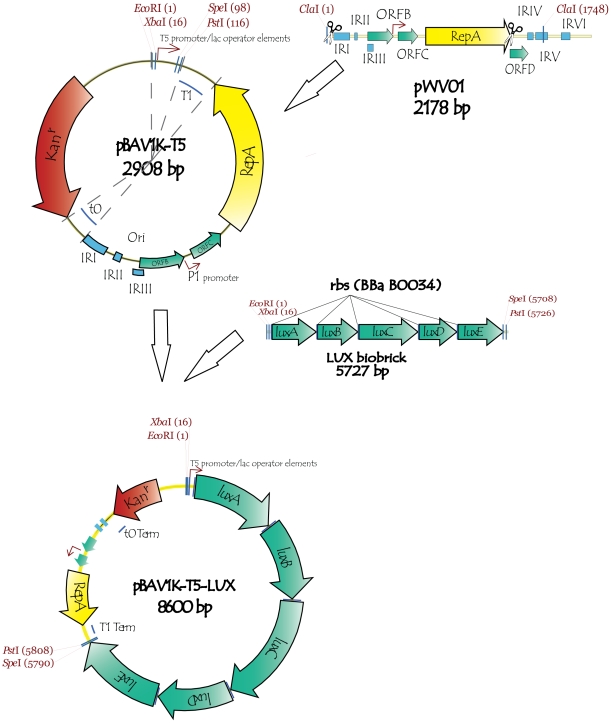
Figure 1. Construction of pBAV1K-T5-lux, a very broad host range expression vector.
The cryptic plasmid, pWV01, exhibits broad host range but is unstable in many species. The ORF D, and inverted repeats IV, V and VI were deleted from its plasmid origin; terminators t0 and T1 were inserted on opposite ends of the shortened origin (upper right). The selectable marker, the Enterococcus 3′,5″-aminoglycoside phosphotransferase type III, and a T5 promoter within a BioBrick multiple cloning site were cloned into the plasmid (top circle). The lux genes of Photorhabdus luminescens were individually PCR amplified, cloned, assembled with ribosome binding sites (middle) and cloned into the plasmid to create pBAV1k-T5-luxABCDE (bottom circle).
Figure 2
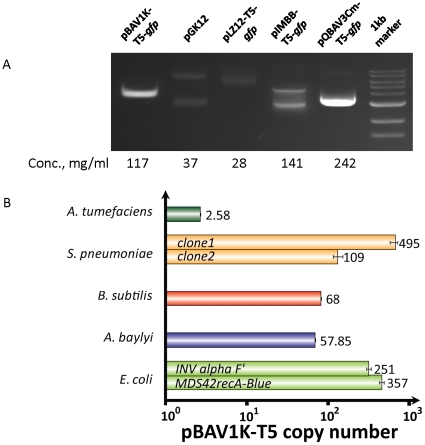
Figure 2. Plasmid pBAV1K-T5-gfp replicates to high copy number in Escherichia coli.
(A) E. coli was transformed with plasmids pBAV1K-T5-gfp, pLZ12-T5-gfp, pGK12 (two other RCR plasmids), pQBAV3Cm-T5-gfp or pIMBB-T5-gfp (two ColE1 derived plasmids). The transformants were propagated in liquid LB cultures supplemented with the appropriate antibiotics. The plasmids were purified, and 2 microliters of each were analyzed on a 0.8% agarose gel. The higher yield and faster mobility of the pBAV1k relative to the larger pWV01 derivatives indicates supercoiling. (B) Five different species of bacteria (namely Agrobacterium tumefaciens, Streptococcus pneumoniae, Bacillus subtilis, Acinetobacter baylyi ADP1 and E. coli) were transformed with pBAV1K-T5-luxABCDE (Table 3). The APH(3′)-IIIa gene present on the plasmid was used as a target to estimate the copy number in reference to the chromosomal relA/spoT gene (or its homolog) by quantitative real-time PCR. Each bar represents the average of three replicates. Error bars represent standard error.
Figure 3
Figure 3. Heterologous GFP expression from pBAV1K-T5-gfp, pLZ12-T5-gfp and pIMBB-T5-gfp.
E. coli was transformed with pIMBB-T5-gfp, pLZ12-T5-gfp, or pBAV1k-T5-gfp. A. baylyi was transformed with pBAV1kT5-gfp only. The transformants were propagated in liquid LB supplemented with the appropriate antibiotic and diluted to 5×10⁵ cells per ml with M9 minimal media before flow cytometric analysis. The major peaks indicate differences in GFP expression; the minor peaks (left) indicate cells that have don't express GFP, possibly due to plasmid instability or cell death.
Figure 4
Figure 4. Dendrogram of bacterial species.
Dendrogram depicting the phylogenetic relationships among eubacteria adapted from phylogenetic trees inferred by Jun et al. Cheng et al. and Brown et al. . Branch lengths do not represent evolutionary distance. Only species related to the study are shown; those that that have demonstrated the capacity to harbor the pBAV1K-T5-gfp and/or pBAV1k-T5-luxABCDE plasmid are underlined.
Figure 5
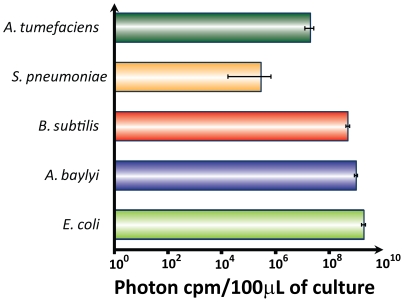
Figure 5. Heterologous expression of lux operon from pBAV1K-T5-luxABCDE.
Five bacterial species (Fig. 2) were transformed with pBAV1K-T5-lux. The transformants were propagated in liquid culture (Table 3). The luminescence from equal volumes of culture (100 microliters) was measured in a luminometer. The values (plotted on a log scale) represent the averages of three independent experiments.
Figure 6
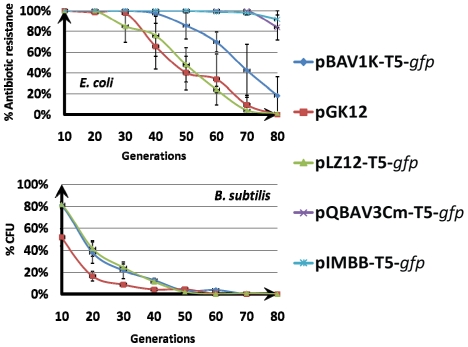
Figure 6. Plasmid stability assays.
(A) Plasmids pBAV1K-T5-gfp, pGK12, pLZ12-T5-gfp, pQBAV3Cm-T5-gfp and pIMBB-T5-gfp were separately propagated in E. coli for 80 generations without antibiotic selection. Plasmid stability was determined by replica plating onto selective media and presented as a percentage of cells that retain antibiotic resistance. (B) Plasmids pBAV1K-T5-gfp, pGK12, pLZ12-T5-gfp, were propagated in B. subtilis for 80 generations without antibiotic selection. Plasmid stability was determined by the plasmid content comparison in the total DNA pools between different generations. Error bars represent standard error.

References

    1. Huang HH, Camsund D, Lindblad P, Heidorn T. Design and characterization of molecular tools for a Synthetic Biology approach towards developing cyanobacterial biotechnology. Nucleic Acids Res. 2010;38:2577–2593. - PMC - PubMed
    1. Bosse JT, Durham AL, Rycroft AN, Kroll JS, Langford PR. New plasmid tools for genetic analysis of Actinobacillus pleuropneumoniae and other pasteurellaceae. Appl Environ Microbiol. 2009;75:6124–6131. - PMC - PubMed
    1. Aakvik T, Degnes KF, Dahlsrud R, Schmidt F, Dam R, et al. A plasmid RK2-based broad-host-range cloning vector useful for transfer of metagenomic libraries to a variety of bacterial species. FEMS Microbiol Lett. 2009;296:149–158. - PubMed
    1. Dennis JJ. The evolution of IncP catabolic plasmids. Curr Opin Biotechnol. 2005;16:291–298. - PubMed
    1. Kok J, van der Vossen JM, Venema G. Construction of plasmid cloning vectors for lactic streptococci which also replicate in Bacillus subtilis and Escherichia coli. Appl Environ Microbiol. 1984;48:726–731. - PMC - PubMed

Publication types