Distinct clones of Yersinia pestis caused the black death
- PMID: 20949072
- PMCID: PMC2951374
- DOI: 10.1371/journal.ppat.1001134
Distinct clones of Yersinia pestis caused the black death
Abstract
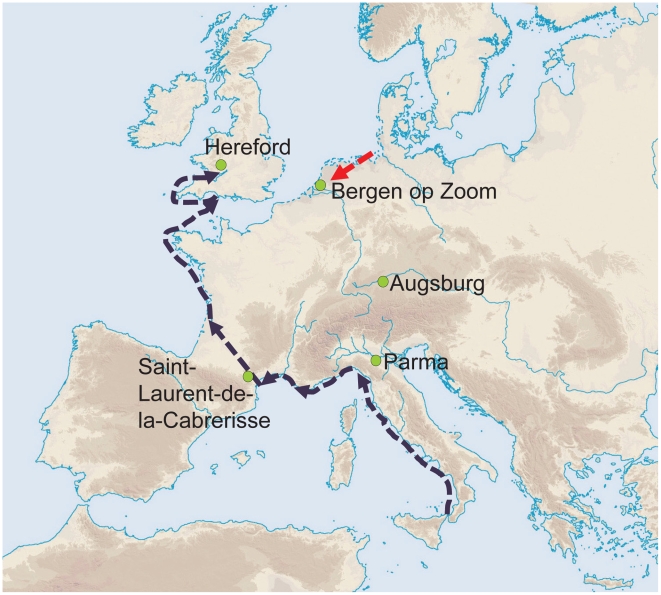
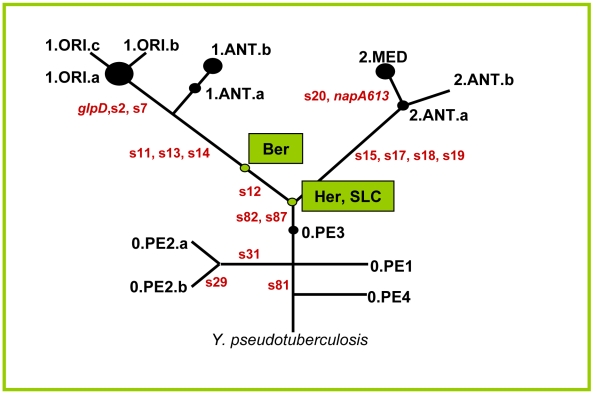
From AD 1347 to AD 1353, the Black Death killed tens of millions of people in Europe, leaving misery and devastation in its wake, with successive epidemics ravaging the continent until the 18(th) century. The etiology of this disease has remained highly controversial, ranging from claims based on genetics and the historical descriptions of symptoms that it was caused by Yersinia pestis to conclusions that it must have been caused by other pathogens. It has also been disputed whether plague had the same etiology in northern and southern Europe. Here we identified DNA and protein signatures specific for Y. pestis in human skeletons from mass graves in northern, central and southern Europe that were associated archaeologically with the Black Death and subsequent resurgences. We confirm that Y. pestis caused the Black Death and later epidemics on the entire European continent over the course of four centuries. Furthermore, on the basis of 17 single nucleotide polymorphisms plus the absence of a deletion in glpD gene, our aDNA results identified two previously unknown but related clades of Y. pestis associated with distinct medieval mass graves. These findings suggest that plague was imported to Europe on two or more occasions, each following a distinct route. These two clades are ancestral to modern isolates of Y. pestis biovars Orientalis and Medievalis. Our results clarify the etiology of the Black Death and provide a paradigm for a detailed historical reconstruction of the infection routes followed by this disease.
Conflict of interest statement
The authors have declared that no competing interests exist.
Figures

References
-
- Brossolet J, Mollaret H. Pourquoi la peste? Le rat, la puce et le bubon. Paris: Gallimard; 1994.
-
- Biraben J-N. Les hommes et la peste en France et dans les pays européens et méditerranéens, 2 vols. Paris: Mouton; 1975.
-
- Yersin A. La peste bubonique à Hong Kong. Ann Inst Pasteur Paris. 1894;8:662–667.
-
- Yersin A. La peste bubonique à Hong Kong. Archives de Médecine Navales. 1894;62:256–261.
Publication types
MeSH terms
Substances
LinkOut - more resources
Full Text Sources
Other Literature Sources
Medical