


doi: 10.1021/bc100136e.
Epub 2010 Oct 15.
Self-protecting bactericidal titanium alloy surface formed by covalent bonding of daptomycin bisphosphonates
Affiliations
- PMID: 20949909
- PMCID: PMC2987735
- DOI: 10.1021/bc100136e
Item in Clipboard
Self-protecting bactericidal titanium alloy surface formed by covalent bonding of daptomycin bisphosphonates
Bioconjug Chem.
.
Abstract
Infections are a devastating complication of titanium alloy orthopedic implants. Current therapy includes antibiotic-impregnated bone cement and antibiotic-containing coatings. We hypothesized that daptomycin, a Gram-positive peptide antibiotic, could prevent bacterial colonization on titanium alloy surfaces if covalently bonded via a flexible, hydrophilic spacer. We designed and synthesized a series of daptomycin conjugates for bonding to the surface of 1.0 cm² Ti6Al4V foils through bisphosphonate groups, reaching a maximum yield of 180 pmol/cm². Daptomycin-bonded foils killed 53 ± 5% of a high challenge dose of 3 × 10⁵ cfu Staphylococcus aureus ATCC 29213.
Figures
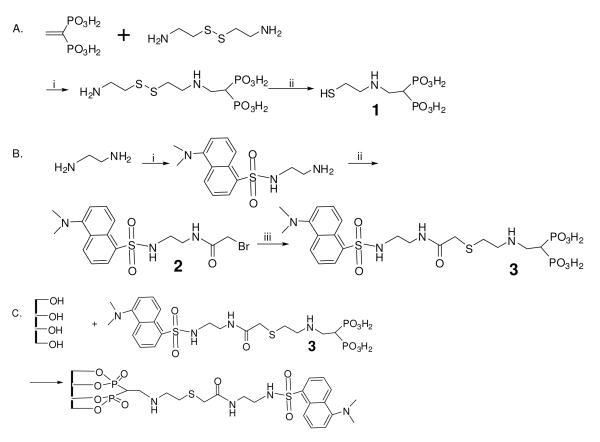
Synthesis of dansyl bisphosphonic acid (3) and attachment to the oxidized surface of Ti6Al4V foil. A. 2-(2-mercaptoethylamino) ethylidene-1,1-bisphosphonic acid (1): (i) water, 110°C, 6 hr. (ii) Me3P. B. Dansyl bisphosphonic acid (3): (i) dansyl chloride, rt 2 hr. (ii) bromoacetic acid, DCC, EtOAc. (iii) 2-(2-mercaptoethylamino)ethylidene-1,1-bisphosphonic acid (1), 50% Me2NCHO/50% water. C. Attachment to Ti6Al4V foil.
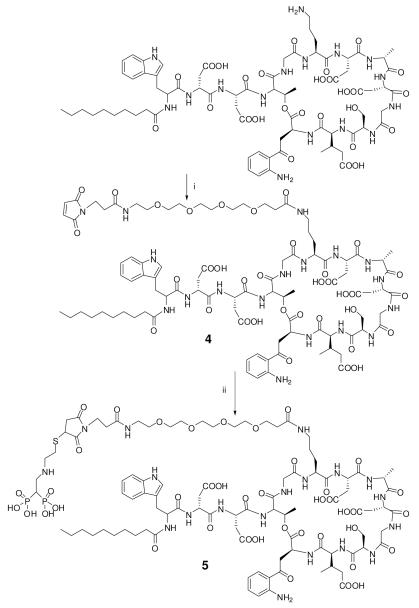
Synthesis of daptomycin-TEG-bisphosphonic acid (5). i) 1.1 equivalent of succinimidyl TEG maleimide, Me2NCHO, r.t. ii) 2-(2-mercaptoethylamino) ethylidene-1,1-bisphosphonic acid (1), 50% Me2NCHO/50% water.
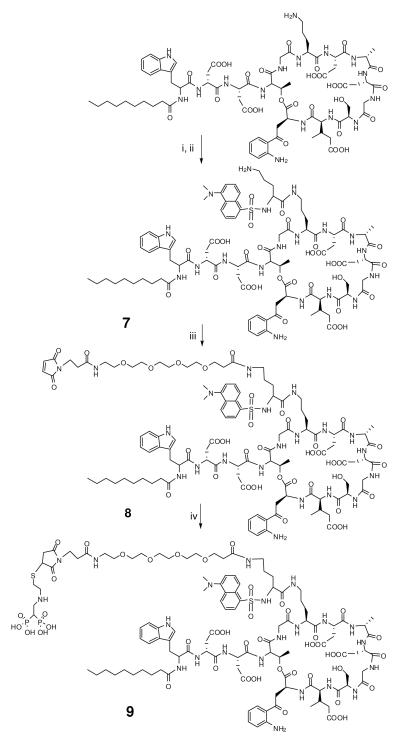
Synthesis of N-dansyl daptomycin bisphosphonic acid (9). i) Dansyl-Lys (Boc)-NHS ester, Me2NCHO, r.t, overnight. ii) CF3CO2H: water: iPr3SiH (95:2.5:2.5), rt, 1h. iii) succinimidyl-TEG-maleimide, Me2NCHO, rt, overnight. iv) 2-(2-mercaptoethylamino) ethylidene-1, 1-bisphosphonic acid , 50% Me2NCHO/50% water.
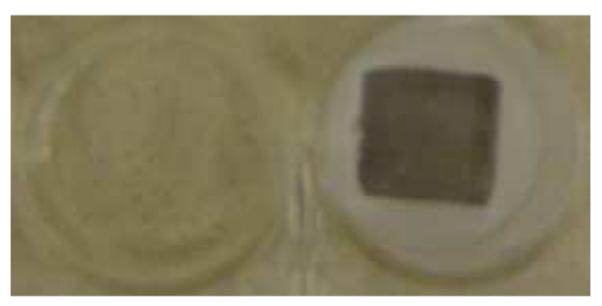
Each dried Ti6Al4V foil was adhered in place in an individual well of a 24-well plate by low melting point wax for antibiotic activity evaluation with the upper surface uncovered. Left: empty well; right: one piece of Ti6Al4V foil adhered in the well using low melting point wax.
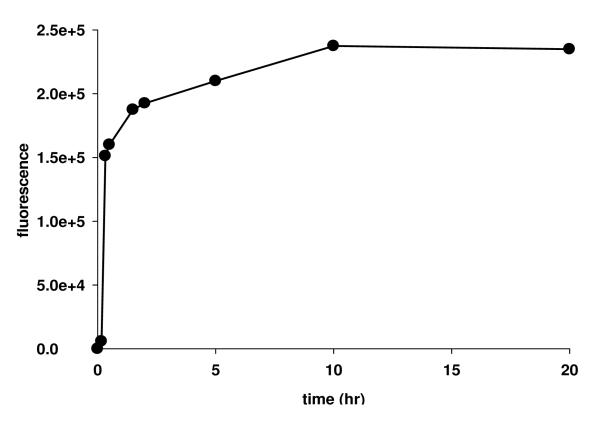
Time course of attachment of dansyl bisphosphonic acid bound to the surface of Ti6Al4V foils at different time points. The passivated foils were incubated with dansyl bisphosphonic acid (pH 7.4, 2.5 mg/mL) at room temperature. The foils were removed from the solution at a series of time points, washed with Me2NCHO and water, followed by incubating with 1 mL 0.01 M NaOH at room temperature for 3 hr. The fluorescence in the NaOH solution was recorded with λex 337 nm and λem 520 nm (30).
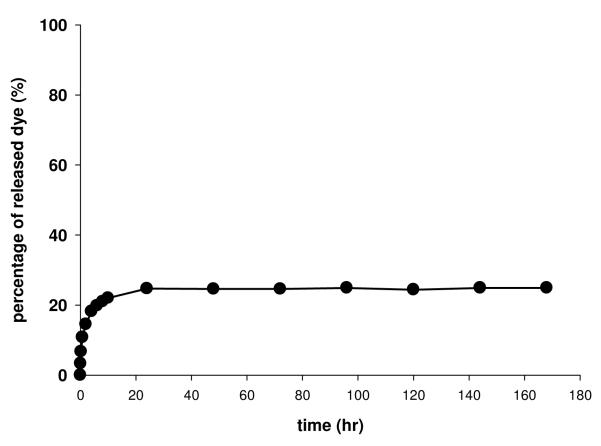
Release kinetics of dansyl bisphosphonic acid on the surface of Ti6Al4V foil. The foil was incubated in 1 mL phosphate buffer (pH 7.4) at 37°C. Dansyl fluorescence was recorded with with λex 337 nm and λem 520 nm. The data was expressed as release percentage = (Fsample-F0)/(Ffinal-F0). Fsample: the fluorescence at a certain time point; F0: background of phosphate buffer; Ffinal: fluorescence of the loading dansyl bisphosphonic acid.
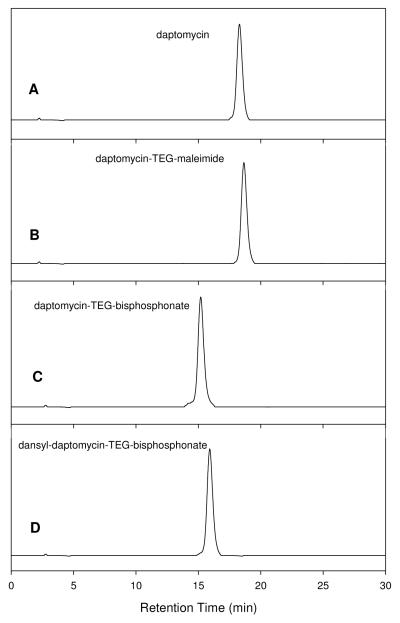
Analytical HPLC of daptomycin (A), daptomycin-TEG-maleimide (B), daptomycin-TEG-bisphosphonate (C), and dansyl-daptomycin-TEG-bisphosphonate (D). The analysis was performed with a Waters 600E system, using Alltech C18 5μ, 250×4.6 mm column coupled to a Waters 486 detector at 254 nm. Sample was eluted with a linear gradient of 20-70% CH3CN in water containing 0.1% CF3CO2H in 30 min with a flow rate of 1mL/min. The retention times for the peaks in A, B, C, and D were 18.3 min, 18.4 min, 15.5 min and 15.9 min, respectively.
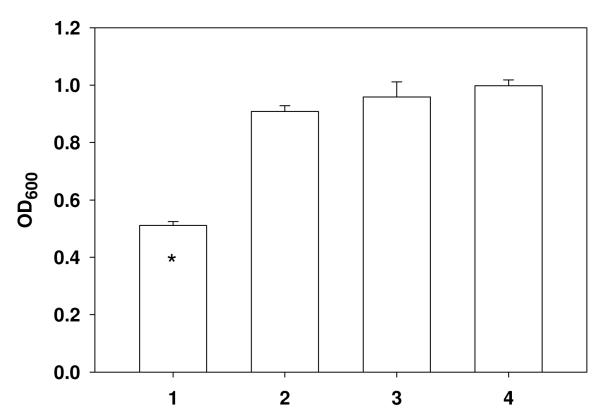
Histogram of antibacterial activity of daptomycin bisphosphonic acid covalently bound to the surface of Ti6Al4V foils. 1: daptomycin modified foils adhered by wax, covered by 200 μL of broth containing 3×10⁵ cfu S. aureus; 2: non-adhered daptomycin modified foils floating in 200 μL of broth containing 3×10⁵ cfu S. aureus; 3: adhered blank foils incubated with 200 μL of broth containing 3×10⁵ cfu S. aureus; 4: 200 μL of broth containing 3×10⁵ cfu S. aureus. Symbol * indicates statistically significant differences (p<0.05) from the other groups. The y-axis is the optical density of the bacteria-containing broth at 600 nm.
References
-
- Moss AJ, Hamburger S, Moore RM, Jr., Jeng LL, Howie LJ. Use of selected medical device implants in the United States, 1988. Adv Data. 1991:1–24. - PubMed
-
- Garvin KL, Hanssen AD. Infection after total hip arthroplasty: Past, present, and future. J. Bone Joint Surg. 1995;77A:1576–1588. - PubMed
-
- Mahan J, Seligson D, Henry SL, Hynes P, Dobbins J. Factors in pin tract infections. Orthopedics. 1991;14:305–308. - PubMed
-
- Duggan JM, Georgiadis GM, Kleshinski JF. Management of prosthetic joint infections. Infect. Med. 2001;18:534–541.
-
- Zimmerli W, Trampuz A, Ochsner PE. Prosthetic-joint infections. N Engl J Med. 2004;351:1645–54. - PubMed
Publication types
MeSH terms
Substances
Grants and funding
LinkOut - more resources
Full Text Sources
Medical
Molecular Biology Databases
