


doi: 10.1021/ja107677q.
Interaction-dependent PCR: identification of ligand-target pairs from libraries of ligands and libraries of targets in a single solution-phase experiment
Affiliations
- PMID: 20949943
- PMCID: PMC2974369
- DOI: 10.1021/ja107677q
Item in Clipboard
Interaction-dependent PCR: identification of ligand-target pairs from libraries of ligands and libraries of targets in a single solution-phase experiment
J Am Chem Soc.
.
Free PMC article
Abstract
Interaction-dependent PCR (IDPCR) is a solution-phase method to identify binding partners from combined libraries of small-molecule ligands and targets in a single experiment. Binding between DNA-linked targets and DNA-linked ligands induces formation of an extendable duplex. Extension links codes that identify the ligand and target into one selectively amplifiable DNA molecule. In a model selection, IDPCR resulted in the enrichment of DNA encoding all five known protein-ligand pairs out of 67 599 possible sequences.
Figures
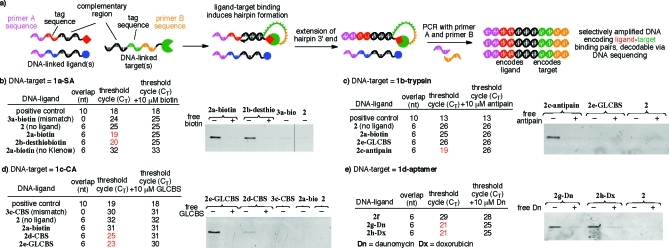
(a) Overview of IDPCR. (b) IDPCR with streptavidin as the target (1a-SA) and biotin (2a-biotin, Kd = 40 pM) or desthiobiotin (2b-desthiobiotin, Kd = 2 nM) as ligands was analyzed by qPCR and PAGE (21 cycles of PCR). IDPCR reports the interaction of (c) trypsin and antipain (Ki = 100 nM); (d) carbonic anhydrase and carboxy benzene sulfonamide (CBS, Ki = 3.2 μM) or Gly-Leu-CBS (GLCBS, Ki = 9 nM); and (e) a DNA aptamer and daunomycin (Dn) (Dn, Kd = 272 nM) or doxorubicin (Dx). PAGE gels in (c), (d), and (e) show DNA after 20, 24, and 23 cycles of PCR, respectively.
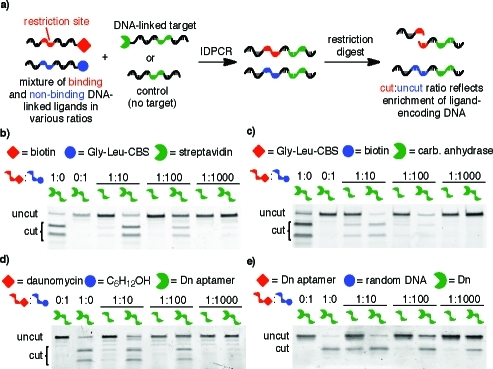
(a) IDPCR with a single target in the presence of mock ligand library. (b) Mixtures of 2i-biotin and excess 2k-GLCBS were subjected to IDPCR with 1a-SA or 1. (c) Mixtures of 2k-GLCBS and excess 2i-biotin were subjected to IDPCR with 1c-CA or 1. (d) Mixtures of 2n-Dn and excess 2l were subjected to IDPCR against 1f-aptamer or 1h. (e) Mixtures of 1g-aptamer and excess unstructured DNA (1h) were subjected to IDPCR with 2g-Dn or 2f. The DNA in (b), (c), (d), and (e) was digested with EcoRI, HindIII, NsiI, or NsiI, respectively.
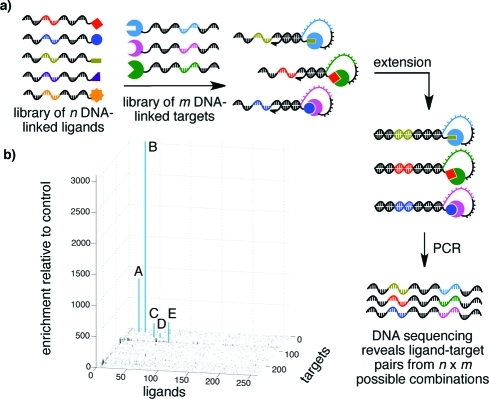
(a) A model library of DNA-encoded ligands mixed with a model library of DNA-encoded targets allows multiplexed detection of binding pairs. (b) IDPCR was used to perform a model selection on an equimolar 261-member DNA−ligand library and an equimolar 259-member DNA−target library containing five known protein−ligand pairs out of 67 599 possible combinations. For each protein target, the most highly enriched sequences (blue bars) relative to a control lacking proteins corresponded to the known protein−ligand pairs, labeled A−E in the plot. A: biotin + SA; B: desthiobiotin + SA; C: GLCBS + CA; D: CBS + CA; E: trypsin + antipain.
References
Publication types
MeSH terms
Substances
Grants and funding
LinkOut - more resources
Full Text Sources
Other Literature Sources
