


A comparative analysis of HIV drug resistance interpretation based on short reverse transcriptase sequences versus full sequences
- PMID: 20950432
- PMCID: PMC2984380
- DOI: 10.1186/1742-6405-7-38
A comparative analysis of HIV drug resistance interpretation based on short reverse transcriptase sequences versus full sequences
Abstract
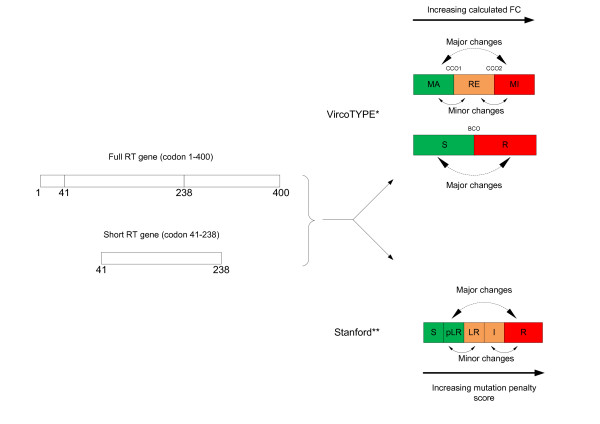
Background: As second-line antiretroviral treatment (ART) becomes more accessible in resource-limited settings (RLS), the need for more affordable monitoring tools such as point-of-care viral load assays and simplified genotypic HIV drug resistance (HIVDR) tests increases substantially. The prohibitive expenses of genotypic HIVDR assays could partly be addressed by focusing on a smaller region of the HIV reverse transcriptase gene (RT) that encompasses the majority of HIVDR mutations for people on ART in RLS. In this study, an in silico analysis of 125,329 RT sequences was performed to investigate the effect of submitting short RT sequences (codon 41 to 238) to the commonly used virco®TYPE and Stanford genotype interpretation tools.
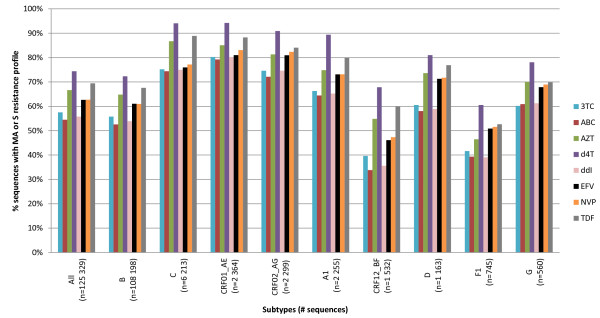
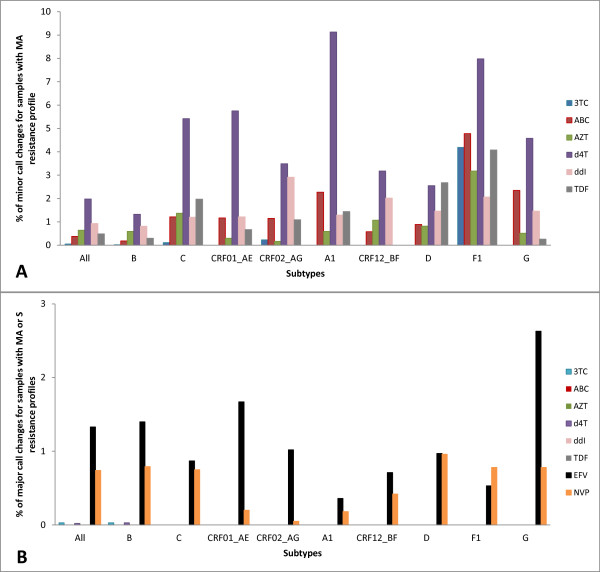
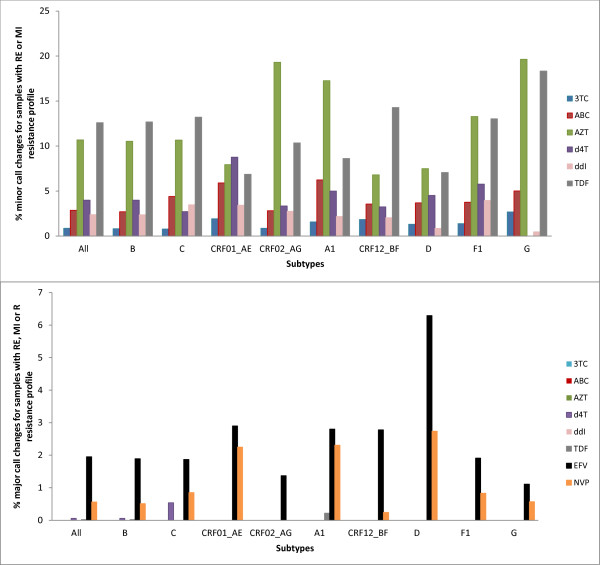
Results: Pair-wise comparisons between full-length and short RT sequences were performed. Additionally, a non-inferiority approach with a concordance limit of 95% and two-sided 95% confidence intervals was used to demonstrate concordance between HIVDR calls based on full-length and short RT sequences.The results of this analysis showed that HIVDR interpretations based on full-length versus short RT sequences, using the Stanford algorithms, had concordance significantly above 95%. When using the virco®TYPE algorithm, similar concordance was demonstrated (>95%), but some differences were observed for d4T, AZT and TDF, where predictions were affected in more than 5% of the sequences. Most differences in interpretation, however, were due to shifts from fully susceptible to reduced susceptibility (d4T) or from reduced response to minimal response (AZT, TDF) or vice versa, as compared to the predicted full RT sequence. The virco®TYPE prediction uses many more mutations outside the RT 41-238 amino acid domain, which significantly contribute to the HIVDR prediction for these 3 antiretroviral agents.
Conclusions: This study illustrates the acceptability of using a shortened RT sequences (codon 41-238) to obtain reliable genotype interpretations by virco®TYPE and Stanford algorithms. Implementation of this simplified protocol could significantly reduce the cost of both resistance testing and ARV treatment monitoring in RLS.
Figures
References
-
- DHHS. Guidelines for the use of antiretroviral agents in HIV-infected adults and adolescents. 2008. - PubMed
-
- EACS. Guidelines for the Clinical Management and Treatment of HIV Infected Adults in Europe 2008. 2008. - PubMed
-
- WHO. Antiretroviral therapy for HIV infection in adults and adolescents: towards universal access. Recommendations for a public health approach. Geneva: World Health Organization; 2006. - PubMed
-
- WHO. New WHO Recommendations: Antiretroviral therapy for adults and adolescents. Geneva: WHO; 2009.
-
- WHO. Scaling up antiretroviral therapy in resource-limited settings: Treatment guidelines for a public health approach. Geneva: World Health Organization; 2003.
LinkOut - more resources
Full Text Sources
Research Materials
