Case Reports
. 2010 Nov 12;87(5):671-8.
doi: 10.1016/j.ajhg.2010.09.017. Epub 2010 Oct 14.

De novo mutations in FOXP1 in cases with intellectual disability, autism, and language impairment

Affiliations
Case Reports

De novo mutations in FOXP1 in cases with intellectual disability, autism, and language impairment

Fadi F Hamdan et al. Am J Hum Genet. .

Abstract

Heterozygous mutations in FOXP2, which encodes a forkhead transcription factor, have been shown to cause developmental verbal dyspraxia and language impairment. FOXP2 and its closest homolog, FOXP1, are coexpressed in brain regions that are important for language and cooperatively regulate developmental processes, raising the possibility that FOXP1 may also be involved in developmental conditions that are associated with language impairment. In order to explore this possibility, we searched for mutations in FOXP1 in patients with intellectual disability (ID; mental retardation) and/or autism spectrum disorders (ASD). We first performed array-based genomic hybridization on sporadic nonsyndromic ID (NSID) (n = 30) or ASD (n = 80) cases. We identified a de novo intragenic deletion encompassing exons 4-14 of FOXP1 in a patient with NSID and autistic features. In addition, sequencing of all coding exons of FOXP1 in sporadic NSID (n = 110) or ASD (n = 135) cases, as well as in 570 controls, revealed the presence of a de novo nonsense mutation (c.1573C>T [p.R525X]) in the conserved forkhead DNA-binding domain in a patient with NSID and autism. Luciferase reporter assays showed that the p.R525X alteration disrupts the activity of the protein. Formal assessments revealed that both patients with de novo mutations in FOXP1 also show severe language impairment, mood lability with physical aggressiveness, and specific obsessions and compulsions. In conclusion, both FOXP1 and FOXP2 are associated with language impairment, but decrease of the former has a more global impact on brain development than that of the latter.


Figures

Figure 1
Figure 1
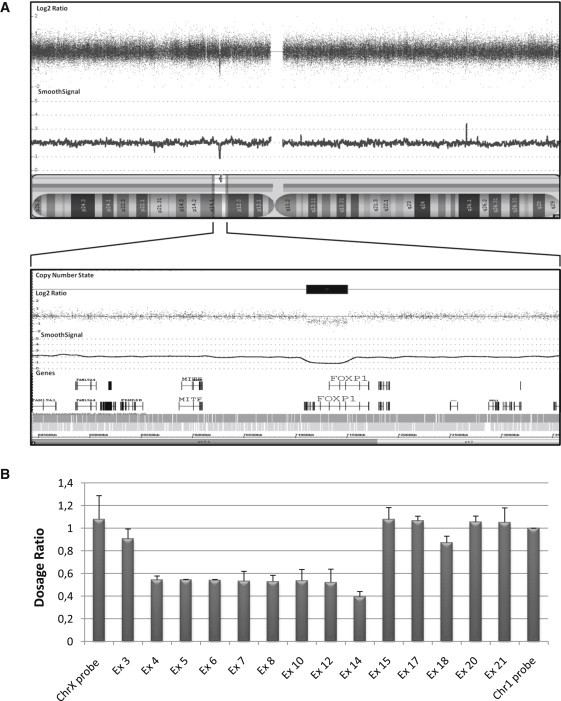
De Novo FOXP1 Deletion at 3p14.1 in Patient A (A) The Affymetrix Genome-Wide Human SNP 6.0 Array result for patient A is shown above the ideogram of chromosome 3 (Netaffx version 28). Each dot represents a SNP or a copy number marker, with normal copy number having a log2 ratio of ∼0 and deleted regions less than −1. The CNV analysis was performed according to the manufacturer's procedure with the use of the Affymetrix reference library, GenomeWideSNP_6.hapmap270.na30r1.a5, with a regional GC correction. The de novo deletion (chr3: 71109689–71508061; hg18) is boxed, and the only gene affected with this deletion, FOXP1, is shown. (B) Mapping of FOXP1 deleted exons in patient A. Using MLPA analysis, we mapped the deletion breakpoints between exon 4 and exon 14 of FOXP1. MLPA probes targeting 14 exons (Ex) of FOXP1 were custom designed with the ProSeek software. These 14 probes were compared to two control probes on chromosome X and chromosome 1. MLPA was performed on 50 ng of genomic DNA. Probe amplification products were run on an ABI 3730 DNA Analyzer (Applied Biosystems, Foster City, CA, USA). The data were analyzed with the GeneMapper software version 4.0 (Applied Biosystems). The dosage ratio (DR) was calculated as follows: DR = (peak height FOXP1 / peak height chromosome 1 probe) in the patient carrying the deletion / (peak height FOXP1 / peak height chromosome 1 probe) in her unaffected mother, who has no copy number variation in FOXP1. The DR has a theoretical value of ≤ 0.7 for a deletion, between 0.7 and 1.3 for a normal situation, and ≥ 1.3 for a duplication. Values represent mean of samples ± standard deviation of samples run in triplicate. Data show that exons 4–14 are deleted in patient A.
Figure 2
Figure 2
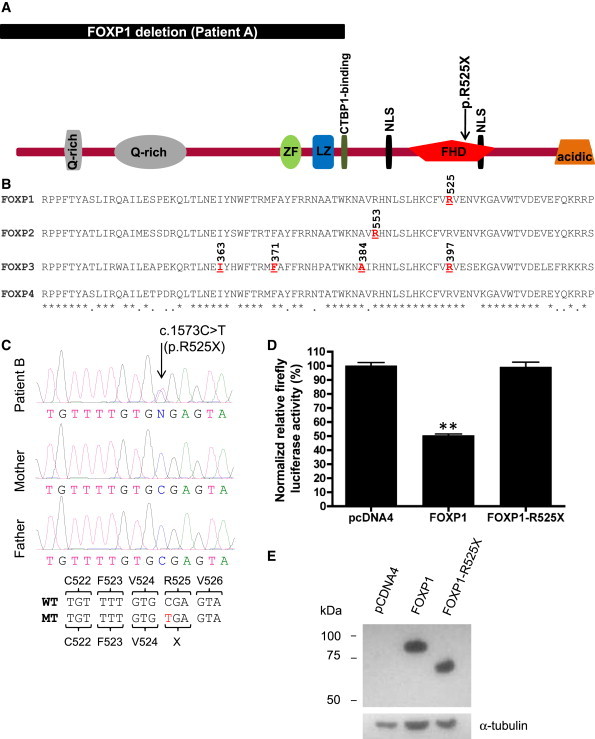
Localization and Characterization of FOXP1 De Novo Mutations (A) Localization of the de novo mutations identified herein with respect to FOXP1 known protein domains (Uniprot no. Q9H334; 677 amino acids [aa]). The deletion in patient A is predicted to affect the first half of FOXP1, including important functional domains such as a zinc finger (ZF; aa 306–331), a leucine zipper (LZ; aa 348–369), and CTBP1-binding (amino acids 382–386) domains. The nonsense p.R525X alteration affects the conserved forkhead DNA-binding domain (FHD, aa 465–555). Also shown are two glutamine rich (Q-rich) regions (aa 55–77, aa 110–194) at the N terminus of the protein and an acidic-rich region (aa 637–677) at its C terminus. The positions of the two nuclear localization signals (NLS; aa 434–440, aa 543–546) are indicated. (B). Alignment of the conserved FHD region of the four members of the human FOXP family. Highlighted and underlined in red are residues that when mutated lead to human disease: p.R525X (current study) in NSID, autism, and language impairment; p.R553H in FOXP2 in severe congenital speech disorder; and p.I363V, p.F371C/L, p.A384T, and p.R397T in FOXP3 in IPEX syndrome. Amino acid identity and similarity are represented by asterisks () and dots (.), respectively. (C) Chromatograms corresponding to the FOXP1 de novo mutation (c.1573C>T [p.R525X]) identified in patient B. Wild-type (WT) and mutant (MT) FOXP1 DNA sequences are shown along with the corresponding amino acids. (D) Luciferase reporter assay assessing the impact of p.R525X on FOXP1 transactivation activity in transfected HEK293 cells. FOXP1 significantly inhibited pGL3-promoter (SV40) transcriptional activity (p < 0.001) as compared to empty vector (pcDNA4)-transfected cells only. In contrast, FOXP1-R525X failed to repress the pGL3-promoter activity. Results (mean ± SEM of three independent experiments, each performed in triplicate) are shown as relative firefly luciferase activity, which is driven by SV40 promoter, normalized with Renilla luciferase, and driven by HSV-TK promoter activity. The control signal value (set to 100%) was obtained with cells transfected with the empty expression vector (pcDNA4HisMax) and both pGL3-promoter (firefly luciferase) and pRL-TK (Renilla luciferase) constructs. (E) Immunoblot performed on total protein extracts from HEK293 cells transfected with pcDNA4-HisMax-based constructs expressing FOXP1 or FOXP1-R525X in frame with an N-terminal Xpress tag, as described in the text. Proteins were resolved on SDS-PAGE, and FOXP1 and FOXP1-R525X were detected with the use of a monoclonal antibody against the N-terminal Xpress tag (Invitrogen). The blot was stripped and probed with an anti-alpha-tubulin antibody (Abcam) as an internal loading control.

References

    1. Fisher S.E., Lai C.S., Monaco A.P. Deciphering the genetic basis of speech and language disorders. Annu. Rev. Neurosci. 2003;26:57–80. - PubMed
    1. Fisher S.E., Scharff C. FOXP2 as a molecular window into speech and language. Trends Genet. 2009;25:166–177. - PubMed
    1. Enard W., Gehre S., Hammerschmidt K., Hölter S.M., Blass T., Somel M., Brückner M.K., Schreiweis C., Winter C., Sohr R. A humanized version of Foxp2 affects cortico-basal ganglia circuits in mice. Cell. 2009;137:961–971. - PubMed
    1. Haesler S., Rochefort C., Georgi B., Licznerski P., Osten P., Scharff C. Incomplete and inaccurate vocal imitation after knockdown of FoxP2 in songbird basal ganglia nucleus Area X. PLoS Biol. 2007;5:e321. - PMC - PubMed
    1. Konopka G., Bomar J.M., Winden K., Coppola G., Jonsson Z.O., Gao F., Peng S., Preuss T.M., Wohlschlegel J.A., Geschwind D.H. Human-specific transcriptional regulation of CNS development genes by FOXP2. Nature. 2009;462:213–217. - PMC - PubMed

Publication types

Substances