Chest-compression-only versus standard cardiopulmonary resuscitation: a meta-analysis
- PMID: 20951422
- PMCID: PMC2987687
- DOI: 10.1016/S0140-6736(10)61454-7
Chest-compression-only versus standard cardiopulmonary resuscitation: a meta-analysis
Abstract
Background: In out-of-hospital cardiac arrest, dispatcher-assisted chest-compression-only bystander CPR might be superior to standard bystander CPR (chest compression plus rescue ventilation), but trial findings have not shown significantly improved outcomes. We aimed to establish the association of chest-compression-only CPR with survival in patients with out-of-hospital cardiac arrest.
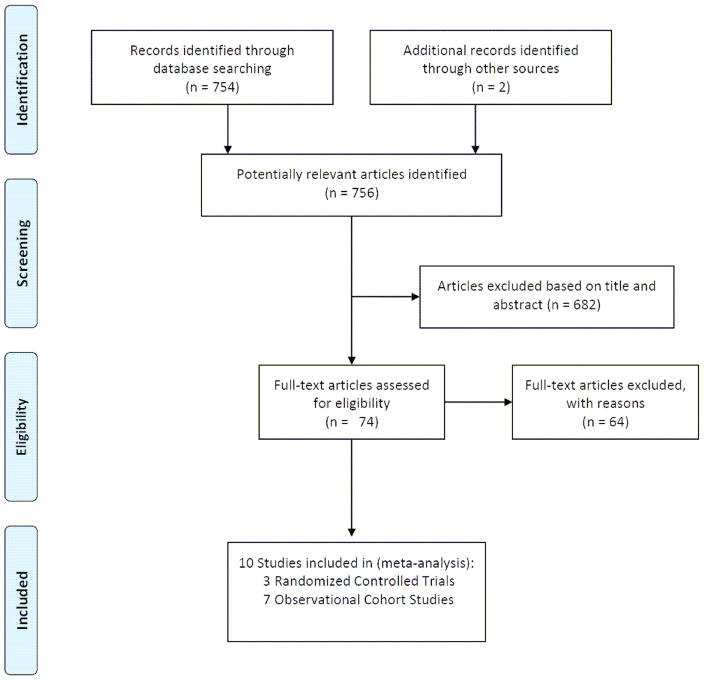
Methods: Medline and Embase were systematically reviewed for studies published between January, 1985, and August, 2010, in which chest-compression-only bystander CPR was compared with standard bystander CPR for adult patients with out-of-hospital cardiac arrest. In the primary meta-analysis, we included trials in which patients were randomly allocated to receive one of the two CPR techniques, according to dispatcher instructions; and in the secondary meta-analysis, we included observational cohort studies of chest-compression-only CPR. All studies had to supply survival data. The primary outcome was survival to hospital discharge. A fixed-effects model was used for both meta-analyses because of an absence of heterogeneity among the studies (I(2)=0%).
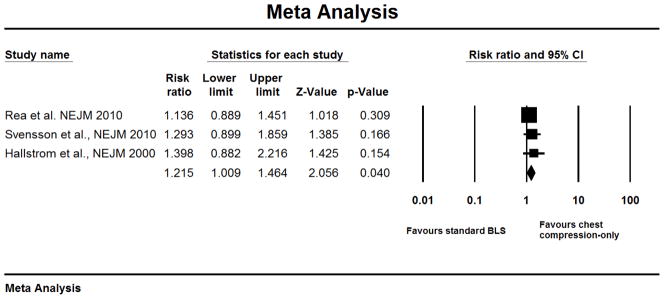
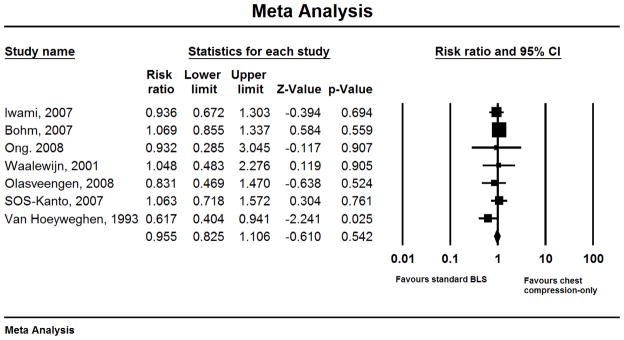
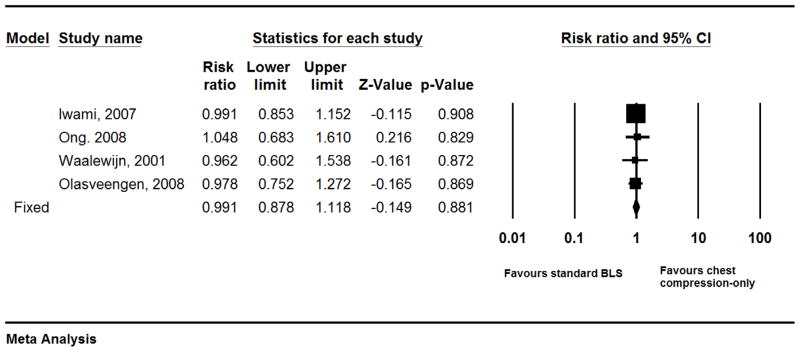
Findings: In the primary meta-analysis, pooled data from three randomised trials showed that chest-compression-only CPR was associated with improved chance of survival compared with standard CPR (14% [211/1500] vs 12% [178/1531]; risk ratio 1·22, 95% CI 1·01-1·46). The absolute increase in survival was 2·4% (95% CI 0·1-4·9), and the number needed to treat was 41 (95% CI 20-1250). In the secondary meta-analysis of seven observational cohort studies, no difference was recorded between the two CPR techniques (8% [223/2731] vs 8% [863/11 152]; risk ratio 0·96, 95% CI 0·83-1·11).
Interpretation: For adults with out-of-hospital cardiac arrest, instructions to bystanders from emergency medical services dispatch should focus on chest-compression-only CPR.
Funding: US National Institutes of Health and American Heart Association.
Copyright © 2010 Elsevier Ltd. All rights reserved.
Conflict of interest statement
PN is receiving research support from Roche Diagnostics, unrelated to this study. MH is receiving salary from St. John’s Ambulance Service, Vienna, Austria and received research support, lecture fees and travel support from Novo Nordisk. HFS does not report a conflict of interest.
Figures
Comment in
-
Dispatcher-assisted bystander CPR: a KISS for a kiss.Lancet. 2010 Nov 6;376(9752):1522-4. doi: 10.1016/S0140-6736(10)61857-0. Epub 2010 Oct 14. Lancet. 2010. PMID: 20951423 No abstract available.
-
Chest-compression-only versus standard CPR.Lancet. 2011 Feb 26;377(9767):716; author reply 718-9. doi: 10.1016/S0140-6736(11)60264-X. Lancet. 2011. PMID: 21353896 No abstract available.
-
Chest-compression-only versus standard CPR.Lancet. 2011 Feb 26;377(9767):716; author reply 718-9. doi: 10.1016/S0140-6736(11)60265-1. Lancet. 2011. PMID: 21353897 No abstract available.
-
Chest-compression-only versus standard CPR.Lancet. 2011 Feb 26;377(9767):717-8; author reply 718-9. doi: 10.1016/S0140-6736(11)60267-5. Lancet. 2011. PMID: 21353898 No abstract available.
-
Chest-compression-only versus standard CPR.Lancet. 2011 Feb 26;377(9767):717; author reply 718-9. doi: 10.1016/S0140-6736(11)60266-3. Lancet. 2011. PMID: 21353899 No abstract available.
-
Chest-compression-only versus standard CPR.Lancet. 2011 Feb 26;377(9767):718; author reply 718-9. doi: 10.1016/S0140-6736(11)60268-7. Lancet. 2011. PMID: 21353901 No abstract available.
-
Vergleich alleinige Herzdruckmassage gegenüber herkömmlicher kardiopulmonaler Reanimation - systematische Review.Praxis (Bern 1994). 2011 Mar 2;100(5):317-8. doi: 10.1024/1661-8157/a000455. Praxis (Bern 1994). 2011. PMID: 21365565 German. No abstract available.
References
-
- Koster RW. Mouth-to-mouth ventilation and/or chest compression in basic life support: The debate continues. Resuscitation. 2008;77(3):283–5. - PubMed
-
- Nolan J. Push, blow or both: Is there a role for compression-only CPR? Anaesthesia. 2010;65(8):771–4. - PubMed
-
- 2005 American Heart Association Guidelines for Cardiopulmonary Resuscitation and Emergency Cardiovascular Care. Circulation. 2005 Dec 13;112(24 Suppl):IV1–203. - PubMed
-
- Handley AJ, Koster R, Monsieurs K, Perkins GD, Davies S, Bossaert L. European Resuscitation Council Guidelines for Resuscitation 2005: Section 2. Adult basic life support and use of automated external defibrillators. Resuscitation. 2005 Dec;67(Supplement 1):S7–S23. - PubMed
-
- Ewy GA, Zuercher M, Hilwig RW, Sanders AB, Berg RA, Otto CW, et al. Improved neurological outcome with continuous chest compressions compared with 30:2 compressions-to-ventilations cardiopulmonary resuscitation in a realistic swine model of out-of-hospital cardiac arrest. Circulation. 2007;116(22):2525–30. - PubMed
Publication types
MeSH terms
Grants and funding
LinkOut - more resources
Full Text Sources
Medical