


Effects of GABA agonist and antagonist injections into the oculomotor vermis on horizontal saccades
- PMID: 20951682
- PMCID: PMC2995326
- DOI: 10.1016/j.brainres.2010.10.027
Effects of GABA agonist and antagonist injections into the oculomotor vermis on horizontal saccades
Abstract
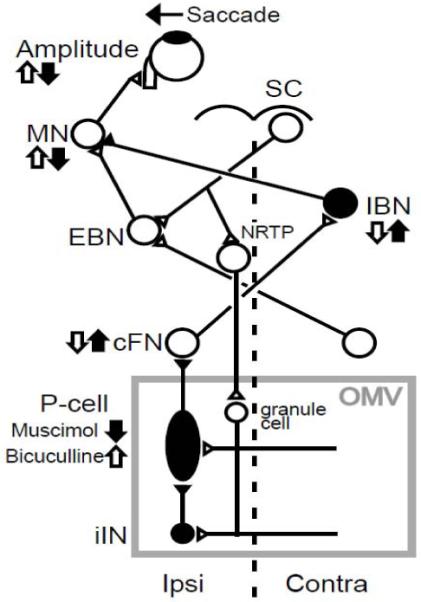
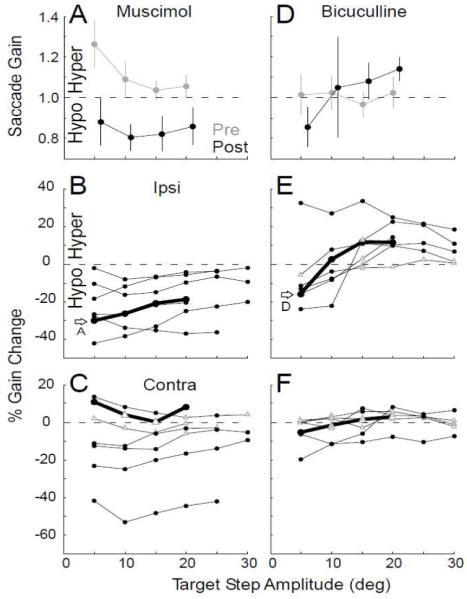
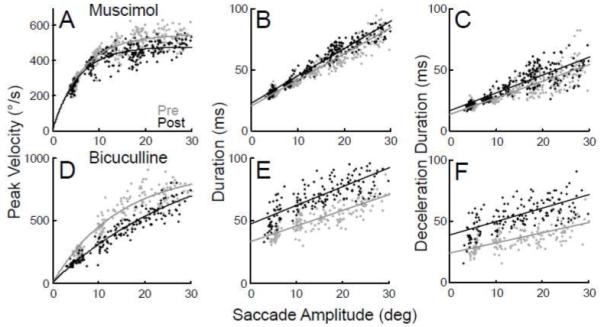
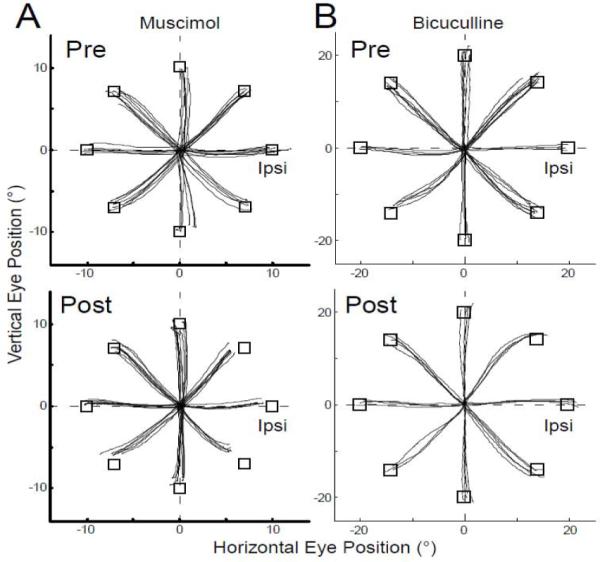
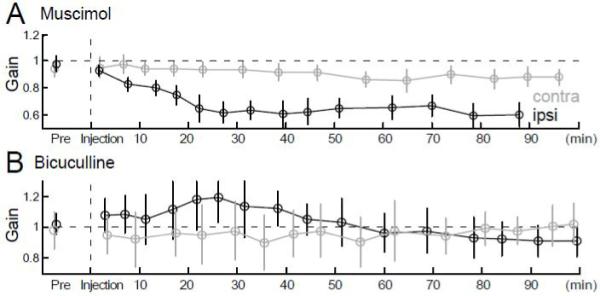
The oculomotor vermis (OMV) of the cerebellum is necessary for the generation of the accurate rapid eye movements called saccades. Large lesions of the midline cerebellar cortex involving the OMV cause saccades to become hypometric and more variable. However, saccades were not examined immediately after these lesions so the interpretation of the resulting deficits might have been contaminated by some adaptation to the saccade dysmetria. Therefore, to better understand the contribution of the OMV to normal saccades, we impaired its operation locally by injecting small amounts of either an agonist or antagonist of γ-aminobutyric acid (GABA), which is a ubiquitous neurotransmitter throughout the cerebellar cortex. Muscimol, a GABA agonist, inactivated part of the OMV, whereas bicuculline, an antagonist, disinhibited it. Muscimol caused all ipsiversive horizontal saccades from 5 to 30° to become hypometric. In contrast, bicuculline produced an amplitude-dependent dysmetria: ipsiversive horizontal saccades elicited by target steps <10° became hypometric, whereas those in response to larger steps became hypermetric. At the transition target amplitude, saccade amplitudes were quite variable with some being hypo- and others hypermetric. After most injections of either agent, saccades had lower peak velocities and longer durations than pre-injection saccades of the same amplitude. The longer durations were associated with a prolongation of the deceleration phase. Both agents produced inconsistent effects on contraversive saccades. These results establish that the oculomotor vermis helps control the characteristics of normal ipsiversive saccades and that GABAergic inhibitory processes are a crucial part of this process.
Published by Elsevier B.V.
Figures
References
-
- Arikan R, Blake NM, Erinjeri JP, Woolsey TA, Giraud L, Highstein SM. A method to measure the effective spread of focally injected muscimol into the central nervous system with electrophysiology and light microscopy. J Neurosci Methods. 2002;118:51–7. - PubMed
-
- Bahill AT, Brockenbrough A, Troost BT. Variability and development of a normative data base for saccadic eye movements. Invest Ophthalmol Vis Sci. 1981;21:116–25. - PubMed
-
- Geurts FJ, De Schutter E, Dieudonné S. Unraveling the cerebellar cortex: cytology and cellular physiology of large-sized interneurons in the granular layer. Cerebellum. 2003;2:290–9. - PubMed
-
- Goffart L, Chen LL, Sparks DL. Deficits in saccades and fixation during muscimol inactivation of the caudal fastigial nucleus in the rhesus monkey. J Neurophysiol. 2004;92:3351–67. - PubMed
Publication types
MeSH terms
Substances
Grants and funding
LinkOut - more resources
Full Text Sources
