


NK cells: elusive participants in transplantation immunity and tolerance
- PMID: 20952173
- PMCID: PMC2967580
- DOI: 10.1016/j.coi.2010.09.005
NK cells: elusive participants in transplantation immunity and tolerance
Abstract
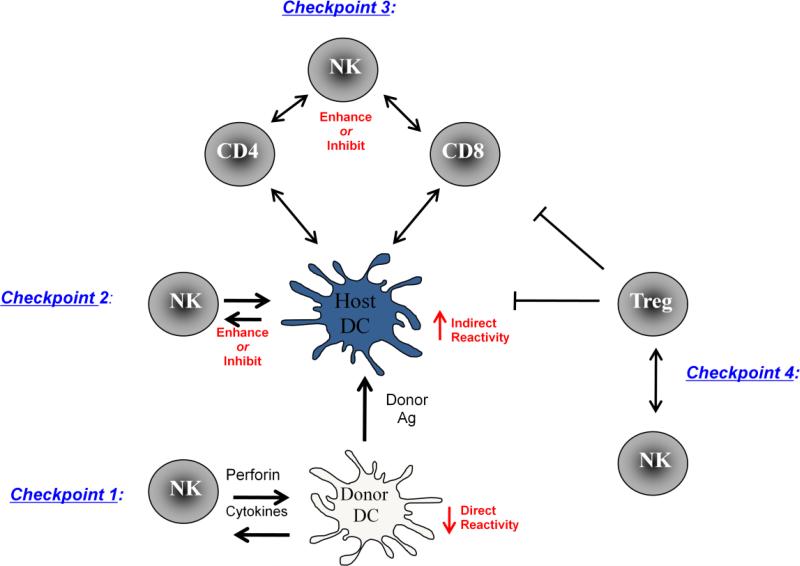
NK cells constitute an innate MHC class I-reactive lymphoid population that rapidly responds to infection, injury, or cell distress. In the transplant field, NK cells have most often been associated with pro-inflammatory immunity resulting in the exacerbation of allograft injury. Despite this general view of NK cell reactivity, it has been challenging to assign unambiguous obligate roles for NK cells in the allograft response. While recent reports continue to provide evidence supporting a role for NK cells in promoting both acute and chronic rejection, there are also a growing number of studies that illustrate an alternative role for NK cells in promoting allograft survival and tolerance. This review addresses the plasticity of NK responses in transplantation by suggesting specific 'checkpoints' whereby NK cells can either enhance or inhibit the allograft response in vivo.
Copyright © 2010 Elsevier Ltd. All rights reserved.
Figures
References
-
- Lanier LL. NK cell recognition. Annu Rev Immunol. 2005;23:225–274. - PubMed
-
- Vivier E, Tomasello E, Baratin M, Walzer T, Ugolini S. Functions of natural killer cells. Nat Immunol. 2008;9:503–510. - PubMed
-
- Karre K, Ljunggren HG, Piontek G, Kiessling R. Selective rejection of H-2-deficient lymphoma variants suggests alternative immune defence strategy. Nature. 1986;319:675–678. - PubMed
-
- Kean LS, Hamby K, Koehn B, Lee E, Coley S, Stempora L, et al. NK cells mediate costimulation blockade-resistant rejection of allogeneic stem cells during nonmyeloablative transplantation. Am J Transplant. 2006;6:292–304. - PubMed
Publication types
MeSH terms
Grants and funding
LinkOut - more resources
Full Text Sources
Research Materials
