. 2010 Oct 15;24(20):2276-81.
doi: 10.1101/gad.1937710.

Control of melanocyte differentiation by a MITF-PDE4D3 homeostatic circuit

Affiliations

Control of melanocyte differentiation by a MITF-PDE4D3 homeostatic circuit

Mehdi Khaled et al. Genes Dev. .

Abstract

Cyclic AMP (cAMP) is a ubiquitous second messenger that regulates a variety of biological processes. The magnitude and duration of cAMP expression are regulated by both production and hydrolysis. Melanocyte-stimulating hormone (MSH) plays a crucial role in pigment cell differentiation via cAMP-regulated expression of the master transcription factor MITF. We report the identification of phosphodiesterase 4D3 as a direct target of the MSH/cAMP/MITF pathway. This creates a negative feedback loop that induces refractoriness to chronic stimulation of the cAMP pathway in melanocytes. This homeostatic pathway highlights a potent mechanism controlling melanocyte differentiation that may be amenable to pharmacologic manipulation for skin cancer prevention.


Figures
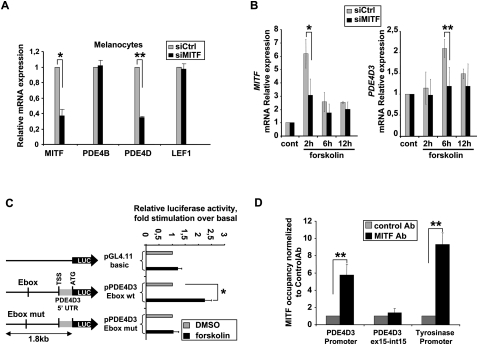
Figure 1.
Figure 1.
cAMP-induced up-regulation of PDE4D3 is dependent on MITF. (A) Primary human melanocytes were transfected with a nontargeting control siRNA (siCtrl) or a siRNA specific for MITF. Total mRNA was subjected to qPCR. The data are normalized to β-actin. (B) Primary human melanocytes were transfected with a nontargeting siRNA (siCtrl) or siRNAs targeting MITF and exposed to forskolin, as indicated. Total mRNA was subjected to qPCR. Results are expressed as fold stimulation and represent the mean ± SD of three independent experiments. (C) UACC62 cells were transiently transfected with reporter plasmids pPDE4D3 and pPDE4D3 Ebox mutated. After 24 h of forskolin stimulation, firefly luciferase was measured and normalized to the renilla luciferase control. Results are shown as fold stimulation and represent the mean ± SD of three experiments performed in triplicate. (TSS) Transcription start site. (D) ChIP from primary human melanocytes was performed using MITF or control antibody (see the Materials and Methods). RNA levels were analyzed by qPCR. Data are plotted as fold change versus control antibody, and each point is the mean ± SD of three independent experiments. P-values were obtained by a paired t-test. (*) P < 0.05; (**) P < 0.005.
Figure 2.
Figure 2.
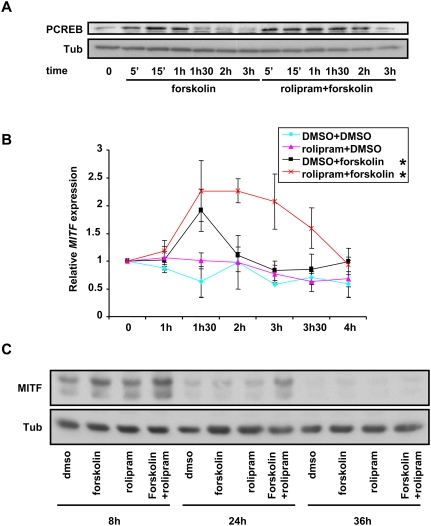
Inhibition of PDE4 potentiates forskolin-induced CREB phosphorylation in primary human melanocytes. (A) Extracts from primary human melanocytes placed in minimal media for 14 h before being treated as indicated were immunoblotted using antibodies against phospho-CREB and α-tubulin. (B) Primary human melanocytes were exposed to the indicated conditions for 30 min before being rinsed and placed in minimal media for the indicated times. The results are normalized to β-actin and are shown as fold induction of MITF. Each data point is the mean ± SD of three experiments. (*) P < 0.05. (C) Extracts from primary human melanocytes were placed in minimal media for 14 h before being exposed for 30 min to rolipram or DMSO prior to being treated with forskolin for 30 min. Subsequently, the cells were rinsed and placed in minimal media for the indicated times. The protein extracts were submitted to immunoblotting using MITF and α-tubulin antibodies.
Figure 3.
Figure 3.
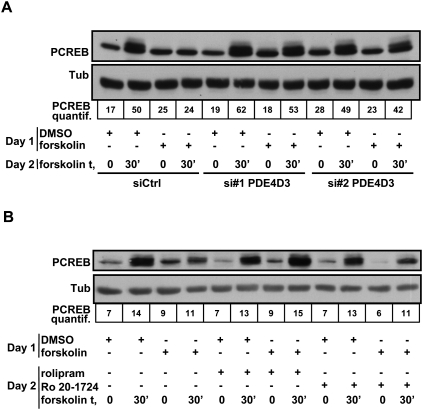
Forskolin pretreatment induces forskolin resistance that is reversible by PDE4D3 knockdown or rolipram treatment. (A) Primary human melanocytes were transfected with a nontargeting siRNA (siCtrl) or siRNAs targeting PDE4D3. Twenty-four hours after transfection, the cells were placed in minimal media (MM) for 14 h, and were subsequently treated with forskolin for 4 h before being returned to minimal media. The following day, the cells were exposed to forskolin for the indicated times. Cell lysates were subjected to Western blotting using antibodies specific for phospho-CREB and α-tubulin. The intensity of the phospho-CREB Western blot was measured and normalized to α-tubulin. (B) Primary human melanocytes were incubated in minimal media for 14 h, treated with forskolin or DMSO for 4 h, and returned to minimal media. The following day, the cells were exposed to DMSO or rolipram or Ro 20-1724 for 4 h and then rechallenged with forskolin for the indicated times. Cell lysates were subjected to Western blotting using antibodies specific for phospho-CREB and α-tubulin. The intensity of the phospho-CREB Western blot was measured and normalized to α-tubulin.
Figure 4.
Figure 4.
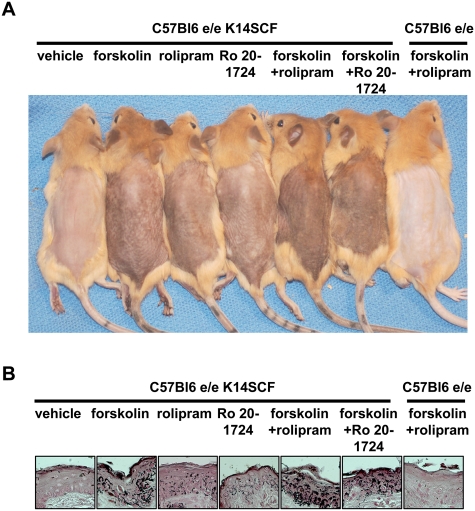
PDE4 inhibition synergizes with forskolin to induce sunless tanning in redhead/fair-skinned mice. (A) C57bl6e/e;K14-SCF and C57bl6e/e mice were treated for five consecutive days with forskolin alone, rolipram alone, Ro 20-1724 alone, or the combinations of forskolin/rolipram or forskolin/Ro 20-1724, once per day. A representative group of mice out of three independent groups receiving the same treatment was photographed at day 5. (B) Fontana-Masson-stained skin sections (for melanin) (black deposits, 63× magnification).
Figure 5.
Figure 5.
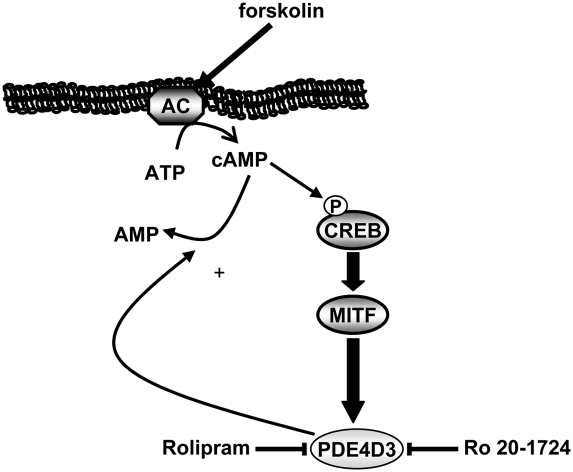
Graphical representation of the cAMP–MITF–PDE4D3 feedback loop.

Comment in

  • Without the sun.
    Anthony K. Anthony K. Nat Rev Cancer. 2010 Dec;10(12):816. doi: 10.1038/nrc2975. Nat Rev Cancer. 2010. PMID: 21155180 No abstract available.

References

    1. Bentley NJ, Eisen T, Goding CR 1994. Melanocyte-specific expression of the human tyrosinase promoter: Activation by the microphthalmia gene product and role of the initiator. Mol Cell Biol 14: 7996–8006 - PMC - PubMed
    1. Bertolotto C, Abbe P, Hemesath TJ, Bille K, Fisher DE, Ortonne JP, Ballotti R 1998. Microphthalmia gene product as a signal transducer in cAMP-induced differentiation of melanocytes. J Cell Biol 142: 827–835 - PMC - PubMed
    1. Bobon D, Breulet M, Gerard-Vandenhove MA, Guiot-Goffioul F, Plomteux G, Sastre-y-Hernandez M, Schratzer M, Troisfontaines B, von Frenckell R, Wachtel H 1988. Is phosphodiesterase inhibition a new mechanism of antidepressant action? A double blind double-dummy study between rolipram and desipramine in hospitalized major and/or endogenous depressives. Eur Arch Psychiatry Neurol Sci 238: 2–6 - PubMed
    1. Busca R, Abbe P, Mantoux F, Aberdam E, Peyssonnaux C, Eychene A, Ortonne JP, Ballotti R 2000. Ras mediates the cAMP-dependent activation of extracellular signal-regulated kinases (ERKs) in melanocytes. EMBO J 19: 2900–2910 - PMC - PubMed
    1. Carreira S, Goodall J, Aksan I, La Rocca SA, Galibert MD, Denat L, Larue L, Goding CR 2005. Mitf cooperates with Rb1 and activates p21Cip1 expression to regulate cell cycle progression. Nature 433: 764–769 - PubMed

Publication types

MeSH terms