


Genetics, phosphorus availability, and herbivore-derived induction as sources of phenotypic variation of leaf volatile terpenes in a pine species
- PMID: 20952630
- PMCID: PMC2955752
- DOI: 10.1093/jxb/erq246
Genetics, phosphorus availability, and herbivore-derived induction as sources of phenotypic variation of leaf volatile terpenes in a pine species
Abstract
Oleoresin produced and stored in pine tree leaves provides direct resistance to herbivores, while leaf volatile terpenes (LVT) in the resin are also powerful airborne infochemicals. Resin concentration and profile show considerable spatial and temporal phenotypic variation within and among pine populations. LVT biochemistry is known to be under genetic control, and although LVT should be plastic to diverse abiotic and biotic environmental factors such as nutrient availability and herbivore attack, little is known about their relative contributions and interactive effects. The aim of this paper was to clarify whether reduced phosphorus availability could increase the LVT concentration and affect the expression of herbivore-derived induced defences, and how plasticity would contribute to the phenotypic variation of LVT. The constitutive and methyl-jasmonate (MeJa) induced LVT concentration and profile were analysed in 17 half-sib Pinus pinaster families growing under two levels of P-availability (complete and P-limited fertilization). Individual terpene concentrations showed large additive genetic variation, which was more pronounced in the control than in MeJa-induced pines. MeJa application did not affect the LVT concentration, but significantly modified the LVT profile by depleting the α-pinene content and reducing the sesquiterpene fraction. Low P-availability strongly reduced plant growth and foliar nutrient concentrations, but did not affect LVT concentration and profile, and did not interact with MeJa-induction. Results indicate a strong homeostasis of LVT concentration to P-availability, and minor changes in the LVT profile due to MeJa-induction. Genetic variation appears to be the main source of phenotypic variation affecting the LVT concentration in this pine species.
Figures

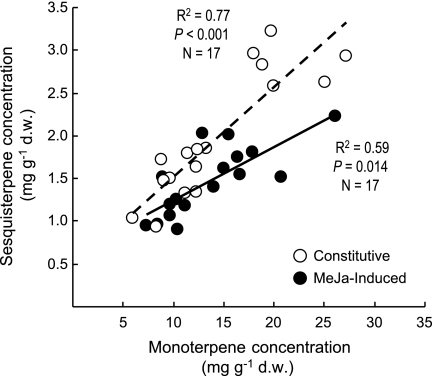
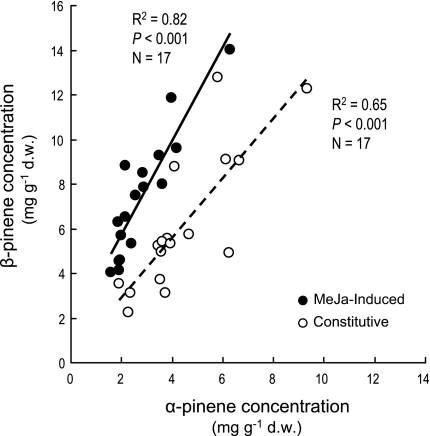
References
-
- Agrawal AA, Conner JK, Johnson MT, Wallsgrove R. Ecological genetics of induced plant defense against herbivores: additive genetic variation and costs of phenotypic plasticity. Evolution. 2002;56:2206–2213. - PubMed
-
- Arrabal C, Cortijo M, Fernández de Simón B, García Vallejo MC, Cadahía E. Differentiation among five Spanish Pinus pinaster provenances based on its oleoresin terpenic composition. Biochemical Systematics and Ecology. 2005;33:1007–1016.
-
- Baradat PH, Bernard-Dagan C, Fillon C, Marpeau A, Pauly G. Les terpènes du Pin maritime: aspects biologiques et génétiques. Il hérédité de la teneur en monoterpènes. Annals of Forest Science. 1972;29:307–334.
-
- Barnola LF, Cedeño A. Inter-population differences in the essential oils of Pinus caribaea needles. Biochemical Systematics and Ecology. 2000;28:923–931. - PubMed
-
- Bauce É Crépin M, Carisey N. Spruce budworm growth, development and food utilization on young and old balsam fir trees. Oecologia. 1994;97:499–507. - PubMed
