. 2011 Feb;213(4):781-9.
doi: 10.1007/s00213-010-2033-2. Epub 2010 Oct 15.

Conditioned cues for smoking elicit preparatory responses in healthy smokers

Affiliations

Conditioned cues for smoking elicit preparatory responses in healthy smokers

Markus H Winkler et al. Psychopharmacology (Berl). 2011 Feb.

Abstract

Rationale: Smoking cues are theorized to be conditioned stimuli (CSs) formed by repeated pairing with drug. Smoking paraphernalia can elicit subjective and physiological responses in smokers, indicative of positive affect and motivation to consume. Although these responses are probably the result of conditioning, direct evidence from human conditioning studies with physiological measures of motivational valence is rare.

Objective: The present study investigated the motivational properties of experimentally conditioned cues for smoking.

Methods: Thirty-nine smokers completed a differential conditioning protocol. Abstract pictures were used as CSs and single puffs on a cigarette as unconditioned stimulus (US). Skin conductance responses and facial electromyography of the zygomatic, corrugator, and orbicularis oris muscles were measured during conditioning.

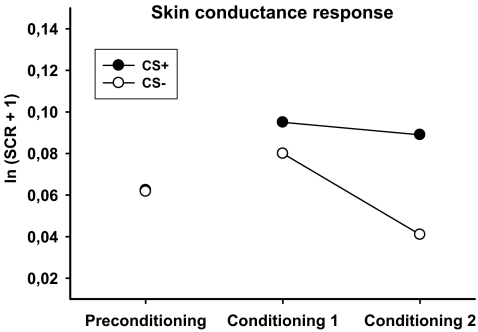
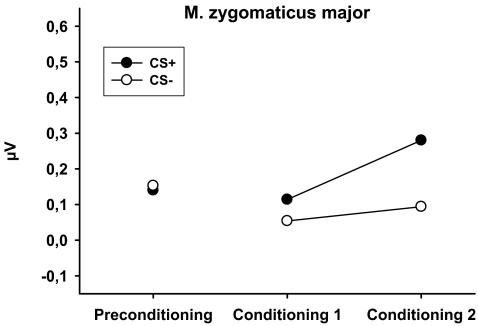
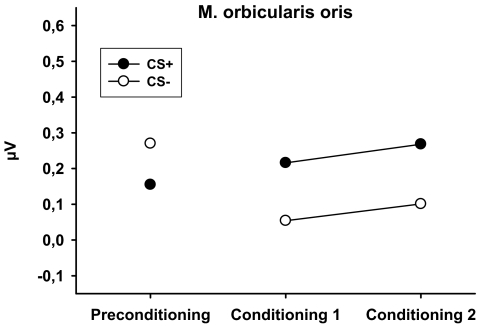
Results: The conditioned cue for smoking (CS+) elicited stronger skin conductance responses and more activity of the zygomatic and orbicularis oris muscles than the CS-.

Conclusions: These results support the notion that through pairing with smoking, neutral stimuli acquire the ability to elicit preparatory physiological responses, which are assumed to play an important role in the maintenance of addiction and relapse in the natural environment.


Figures

Fig. 1
Fig. 1
Stimuli counterbalanced between subjects in the role of CS+ and CS− during the conditioning phase (not to scale)
Fig. 2
Fig. 2
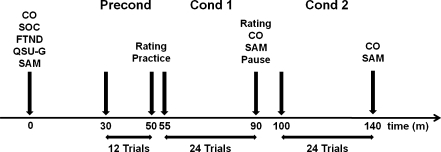
Scheme of the experimental protocol. Precond preconditioning, Cond 1 conditioning 1, Cond 2 conditioning 2, Rating CS−rating, Practice practice trials, CO carbon monoxide test, FTND Fagerström Test for Nicotine Dependence, QSU-G Questionnaire on Smoking Urges-German version, SAM modified version of the Self-Assessment Manikins
Fig. 3
Fig. 3
Mean skin conductance responses (ln (SCR + 1)) in response to CS + and CS− during preconditioning and during the first and second block of conditioning
Fig. 4
Fig. 4
Mean change in EMG activity (microvolt) of the M. zygomaticus major in response to CS+ and CS− during preconditioning and during the first and second block of conditioning
Fig. 5
Fig. 5
Mean change in EMG activity (microvolt) of the M. orbicularis oris in response to CS+ and CS− during preconditioning and during the first and second block of conditioning

References

    1. Berridge KC. Motivation concepts in behavioral neuroscience. Physiol Behav. 2004;81:179–209. doi: 10.1016/j.physbeh.2004.02.004. - DOI - PubMed
    1. Berridge KC, Kringelbach ML. Affective neuroscience of pleasure: reward in humans and animals. Psychopharmacology. 2008;199:457–480. doi: 10.1007/s00213-008-1099-6. - DOI - PMC - PubMed
    1. Berridge KC, Robinson TE. Parsing reward. Trends Neurosci. 2003;26:507–513. doi: 10.1016/S0166-2236(03)00233-9. - DOI - PubMed
    1. Bindra D. A motivational view of learning, performance, and behavior modification. Psychol Rev. 1974;81:199–213. doi: 10.1037/h0036330. - DOI - PubMed
    1. Caggiula AR, Donny EC, White AR, Chaudhri N, Booth S, Gharib MA, Hoffman A, Perkins KA, Sved AF. Environmental stimuli promote the acquisition of nicotine self-administration in rats. Psychopharmacology. 2002;163:230–237. doi: 10.1007/s00213-002-1156-5. - DOI - PubMed

Publication types

LinkOut - more resources