. 2010 Oct;21(9-10):509-15.
doi: 10.1007/s00335-010-9290-6. Epub 2010 Oct 16.

The naked truth: Sphynx and Devon Rex cat breed mutations in KRT71

Affiliations

The naked truth: Sphynx and Devon Rex cat breed mutations in KRT71

Barbara Gandolfi et al. Mamm Genome. 2010 Oct.

Abstract

Hair is a unique structure, characteristic of mammals, controlling body homeostasis, as well as cell and tissue integration. Previous studies in dog, mouse, and rat have identified polymorphisms in Keratin 71 (KRT71) as responsible for the curly/wavy phenotypes. The coding sequence and the 3' UTR of KRT71 were directly sequenced in randomly bred and pedigreed domestic cats with different pelage mutations, including hairless varieties. A SNP altering a splice site was identified in the Sphynx breed and suggested to be the hairless (hr) allele, and a complex sequence alteration, also causing a splice variation, was identified in the Devon Rex breed and suggested to be the curly (re) allele. The polymorphisms were genotyped in approximately 200 cats. All the Devon Rex were homozygous for the complex alterations and most of the Sphynx were either homozygous for the hr allele or compound heterozygotes with the Devon-associated re allele, suggesting that the phenotypes are a result of the identified SNPs. Two Sphynx carrying the proposed hr mutation did not carry the Devon-associated alteration. No other causative mutations for eight different rexoid and hairless cat phenotypes were identified. The allelic series KRT71( + ) > KRT71( hr ) > KRT71( re ) is suggested.


Figures
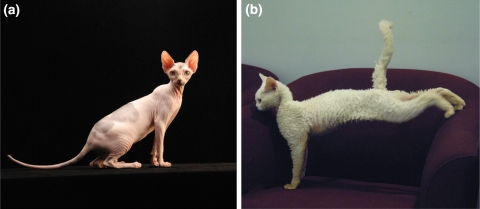
Fig. 1
Fig. 1
Hairless and curly phenotypes on the domestic cat. a Hairless phenotype in a Sphynx cat, characterized by lack of hair with a well-formed bulb. b Curly phenotype in a Devon Rex cat characterized by a short and soft coat, generally missing the guard hairs
Fig. 2
Fig. 2
Alternative splice models of KRT71 gene in cats. RT-PCR analysis on a control cat, a Sphynx, and a Devon Rex. a Genomic DNA with the diamond indicating the SNP [G/A] detected at position +1 of intron 4. b Normal-haired cat cDNA with correct splicing of intron 4. c Sphynx cDNA with the 43-bp insertion caused by the disruption of the donor splice site in intron 4; triangle indicates the introduced stop codon. d Genomic DNA with diamonds indicating the region involved in the deletions/insertions causing the Devon Rex phenotype. e Normal-haired cat cDNA with correct splicing of intron 6. f Devon Rex cDNA with the missing 5′ region of exon 7. Triangle indicates that the exon 7 starts after the alternative splice

References

    1. Bighignoli B, Niini T, Grahn RA, Pedersen NC, Millon LV, et al. Cytidine monophospho-N-acetylneuraminic acid hydroxylase (CMAH) mutations associated with the domestic cat AB blood group. BMC Genet. 2007;8:27. doi: 10.1186/1471-2156-8-27. - DOI - PMC - PubMed
    1. Cadieu E, Neff MW, Quignon P, Walsh K, Chase K, et al. Coat variation in the domestic dog is governed by variants in three genes. Science. 2009;326:150–153. doi: 10.1126/science.1177808. - DOI - PMC - PubMed
    1. Drogemuller C, Rufenacht S, Wichert B, Leeb T. Mutations within the FGF5 gene are associated with hair length in cats. Anim Genet. 2007;38:218–221. doi: 10.1111/j.1365-2052.2007.01590.x. - DOI - PubMed
    1. Dunn LC (1937) Caracul, a dominant mutation. J Hered 334
    1. Hall TA. BioEdit: a user-friendly biological sequence alignment editor and analysis program for Windows 95/98/NT. Nucleic Acids Symp Ser. 1999;41:95–98.

Publication types