Review
. 2010 Oct;14(5):525-40.
doi: 10.1089/omi.2010.0072.

Adaptive response and tolerance to weak acids in Saccharomyces cerevisiae: a genome-wide view

Affiliations
Review

Adaptive response and tolerance to weak acids in Saccharomyces cerevisiae: a genome-wide view

Nuno P Mira et al. OMICS. 2010 Oct.

Abstract

Weak acids are widely used as food preservatives (e.g., acetic, propionic, benzoic, and sorbic acids), herbicides (e.g., 2,4-dichlorophenoxyacetic acid), and as antimalarial (e.g., artesunic and artemisinic acids), anticancer (e.g., artesunic acid), and immunosuppressive (e.g., mycophenolic acid) drugs, among other possible applications. The understanding of the mechanisms underlying the adaptive response and resistance to these weak acids is a prerequisite to develop more effective strategies to control spoilage yeasts, and the emergence of resistant weeds, drug resistant parasites or cancer cells. Furthermore, the identification of toxicity mechanisms and resistance determinants to weak acid-based pharmaceuticals increases current knowledge on their cytotoxic effects and may lead to the identification of new drug targets. This review integrates current knowledge on the mechanisms of toxicity and tolerance to weak acid stress obtained in the model eukaryote Saccharomyces cerevisiae using genome-wide approaches and more detailed gene-by-gene analysis. The major features of the yeast response to weak acids in general, and the more specific responses and resistance mechanisms towards a specific weak acid or a group of weak acids, depending on the chemical nature of the side chain R group (R-COOH), are highlighted. The involvement of several transcriptional regulatory networks in the genomic response to different weak acids is discussed, focusing on the regulatory pathways controlled by the transcription factors Msn2p/Msn4p, War1p, Haa1p, Rim101p, and Pdr1p/Pdr3p, which are known to orchestrate weak acid stress response in yeast. The extrapolation of the knowledge gathered in yeast to other eukaryotes is also attempted.


Figures
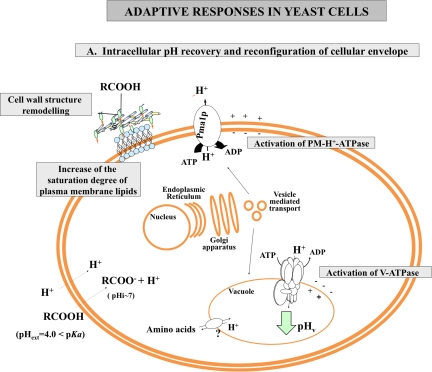
FIG. 1.
FIG. 1.
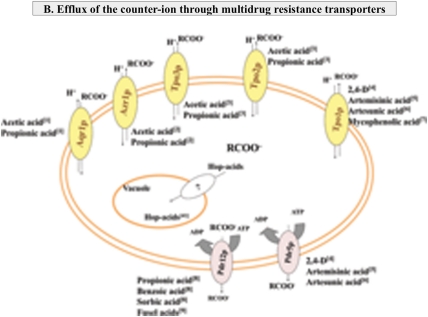
Mechanistic model for the adaptive yeast response to weak acid-induced stress. (A) Stimulation of the activity of H+-ATPases present in the plasma and vacuolar membranes contribute to the recovery of internal pH (pHi) to more physiological values and for metabolite compartmentalization in acid-stressed cells. The reconfiguration of cell wall structure and plasma membrane lipid composition may reduce the diffusion rate of undissociated weak acids and reduce the weak acid-induced plasma membrane damage. (B) Detoxification through multidrug resistance (MDR) transporters of the ATP-binding cassette (ABC) (in yellow) and Major Facilitator Superfamily (MFS) (in pink) is required to reduce the internal concentration of the weak acid counterion. The substrates established for each MDR transporter are indicated based on the information available in the literature. 1) Tenreiro et al., ; 2) Tenreiro et al., ; 3) Fernandes et al., ; 4) Teixeira and Sá-Correia, ; 5) Ro et al., ; 6) Alenquer et al., ; 7) Desmoucelles et al., ; 8) Piper et al., ; 9) Hazelwood et al., .
FIG. 1.
FIG. 1.
Mechanistic model for the adaptive yeast response to weak acid-induced stress. (A) Stimulation of the activity of H+-ATPases present in the plasma and vacuolar membranes contribute to the recovery of internal pH (pHi) to more physiological values and for metabolite compartmentalization in acid-stressed cells. The reconfiguration of cell wall structure and plasma membrane lipid composition may reduce the diffusion rate of undissociated weak acids and reduce the weak acid-induced plasma membrane damage. (B) Detoxification through multidrug resistance (MDR) transporters of the ATP-binding cassette (ABC) (in yellow) and Major Facilitator Superfamily (MFS) (in pink) is required to reduce the internal concentration of the weak acid counterion. The substrates established for each MDR transporter are indicated based on the information available in the literature. 1) Tenreiro et al., ; 2) Tenreiro et al., ; 3) Fernandes et al., ; 4) Teixeira and Sá-Correia, ; 5) Ro et al., ; 6) Alenquer et al., ; 7) Desmoucelles et al., ; 8) Piper et al., ; 9) Hazelwood et al., .
FIG. 2.
FIG. 2.
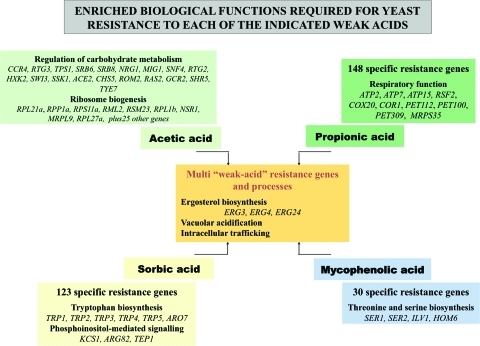
Yeast genes that were found to confer resistance to acetic, propionic, sorbic, and mycophenolic acids, based on the results of (Desmoucelles et al., ; Mira et al., ; Mollapour et al., ; and our unpublished results) were selected and clustered according to their biological function using the MIPS functional catalog. The classes considered enriched in the different gene lists (associated p-value below 0.01) are shown.
FIG. 3.
FIG. 3.
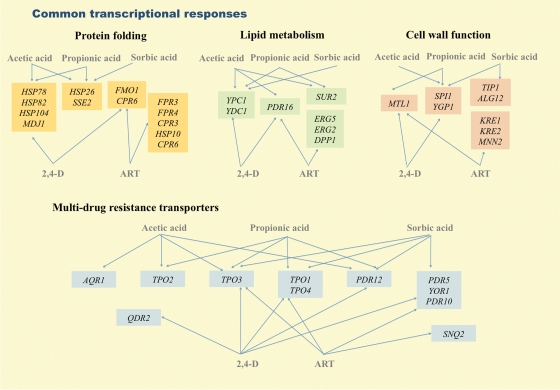
Biological functions found to be represented in the yeast transcriptome-wide response to all weak acids analysed. For each biological function, the specific genes responding to the indicated weak acids are highlighted. ART, Artemisinic acid.
FIG. 4.
FIG. 4.
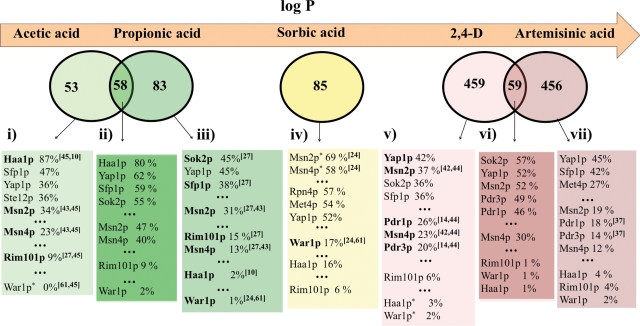
Clustering of the genes upregulated in response to acetic, propionic, sorbic, and artemisinic acids (Mira et al., , ; Ro et al., ; Schuller et al., 2004) or to 2,4-D (Teixeira et al., 2006a) with their documented regulators, according to the information deposited in the YEASTRACT database (March 2010), plus data coming from our recent work (Mira et al., 2010). Based on the level of overlapping, the responsive genes were clustered in three groups: acetic and propionic acid-induced genes, sorbic acid-induced genes and artemisinic acid- and 2,4-D-induced genes. YEASTRACT database was used to cluster, with their documented regulators, the genes that: (1) are activated in cells exposed to acetic acid but not in the presence of propionic acid stress; (2) are upregulated upon exposure to acetic or propionic acid; (3) are activated in cells exposed to propionic acid but not upon acetic acid challenge; (4) are upregulated in yeast cells exposed to sorbic acid; (5) are activated in cells exposed to 2,4D but not in the presence of artemisinic acid stress; (6) are upregulated upon exposure to 2,4-D or artemisinic acid; (7) are activated in cells exposed to artemisinic acid but not upon 2,4-D challenge. The transcription factors were organized by decreasing percentage of documented targets in each dataset. The transcription factors that provide protection toward a given weak acid are distinguished (in bold) from those known to be dispensable for tolerance (indicated with *).

References

    1. Abbott D.A. Knijnenburg T.A. de Poorter L.M. Reinders M,J. Pronk J.T. Van Maris A.J. Generic and specific transcriptional responses to different weak organic acids in anaerobic chemostat cultures of Saccharomyces cerevisiae. FEMS Yeast Res. 2007;7:819–833. - PubMed
    1. Abbott D.A. Suir E. Van Maris A.J.A. Pronk J.T. Physiological and transcriptional responses to high concentrations of lactic acid in anaerobic chemostat cultures of Saccharomyces cerevisiae. Appl Environ Microb. 2008;74:5759–5768. - PMC - PubMed
    1. Abbott D.A. Zelle R.M. Pronk J.T. Van Maris A.J. Metabolic engineering of Saccharomyces cerevisiae for production of carboxylic acids: current status and challenges. FEMS Yeast Res. 2009;9:1123–1136. - PubMed
    1. Alejandro-Osorio A.L. Huebert D.J. Porcaro D.T. Sonntag M.E. Nillasithanukroh S. Will J.L., et al. The histone deacetylase Rpd3p is required for transient changes in genomic expression in response to stress. Genome Biol. 2009;10:R57. - PMC - PubMed
    1. Alenquer M. Tenreiro S. Sá-Correia I. Adaptive response to the antimalarial drug artesunate in yeast involves Pdr1p/Pdr3p-mediated transcriptional activation of the resistance determinants TPO1 and PDR5. FEMS Yeast Res. 2006;6:1130–1139. - PubMed

Publication types

MeSH terms

LinkOut - more resources