. 2010 Nov 2;107(44):18973-8.
doi: 10.1073/pnas.1006614107. Epub 2010 Oct 18.

Mucosal host immune response predicts the severity and duration of herpes simplex virus-2 genital tract shedding episodes

Affiliations

Mucosal host immune response predicts the severity and duration of herpes simplex virus-2 genital tract shedding episodes

Joshua T Schiffer et al. Proc Natl Acad Sci U S A. .

Abstract

Herpes simplex virus-2 (HSV-2) shedding episodes in humans vary markedly in duration and virologic titer within an infected person over time, an observation that is unexplained. To evaluate whether host or virological factors more closely accounted for this variability, we combined measures of viral replication and CD8(+) lymphocyte density in genital biopsies, with a stochastic mathematical model of HSV-2 infection. Model simulations reproduced quantities of virus and duration of shedding detected in 1,003 episodes among 386 persons. In the simulations, local CD8(+) lymphocyte density in the mucosa at episode onset predicted peak HSV DNA copy number and whether genital lesions or subclinical shedding occurred. High density of CD8(+) T cells in the mucosa correlated with decreased infected cell lifespan and fewer infected epithelial cells before episode clearance. If infected cell lifespan increased by 15 min because of CD8(+) lymphocyte decay, then there was potential for a thousandfold increase in the number of infected cells. The model suggests that the rate of containment of infected cells by the peripheral mucosal immune system is the major driver of duration and severity of HSV-2 reactivation in the immunocompetent host.


Conflict of interest statement

The authors declare no conflict of interest.

Figures
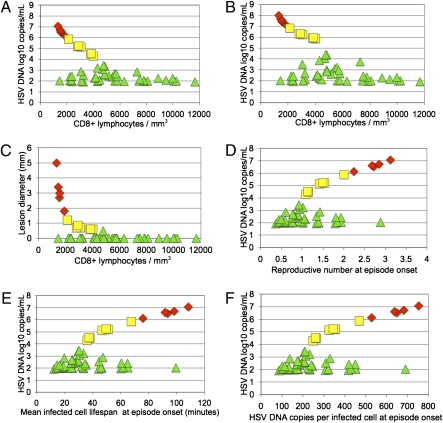
Fig. 1.
Fig. 1.
In a 365-d model simulation, CD8+ lymphocyte density (per mm3), infected cell lifespan, HSV copies produced per infected cell, and reproductive number at episode onset were determinants of shedding episode peak HSV DNA copy number and lesion diameter. Green triangles are low-copy (102 to 104 peak HSV DNA copies per milliliter), yellow squares are medium-copy (<104 to 106 peak HSV DNA copies per milliliter), and red diamonds are high-copy episodes (>106 peak HSV DNA copies per milliliter) (A) HSV-2 DNA peak copy number per episode (y axis) and CD8+ lymphocyte density at episode onset (x axis) for the 54 shedding episodes from the 365-d simulation outlined in Table 1. (B) HSV-2 DNA total copy number per episode (y axis) and CD8+ lymphocyte density at episode onset (x axis) for the 54 shedding episodes. Total HSV copy number exceeds peak HSV copy number in medium- and high-copy episodes by ≈1 log. (C) Peak lesion diameter (y axis) and CD8+ lymphocyte density (x axis) at episode onset for the 54 shedding episodes. (D) HSV-2 DNA peak copy number (y axis) and reproductive number at episode onset (x axis) for the 54 shedding episodes. (E) HSV-2 DNA peak copy number (y axis) and average infected cell lifespan at episode onset (x axis) for the 54 shedding episodes. F) HSV-2 DNA peak copy number (y axis) and mean HSV-2 production per infected cell at episode onset (x axis) for the 54 shedding episodes.
Fig. 2.
Fig. 2.
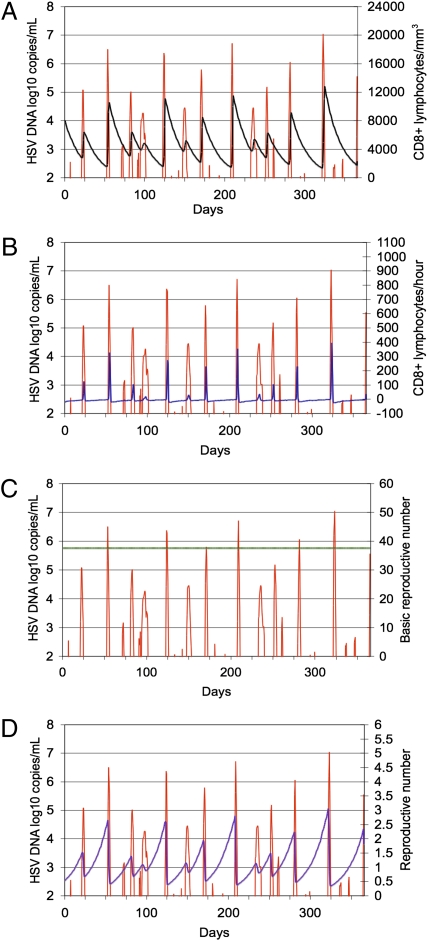
Stochastic model simulation (365 d) outlined in Table 1. (A) In this simulation, CD8+ lymphocyte replenishment randomly occurred 12 times during the course of a year. The simulation also illustrates the heterogeneity of genital HSV-2 episodes during the course of the year. Red line, log10 HSV-2 DNA/mL transport medium (left y axis). (A) Black line, CD8+ lymphocytes per mm3 (right y axis). (B) Blue line, CD8+ T-cell rate of change per hour (right y axis). Green line, basic reproductive number (R0, right y axis) (C); and violet line, reproductive number (R, right y axis) (D).

References

    1. Corey L, Adams HG, Brown ZA, Holmes KK. Genital herpes simplex virus infections: Clinical manifestations, course, and complications. Ann Intern Med. 1983;98:958–972. - PubMed
    1. Wald A, Zeh J, Selke S, Ashley RL, Corey L. Virologic characteristics of subclinical and symptomatic genital herpes infections. N Engl J Med. 1995;333:770–775. - PubMed
    1. Wald A, et al. Reactivation of genital herpes simplex virus type 2 infection in asymptomatic seropositive persons. N Engl J Med. 2000;342:844–850. - PubMed
    1. Mark KE, et al. Rapidly cleared episodes of herpes simplex virus reactivation in immunocompetent adults. J Infect Dis. 2008;198:1141–1149. - PMC - PubMed
    1. Cherpes TL, Busch JL, Sheridan BS, Harvey SA, Hendricks RL. Medroxyprogesterone acetate inhibits CD8+ T cell viral-specific effector function and induces herpes simplex virus type 1 reactivation. J Immunol. 2008;181:969–975. - PMC - PubMed

Publication types

MeSH terms