Diabetes control with reciprocal peer support versus nurse care management: a randomized trial
- PMID: 20956707
- PMCID: PMC4117390
- DOI: 10.7326/0003-4819-153-8-201010190-00007
Diabetes control with reciprocal peer support versus nurse care management: a randomized trial
Abstract
Background: Resource barriers complicate diabetes care management. Support from peers may help patients manage their diabetes.
Objective: To compare a reciprocal peer-support (RPS) program with nurse care management (NCM).
Design: Randomized, controlled trial. (ClinicalTrials.gov registration number: NCT00320112)
Setting: 2 U.S. Department of Veterans Affairs health care facilities.
Patients: 244 men with hemoglobin A(1c) (HbA(1c)) levels greater than 7.5% during the previous 6 months.
Measurements: The primary outcome was 6-month change in HbA(1c) level. Secondary outcomes were changes in insulin therapy; blood pressure; and patient reports of medication adherence, diabetes-related support, and emotional distress.
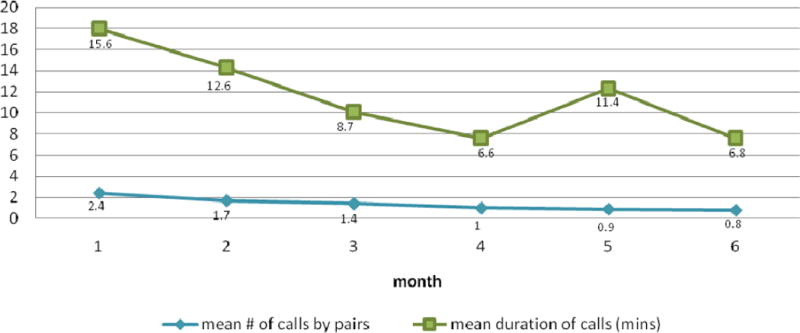
Intervention: Patients in the RPS group attended an initial group session to set diabetes-related behavioral goals, receive peer communication skills training, and be paired with another age-matched peer patient. Peers were encouraged to talk weekly using a telephone platform that recorded call occurrence and provided reminders to promote peer contact. These patients could also participate in optional group sessions at 1, 3, and 6 months. Patients in the NCM group attended a 1.5-hour educational session and were assigned to a nurse care manager.
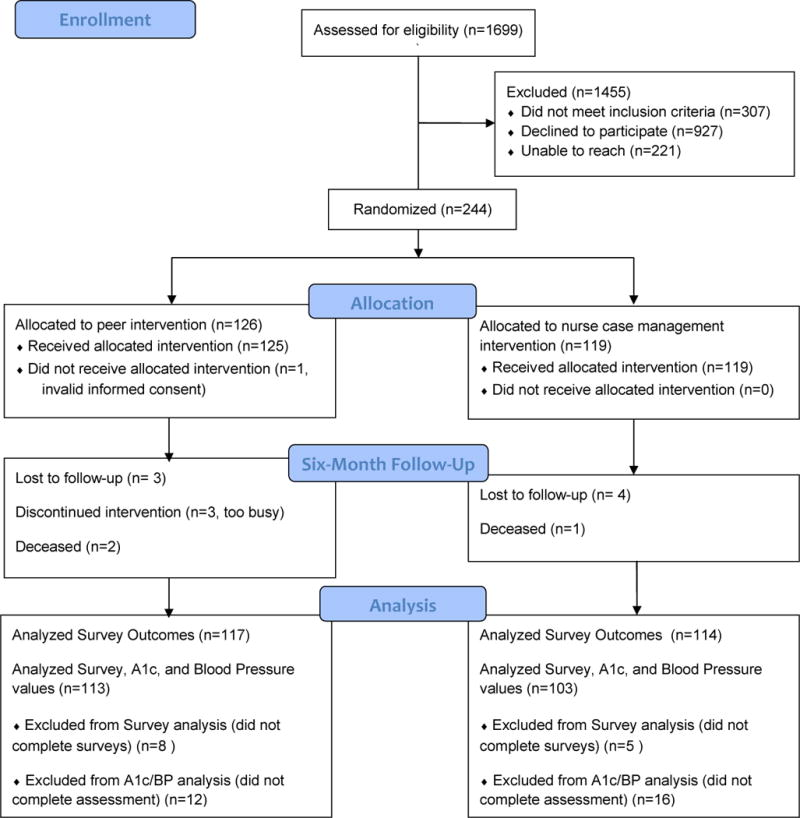
Results: Of the 244 patients enrolled, 216 (89%) completed the HbA(1c) assessments and 231 (95%) completed the survey assessments at 6 months. Mean HbA(1c) level decreased from 8.02% to 7.73% (change, -0.29%) in the RPS group and increased from 7.93% to 8.22% (change, 0.29%) in the NCM group. The difference in HbA(1c) change between groups was 0.58% (P = 0.004). Among patients with a baseline HbA(1c) level greater than 8.0%, those in the RPS group had a mean decrease of 0.88%, compared with a 0.07% decrease among those in the NCM group (between-group difference, 0.81%; P < 0.001). Eight patients in the RPS group started insulin therapy, compared with 1 patient in the NCM group (P = 0.020). Groups did not differ in blood pressure, self-reported medication adherence, or diabetes-specific distress, but the RPS group reported improvement in diabetes social support.
Limitation: The study included only male veterans and lasted only 6 months.
Conclusion: Reciprocal peer support holds promise as a method for diabetes care management.
Figures
Comment in
-
Summaries for patients. Can patients with diabetes help each other get better?Ann Intern Med. 2010 Oct 19;153(8):I-54. doi: 10.7326/0003-4819-153-8-201010190-00003. Ann Intern Med. 2010. PMID: 20956692 No abstract available.
-
The role of peer patients in chronic disease management.Ann Intern Med. 2010 Oct 19;153(8):544-5. doi: 10.7326/0003-4819-153-8-201010190-00014. Ann Intern Med. 2010. PMID: 20956712 No abstract available.
-
In individuals with poorly controlled diabetes, a reciprocal peer support programme gives greater 6-month improvement in HbA1c than does nurse care management.Evid Based Nurs. 2011 Apr;14(2):49-50. doi: 10.1136/ebn.14.2.49. Evid Based Nurs. 2011. PMID: 21421976 No abstract available.
References
-
- Norris SL, Nichols PJ, Caspersen CJ, et al. The effectiveness of disease and case management for people with diabetes. A systematic review. Amer J Prev Med. 2002;22(4 Suppl):15–38. - PubMed
-
- Shojania KG, Ranji SR, McDonald KM, et al. Effects of Quality Improvement Strategies for Type 2 Diabetes on Glycemic Control: A Meta-Regression Analysis. JAMA. 2006;296(4):427–440. - PubMed
-
- Stanford University, UCSF Evidence-based Practice Center. Evidence-based Practice Center Closing the Quality Gap: A Critical Analysis of Quality Improvement Strategies. Vol. Volume 2 – Diabetes Mellitus. AHRQ. 2004 http://www.ahrq.gov/downloads/pub/evidence/pdf/qualgap2/qualgap2.pdf. Accessed June 24, 2010.
-
- American College of Physicians. Patient-Centered Medical Home. Philadelphia, PA: 2010. http://www.acponline.org/running_practice/pcmh/. Accessed June 24, 2010.
Publication types
MeSH terms
Substances
Associated data
Grants and funding
LinkOut - more resources
Full Text Sources
Other Literature Sources
Medical
Miscellaneous