High incidence of hospital admissions with multidrug-resistant and extensively drug-resistant tuberculosis among South African health care workers
- PMID: 20956708
- PMCID: PMC3074259
- DOI: 10.7326/0003-4819-153-8-201010190-00008
High incidence of hospital admissions with multidrug-resistant and extensively drug-resistant tuberculosis among South African health care workers
Abstract
Background: Nosocomial transmission has been described in extensively drug-resistant tuberculosis (XDR-TB) and HIV co-infected patients in South Africa. However, little is known about the rates of drug-resistant tuberculosis among health care workers in countries with high tuberculosis and HIV burden.
Objective: To estimate rates of multidrug-resistant tuberculosis (MDR-TB) and XDR-TB hospitalizations among health care workers in KwaZulu-Natal, South Africa.
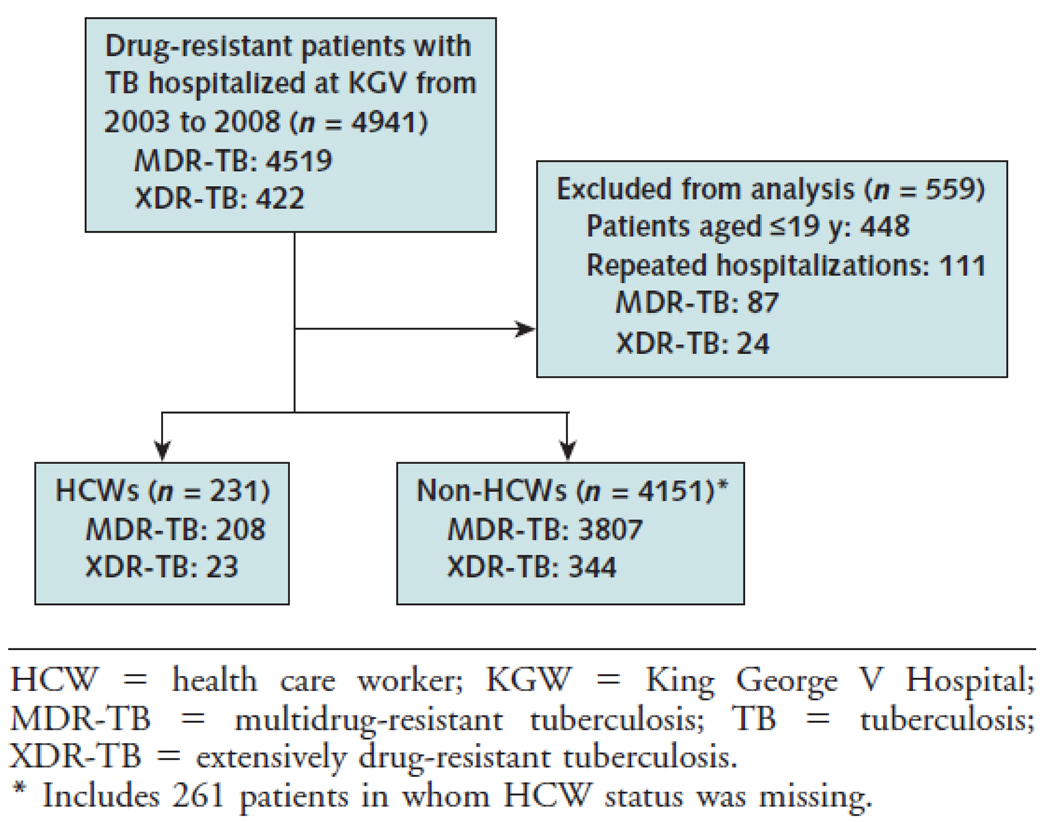
Design: Retrospective study of patients with drug-resistant tuberculosis who were admitted from 2003 to 2008 for the initiation of drug-resistant tuberculosis therapy.
Setting: A public tuberculosis referral hospital in KwaZulu-Natal, South Africa.
Participants: 231 health care workers and 4151 non-health care workers admitted for initiation of MDR-TB or XDR-TB treatment.
Measurements: Hospital admission rates and hospital admission incidence rate ratios.
Results: Estimated incidence of MDR-TB hospitalization was 64.8 per 100,000 health care workers versus 11.9 per 100,000 non-health care workers (incidence rate ratio, 5.46 [95% CI, 4.75 to 6.28]). Estimated incidence of XDR-TB hospitalizations was 7.2 per 100,000 health care workers versus 1.1 per 100,000 non-health care workers (incidence rate ratio, 6.69 [CI, 4.38 to 10.20]). A higher percentage of health care workers than non-health care workers with MDR-TB or XDR-TB were women (78% vs. 47%; P < 0.001), and health care workers were less likely to report previous tuberculosis treatment (41% vs. 92%; P < 0.001). HIV infection did not differ between health care workers and non-health care workers (55% vs. 57%); however, among HIV-infected patients, a higher percentage of health care workers were receiving antiretroviral medications (63% vs. 47%; P < 0.001).
Limitation: The study had an observational retrospective design, is subject to referral bias, and had no information on type of health care work or duration of occupational exposure to tuberculosis.
Conclusion: Health care workers in this HIV-endemic area were substantially more likely to be hospitalized with either MDR-TB or XDR-TB than were non-health care workers. The increased risk may be explained by occupational exposure, underlining the urgent need for tuberculosis infection-control programs.
Summary for patients in
-
Summaries for patients. Incidence of hospital admissions with multidrug-resistant and extensively drug-resistant tuberculosis among South African health care workers.Ann Intern Med. 2010 Oct 19;153(8):I-62. doi: 10.7326/0003-4819-153-8-201010190-00004. Ann Intern Med. 2010. PMID: 20956693 No abstract available.
References
-
- WHO. Global tuberculosis control - surveillance, planning, financing. Geneva Switzerland: World Health Organization; 2008.
-
- Menzies D, Joshi R, Pai M. Risk of tuberculosis infection and disease associated with work in health care settings. Int J Tuberc Lung Dis. 2007;11(6):593–605. - PubMed
-
- Naidoo S, Jinabhai CC. TB in health care workers in KwaZulu-Natal, South Africa. Int J Tuberc Lung Dis. 2006;10(6):676–682. - PubMed
-
- Pearson ML, Jereb JA, Frieden TR, Crawford JT, Davis BJ, Dooley SW, Jarvis WR. Nosocomial transmission of multidrug-resistant Mycobacterium tuberculosis. A risk to patients and health care workers. Ann Intern Med. 1992;117(3):191–196. - PubMed
Publication types
MeSH terms
Grants and funding
LinkOut - more resources
Full Text Sources