


Premorbid cognitive leisure independently contributes to cognitive reserve in multiple sclerosis
- PMID: 20956787
- PMCID: PMC3039206
- DOI: 10.1212/WNL.0b013e3181f881a6
Premorbid cognitive leisure independently contributes to cognitive reserve in multiple sclerosis
Abstract
Objective: Consistent with the cognitive reserve hypothesis, higher education and vocabulary help persons with Alzheimer disease (AD) and multiple sclerosis (MS) better withstand neuropathology before developing cognitive impairment. Also, premorbid cognitive leisure (e.g., reading, hobbies) is an independent source of cognitive reserve for elders with AD, but there is no research on the contribution of leisure activity to cognition in MS. We investigated whether premorbid cognitive leisure protects patients with MS from cognitive impairment.
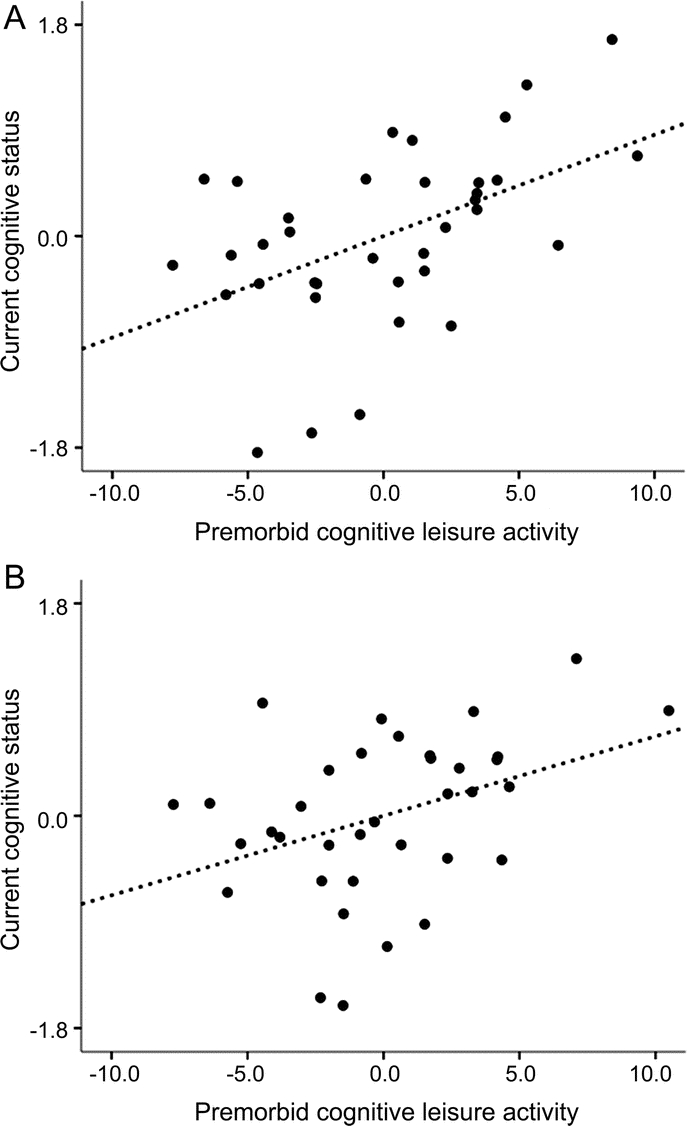
Methods: Premorbid cognitive leisure was surveyed in 36 patients with MS. Neurologic disease severity was estimated with brain atrophy, measured as third ventricle width on high-resolution MRI. Cognitive status was measured with a composite score of processing speed and memory.
Results: Controlling for brain atrophy, premorbid cognitive leisure was positively associated with current cognitive status (r(p) = 0.49, p < 0.01), even when controlling for vocabulary (r(p) = 0.39, p < 0.05) and education (r(p) = 0.47, p < 0.01). Also, premorbid cognitive leisure was unrelated to brain atrophy (r = 0.03, p > 0.5), but a positive partial correlation between leisure and atrophy emerged when controlling for cognitive status (r(p) = 0.37, p < 0.05), which remained when also controlling for vocabulary (r(p) = 0.34, p < 0.05) and education (r(p) = 0.35, p < 0.05).
Conclusions: Premorbid cognitive leisure contributes to cognitive status in patients with MS independently of vocabulary and education. Also, patients with MS who engaged in more cognitive leisure were able to withstand more severe brain atrophy at a given cognitive status. Premorbid cognitive leisure is supported as an independent source of cognitive reserve in patients with MS.
Figures
References
-
- Stern Y. What is cognitive reserve? Theory and research application of the reserve concept. J Int Neuropsychol Soc 2002;8:448–460. - PubMed
-
- Sumowski JF, Chiaravalloti N, Wylie GR, DeLuca J. Cognitive reserve moderates the negative effect of brain atrophy on cognitive efficiency in multiple sclerosis. J Int Neuropsychol Soc 2009;15:606–612. - PubMed
Publication types
MeSH terms
Grants and funding
LinkOut - more resources
Full Text Sources
Medical
