


Review
doi: 10.1093/jncimonographs/lgq038.
Communication between patients and providers and informed decision making
Affiliations
- PMID: 20956831
- PMCID: PMC3140849
- DOI: 10.1093/jncimonographs/lgq038
Item in Clipboard
Review
Communication between patients and providers and informed decision making
J Natl Cancer Inst Monogr.
2010.
Abstract
Women with ductal carcinoma in situ (DCIS) need to comprehend the meaning of the diagnosis and the potential benefits and harms of treatment options. Full and understandable information is a requirement, not an option. However, with DCIS, as with many areas of medicine, a high level of uncertainty about the disease remains. In this article, we define informed medical decision making, review challenges to its implementation, and provide suggestions on how to improve communication with women about the diagnosis and treatment of DCIS.
Figures
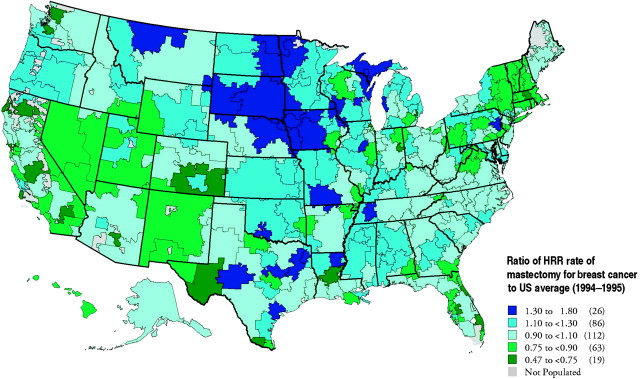
(1994–1995). Data shown are the ratio of hospital referral region (HRR) rates of mastectomy for breast cancer to the US average (This figure reproduced with permission from Kristen Bronner, Dartmouth Atlas Project).
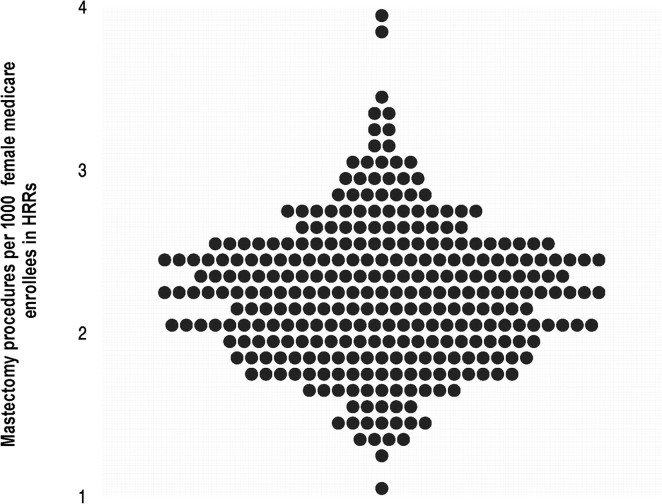
Mastectomy among hospital referral regions (HRRs) (1994–1995). The rates varied from 1.1 to 4.0 per thousand female Medicare enrollees, after adjustment. Each point represents one of the 306 HRRs in the United States (This figure reproduced with permission from Kristen Bronner, Dartmouth Atlas Project).
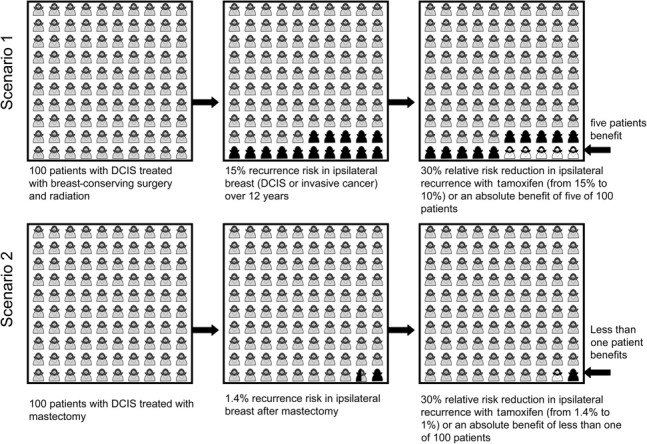
Two clinical scenarios, both with a 30% relative risk reduction in ipsilateral breast tumor recurrence using tamoxifen after surgical treatment for DCIS, but with two different reductions in absolute risk because of differences in baseline recurrence risks. Scenario 1 has a 15% risk of recurrence after breast-conserving surgery with radiation, with five of 100 women benefiting from tamoxifen treatment. Scenario 2 has a 1.4% risk of recurrence after mastectomy, with less than one in 100 women treated with mastectomy benefiting from tamoxifen treatment. This figure represents recurrence risk. These scenarios do not take into account the effects of tamoxifen on contralateral breast cancer risk.
References
-
- Rimer BK, Briss PA, Zeller PK, Chan EC, Woolf SH. Informed decision making: what is its role in cancer screening? Cancer. 2004;101(5 suppl):1214–1228. - PubMed
-
- O’Connor AM, Bennett CL, Stacey D, et al. Decision aids for people facing health treatment or screening decisions. Cochrane Database Syst Rev. 2009 8(3):CD001431. - PubMed
-
- The Foundation for Informed Medical Decision Making (FIMDM). Problems With Medical Decision Making—Ethical Concerns. 2010 http://www.informedmedicaldecisions.org/problems_with_medical_decision_m.... Accessed January 6, 2010.
-
- Allegra CJ, Aberle DR, Ganschow P, et al. NIH state-of-the-science conference statement: diagnosis and management of ductal carcinoma in situ (DCIS) NIH Consens State Sci Statements. 2009;26(2):1–27. - PubMed
-
- Black WC, Nease RF, Jr, Tosteson AN. Perceptions of breast cancer risk and screening effectiveness in women younger than 50 years of age. J Natl Cancer Inst. 1995;87(10):720–731. - PubMed
Publication types
MeSH terms
Grants and funding
LinkOut - more resources
Full Text Sources
Medical
