


Identification of restricted subsets of mature microRNA abnormally expressed in inactive colonic mucosa of patients with inflammatory bowel disease
- PMID: 20957151
- PMCID: PMC2950152
- DOI: 10.1371/journal.pone.0013160
Identification of restricted subsets of mature microRNA abnormally expressed in inactive colonic mucosa of patients with inflammatory bowel disease
Abstract
Background: Ulcerative Colitis (UC) and Crohn's Disease (CD) are two chronic Inflammatory Bowel Diseases (IBD) affecting the intestinal mucosa. Current understanding of IBD pathogenesis points out the interplay of genetic events and environmental cues in the dysregulated immune response. We hypothesized that dysregulated microRNA (miRNA) expression may contribute to IBD pathogenesis. miRNAs are small, non-coding RNAs which prevent protein synthesis through translational suppression or mRNAs degradation, and regulate several physiological processes.
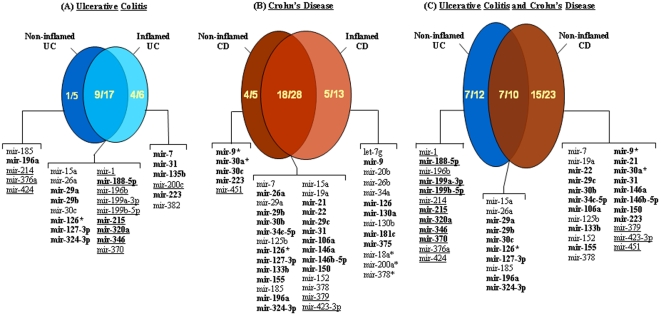
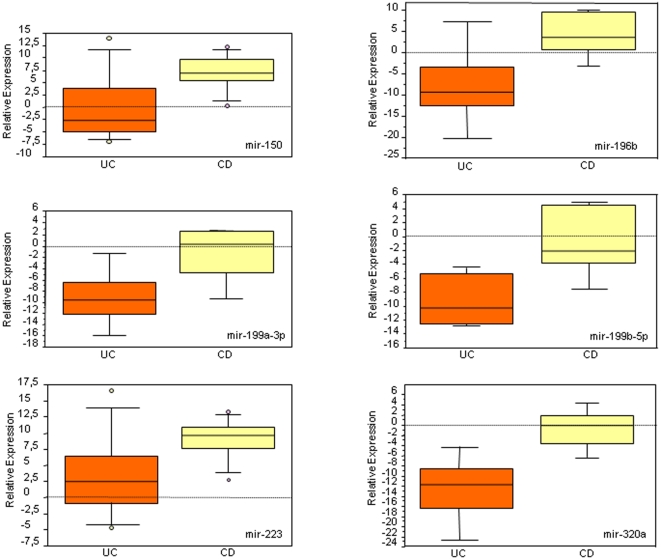
Methodology/findings: Expression of mature miRNAs was studied by Q-PCR in inactive colonic mucosa of patients with UC (8), CD (8) and expressed relative to that observed in healthy controls (10). Only miRNAs with highly altered expression (>5 or <0.2 -fold relative to control) were considered when Q-PCR data were analyzed. Two subsets of 14 (UC) and 23 (CD) miRNAs with highly altered expression (5.2->100 -fold and 0.05-0.19 -fold for over- and under- expression, respectively; 0.001<p≤0.05) were identified in quiescent colonic mucosa, 8 being commonly dysregulated in non-inflamed UC and CD (mir-26a,-29a,-29b,-30c,-126*,-127-3p,-196a,-324-3p). Several miRNA genes with dysregulated expression co-localize with acknowledged IBD-susceptibility loci while others, (eg. clustered on 14q32.31), map on chromosomal regions not previously recognized as IBD-susceptibility loci. In addition, in silico clustering analysis identified 5 miRNAs (mir-26a,-29b,-126*,-127-3p,-324-3p) that share coordinated dysregulation of expression both in quiescent and in inflamed colonic mucosa of IBD patients. Six miRNAs displayed significantly distinct alteration of expression in non-inflamed colonic biopsies of UC and CD patients (mir-196b,-199a-3p,-199b-5p,-320a,-150,-223).
Conclusions/significance: Our study supports miRNAs as crucial players in the onset and/or relapse of inflammation from quiescent mucosal tissues in IBD patients. It allows speculating a role for miRNAs as contributors to IBD susceptibility and suggests that some of the miRNA with altered expression in the quiescent mucosa of IBD patients may define miRNA signatures for UC and CD and help develop new diagnostic biomarkers.
Conflict of interest statement
Figures
References
-
- Schreiber S, Rosenstiel P, Albrecht M, Hampe J, Krawczak M. Genetics of Crohn disease, an archetypal inflammatory barrier disease. Nat Rev Genet. 2005;6:376–88. - PubMed
-
- Kugathasan S, Amre D. Inflammatory bowel disease–environmental modification and genetic determinants. Pediatr Clin North Am. 2006;53:727–49. - PubMed
-
- Bouma G, Strober W. The immunological and genetic basis of inflammatory bowel disease. Nat Rev Immunol. 2003;3:521–33. - PubMed
-
- Farmer RG, Easley KA, Rankin GB. Clinical patterns, natural history, and progression of ulcerative colitis. A long-term follow-up of 1116 patients. Dig Dis Sci. 1993;38:1137–46. - PubMed
Publication types
MeSH terms
Substances
LinkOut - more resources
Full Text Sources
Other Literature Sources
