


Review
doi: 10.1038/nrn2920.
Emotion processing and the amygdala: from a 'low road' to 'many roads' of evaluating biological significance
Affiliations
- PMID: 20959860
- PMCID: PMC3025529
- DOI: 10.1038/nrn2920
Item in Clipboard
Review
Emotion processing and the amygdala: from a 'low road' to 'many roads' of evaluating biological significance
Nat Rev Neurosci.
2010 Nov.
Abstract
A subcortical pathway through the superior colliculus and pulvinar to the amygdala is commonly assumed to mediate the non-conscious processing of affective visual stimuli. We review anatomical and physiological data that argue against the notion that such a pathway plays a prominent part in processing affective visual stimuli in humans. Instead, we propose that the primary role of the amygdala in visual processing, like that of the pulvinar, is to coordinate the function of cortical networks during evaluation of the biological significance of affective visual stimuli. Under this revised framework, the cortex has a more important role in emotion processing than is traditionally assumed.
Figures
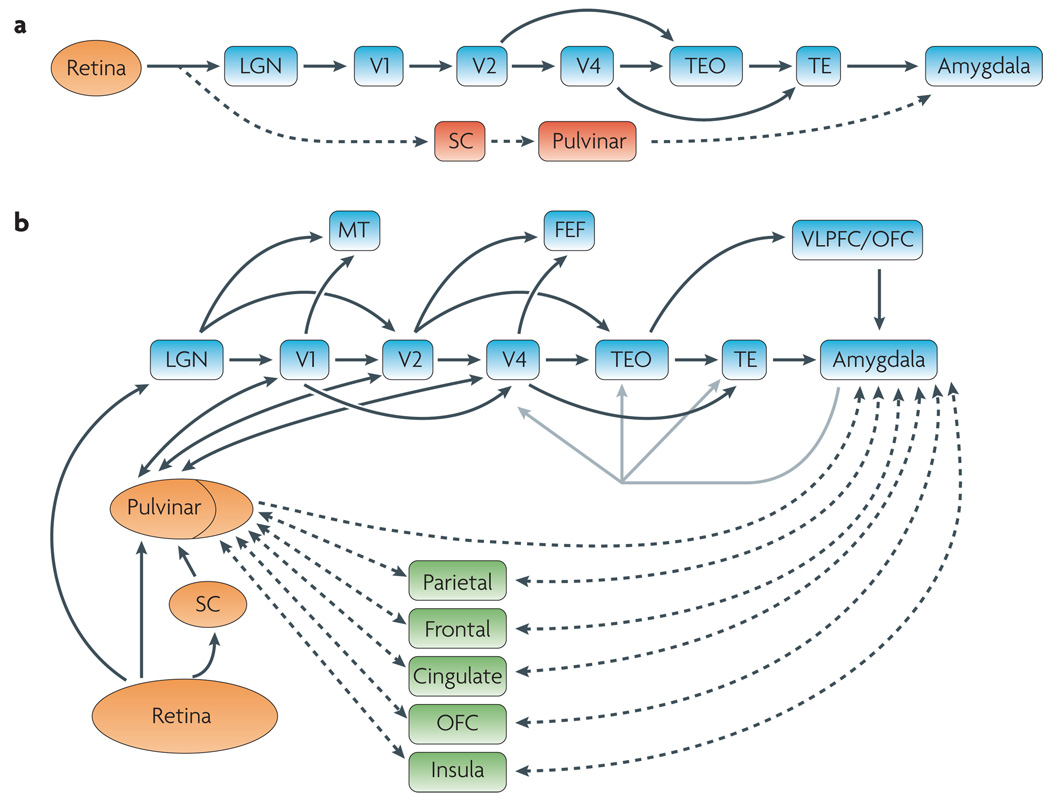
a | A traditional flowchart of visual processing typically emphasizes the LGN–V1–V2–V4–TEO–TE pathway, although the scheme is not strictly hierarchical. The amygdala, in particular, is a recipient of visual signals from the anterior visual cortex. According to the ‘standard hypothesis’, a subcortical pathway involving the superior colliculus and the pulvinar nucleus of the thalamus provides fast and automatic access to the amygdala. b | An alternative view of the flow of visual signals includes multiple pathways, including both alternative routes (for example, LGN to MT) and shortcuts (for example, V2 to TEO). Only some of these are shown. The flow of visual information may be more appropriately viewed in terms of ‘multiple waves’ of activation that initiate and refine cell responses at a given processing ‘stage’. For simplicity, feedback pathways, which are known to be quite extensive, have been omitted. The existence of such feedback pathways dictates, however, that a complex ebb-and-flow of activation sculpts the neuronal profile of activation throughout the visual cortex, and likewise the amygdala responses. Some of the connections between the pulvinar and visual cortex, and between the pulvinar and ‘associational’ areas, are also indicated. The line in the pulvinar is intended to schematically separate the medial pulvinar (to the right of the line) from the rest of the structure. FEF, frontal eye field; LGN, lateral geniculate nucleus; MT, medial temporal area (also known as V5); OFC, orbitofrontal cortex; SC, superior colliculus; TE, inferior temporal area TE; TEO, inferior temporal area TEO; V, visual cortex; VLPFC, ventrolateral prefrontal cortex.
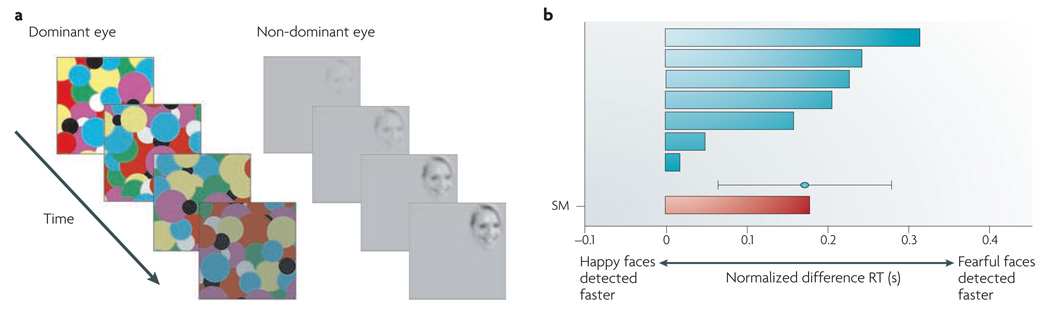
In a subject with complete amygdala lesions (subject S.M.), fearful faces broke into consciousness during continuous flash suppression with latencies similar to those of control subjects. a | Experimental stimulus: fearful or happy faces were shown to the non-dominant eye while a flashing Mondrian pattern was shown to the dominant eye. This technique is called continuous flash suppression as it suppresses the visibility of the stimulus presented to the non-dominant eye. The contrast of the Mondrian pattern was gradually decreased while that of the face was increased until subjects could detect the face and indicate it with a button press to establish reaction time. b | Plots of reaction times (RT) in the task. In the case of S.M., fearful faces broke interocular suppression faster than happy faces (shown by the red bar) and to the same degree as 7 demographically matched healthy controls (shown by blue bars; the mean and standard deviation are also shown). Figure is reproduced, with permission, from REF. © (2009) Macmillan Publishers Ltd. All rights reserved.
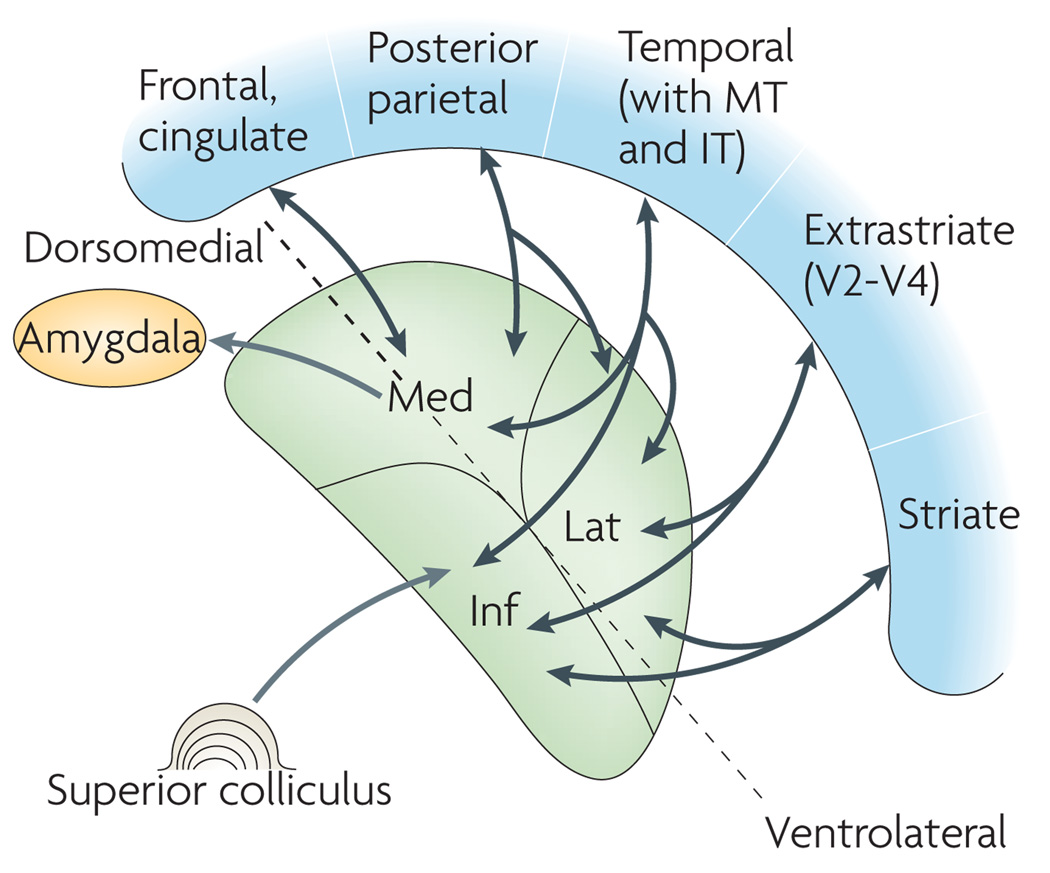
Some traditional characterizations of the pulvinar emphasize the inferior (Inf), lateral (Lat) and medial (Med) nuclei. Most pulvinar nuclei (including other nuclei and sub-nuclei that are not shown here) are involved in thalamo–cortical loops that target different cortical territories (shown in blue),. The inferior nucleus is reciprocally connected to striate and extrastriate cortices, the lateral nucleus is connected to association cortices in temporal and parietal lobes (although it is also interconnected with the extrastriate cortex) and the medial nucleus is connected to the higher-order association cortex in parietal, frontal, orbital (not shown), cingulate and insular regions (the insula is not shown), in addition to the amygdala. Thus, the medial nucleus, which is of great interest in the present context, is not only connected with the amygdala but is also part of multiple thalamo–cortical loops (note, however, that the connection to the amygdala does not seem to be bidirectional). The superior colliculus is a layered structure whose superficial layers are visual in nature and project to the inferior nucleus. Its intermediate and deeper layers are multimodal and involved in motor preparation, including for eye movements, and project to the medial nucleus. A ventrolateral to dorsomedial axis that is helpful in understanding the organization of pulvinar nuclei and potential ‘ventral’ and ‘dorsal’ domains is shown by a dotted line (see also REF. for a related scheme). Figure is modified, with permission, from REF. © (2004) CRC Press. IT, inferior temporal cortex; MT, medial temporal area (also known as V5).
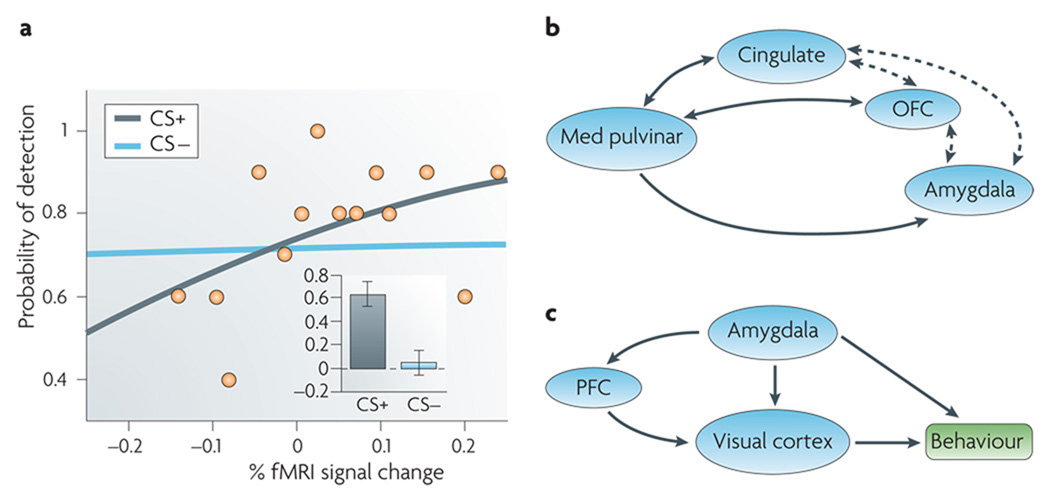
a | Logistic regression analysis of evoked responses in the left pulvinar as a function of affective significance for a sample individual during an attentional blink task. The slope of the logistic fit indicates the strength of the predictive effect. For clarity, only binned data for the conditioned stimulus (CS+) condition are included (shown by orange dots). The grey line shows the fit for these data, and the blue line shows the fit for data from the neutral stimulus (CS−) condition. The inset shows mean logistic slopes across individuals, revealing that a relationship was detected for the affective (CS+) but not the neutral (CS−) condition. b | The medial pulvinar is proposed to amplify evoked responses of behaviourally-relevant stimuli via circuits involving the cingulate cortex, orbitofrontal cortex (OFC) and amygdala, all regions important for the valuation of an incoming stimulus. c | Valuation signals in the amygdala affect behaviour by impacting responses across the brain. During an attentional blink task using affective stimuli, a response in the amygdala to a stimulus predicted that the stimulus would be detected. Statistical path analysis revealed that this effect is mediated through projections from the amygdala to the visual cortex, as well as through projections involving the prefrontal cortex (PFC). fMRI, functional MRI. Data in part a from REF. .
Comment in
-
Emotion in the brain: of low roads, high roads and roads less travelled.Nat Rev Neurosci. 2011 Jun 15;12(7):425; author reply 425. doi: 10.1038/nrn2920-c1. Nat Rev Neurosci. 2011. PMID: 21673722 No abstract available.
References
-
- Tamietto M, de Gelder B. Neural bases of the non-conscious perception of emotional signals. Nature Rev. Neurosci. 2010;11:697–709. - PubMed
-
- Ohman A, Mineka S. Fears, phobias, and preparedness: toward an evolved module of fear and fear learning. Psychol. Rev. 2001;108:483–522. - PubMed
-
- Lonsdorf TB, et al. Genetic gating of human fear learning and extinction: possible implications for gene-environment interaction in anxiety disorder. Psychol. Sci. 2009;20:198–206. - PubMed
-
- LeDoux JE. The Emotional Brain. New York: Simon & Schuster; 1996.
-
- Dolan RJ, Vuilleumier P. Amygdala automaticity in emotional processing. Ann. NY Acad. Sci. 2003;985:348–355. - PubMed
Publication types
MeSH terms
Grants and funding
LinkOut - more resources
Full Text Sources
Other Literature Sources
Medical
