


Prediction of significant prostate cancer diagnosed 20 to 30 years later with a single measure of prostate-specific antigen at or before age 50
- PMID: 20960520
- PMCID: PMC3412541
- DOI: 10.1002/cncr.25568
Prediction of significant prostate cancer diagnosed 20 to 30 years later with a single measure of prostate-specific antigen at or before age 50
Abstract
Background: We previously reported that a single prostate-specific antigen (PSA) measured at ages 44-50 was highly predictive of subsequent prostate cancer diagnosis in an unscreened population. Here we report an additional 7 years of follow-up. This provides replication using an independent data set and allows estimates of the association between early PSA and subsequent advanced cancer (clinical stage ≥T3 or metastases at diagnosis).
Methods: Blood was collected from 21,277 men in a Swedish city (74% participation rate) during 1974-1986 at ages 33-50. Through 2006, prostate cancer was diagnosed in 1408 participants; we measured PSA in archived plasma for 1312 of these cases (93%) and for 3728 controls.
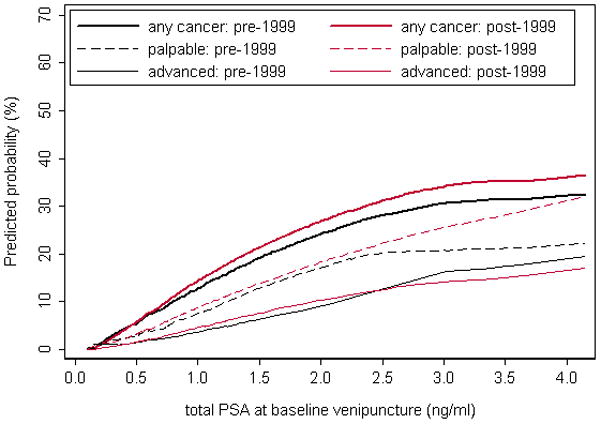
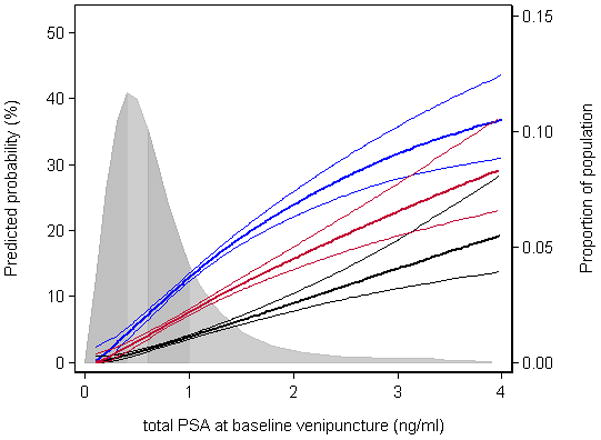
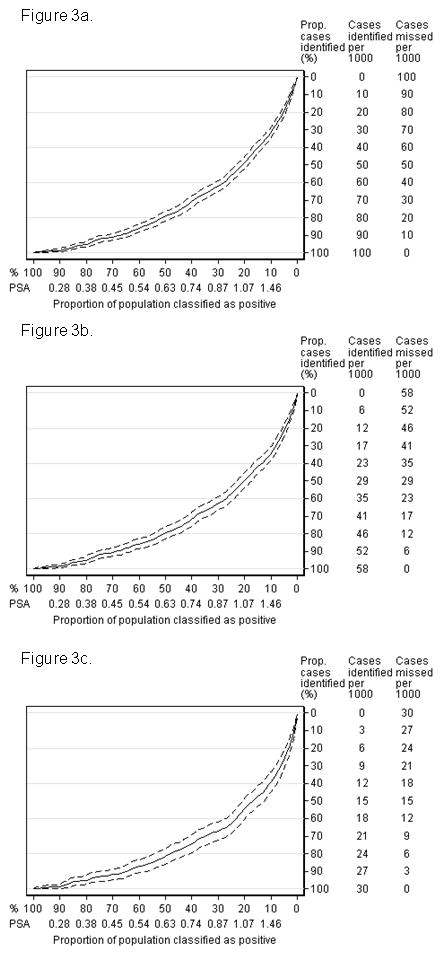
Results: At a median follow-up of 23 years, baseline PSA was strongly associated with subsequent prostate cancer (area under the curve, 0.72; 95% CI, 0.70-0.74; for advanced cancer, 0.75; 95% CI, 0.72-0.78). Associations between PSA and prostate cancer were virtually identical for the initial and replication data sets, with 81% of advanced cases (95% CI, 77%-86%) found in men with PSA above the median (0.63 ng/mL at ages 44-50).
Conclusions: A single PSA at or before age 50 predicts advanced prostate cancer diagnosed up to 30 years later. Use of early PSA to stratify risk would allow a large group of low-risk men to be screened less often but increase frequency of testing on a more limited number of high-risk men. This is likely to improve the ratio of benefit to harm for screening.
Copyright © 2010 American Cancer Society.
Conflict of interest statement
Dr. Hans Lilja holds patents for free PSA and hK2 Assays.
Figures
Comment in
-
Editorial for "Prediction of significant prostate cancer diagnosed 20 to 30 years later with a single measure of prostate-specific antigen at or before age 50".Cancer. 2011 Mar 15;117(6):1110-2. doi: 10.1002/cncr.25559. Epub 2010 Oct 19. Cancer. 2011. PMID: 20960524 No abstract available.
References
-
- Schroder FH, Hugosson J, Roobol MJ, et al. Screening and prostate-cancer mortality in a randomized European study. N Engl J Med. 2009;360:1320–8. - PubMed
-
- Draisma G, Boer R, Otto SJ, et al. Lead times and overdetection due to prostate-specific antigen screening: estimates from the European Randomized Study of Screening for Prostate Cancer. J Natl Cancer Inst. 2003;95:868–78. - PubMed
-
- Antenor JA, Han M, Roehl KA, Nadler RB, Catalona WJ. Relationship between initial prostate specific antigen level and subsequent prostate cancer detection in a longitudinal screening study. J Urol. 2004;172:90–3. - PubMed
-
- Fang J, Metter EJ, Landis P, Chan DW, Morrell CH, Carter HB. Low levels of prostate-specific antigen predict long-term risk of prostate cancer: results from the Baltimore Longitudinal Study of Aging. Urology. 2001;58:411–6. - PubMed
Publication types
MeSH terms
Substances
Grants and funding
LinkOut - more resources
Full Text Sources
Other Literature Sources
Medical
Research Materials
Miscellaneous
