. 2010 Oct 20:10:52.
doi: 10.1186/1471-2466-10-52.

Domiciliary pulse-oximetry at exacerbation of chronic obstructive pulmonary disease: prospective pilot study

Affiliations

Domiciliary pulse-oximetry at exacerbation of chronic obstructive pulmonary disease: prospective pilot study

John R Hurst et al. BMC Pulm Med. .

Abstract

Background: The ability to objectively differentiate exacerbations of chronic obstructive pulmonary disease (COPD) from day-to-day symptom variations would be an important development in clinical practice and research. We assessed the ability of domiciliary pulse oximetry to achieve this.

Methods: 40 patients with moderate-severe COPD collected daily data on changes in symptoms, heart-rate (HR), oxygen saturation (SpO2) and peak-expiratory flow (PEF) over a total of 2705 days. 31 patients had data suitable for baseline analysis, and 13 patients experienced an exacerbation. Data were expressed as multiples of the standard deviation (SD) observed from each patient when stable.

Results: In stable COPD, the SD for HR, SpO2 and PEF were approximately 5 min(-1), 1% and 10l min(-1). There were detectable changes in all three variables just prior to exacerbation onset, greatest 2-3 days following symptom onset. A composite Oximetry Score (mean magnitude of SpO2 fall and HR rise) distinguished exacerbation onset from symptom variation (area under receiver-operating characteristic curve, AUC = 0.832, 95%CI 0.735-0.929, p = 0.003). In the presence of symptoms, a change in Score of ≥1 (average of ≥1SD change in both HR and SpO2) was 71% sensitive and 74% specific for exacerbation onset.

Conclusion: We have defined normal variation of pulse oximetry variables in a small sample of patients with COPD. A composite HR and SpO2 score distinguished exacerbation onset from symptom variation, potentially facilitating prompt therapy and providing validation of such events in clinical trials.


Figures
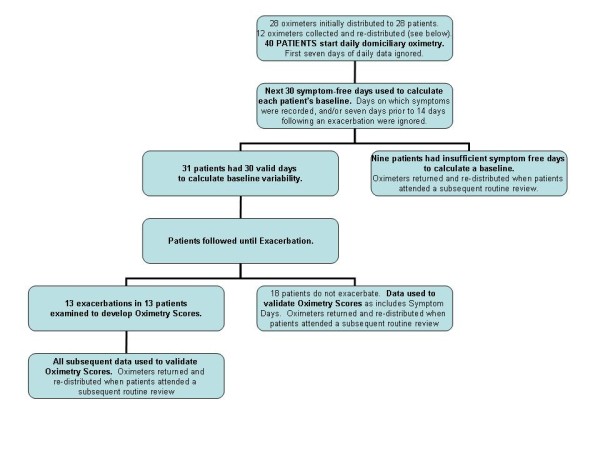
Figure 1
Figure 1
Study Profile. Study profile summarising distribution of oximeters and data collection. No data were used in more than one analysis.
Figure 2
Figure 2
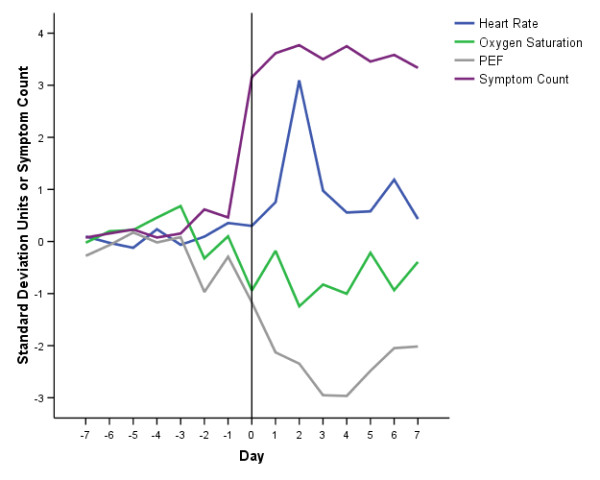
Time Course of Symptoms and Oximetry Variables at Exacerbation. Time course of symptom count, heart rate, oxygen saturation (SpO2) and peak-expiratory flow (PEF) from seven days prior (-7) to exacerbation onset (day 0, vertical line) and seven days into exacerbation of COPD. Values of the physiological variables are the mean of 13 exacerbations in 13 patients, expressed as standard deviation multiples away from each patient's stable mean (see text for details). A 1SD change is an approximate alteration in heart rate of 5 min-1, SpO2 of 1% and PEF of 10l min-1. Symptom count values are the mean from the 13 patients.
Figure 3
Figure 3
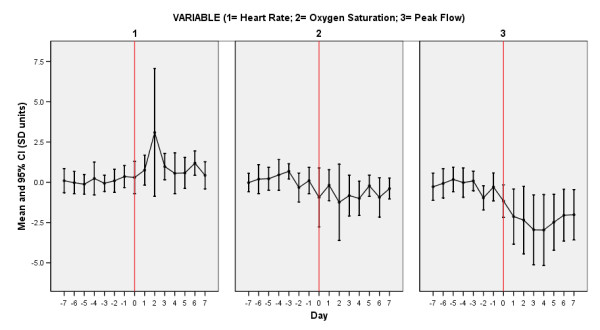
Time Course of Symptoms and Oximetry Variables At Exacerbation. Time course of heart rate, oxygen saturation (SpO2) and peak-expiratory flow (PEF) from seven days prior (-7) to exacerbation onset (day 0, vertical line) and seven days into exacerbation of COPD. Data expressed as mean and 95%CI (in SD units) for each variable separately.
Figure 4
Figure 4
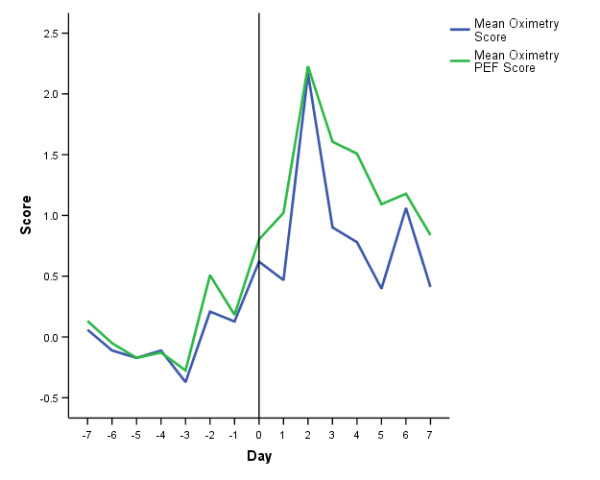
Time Course of Oximetry and Oximetry-PEF Scores At Exacerbation. Time course of Oximetry and Oximetry-PEF scores from seven days prior (-7) to exacerbation onset (day 0, vertical line) and seven days into exacerbation of COPD. Values are the mean score of 13 exacerbations in 13 patients (see text for details).
Figure 5
Figure 5
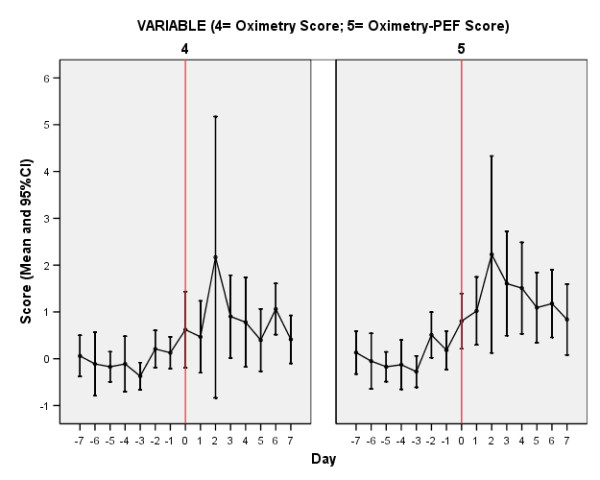
Time Course of Oximetry and Oximetry-PEF Scores At Exacerbation. Time course of Oximetry and Oximetry-PEF scores from seven days prior (-7) to exacerbation onset (day 0, vertical line) and seven days into exacerbation of COPD. Data represent the mean and 95%CI for each score separately.
Figure 6
Figure 6
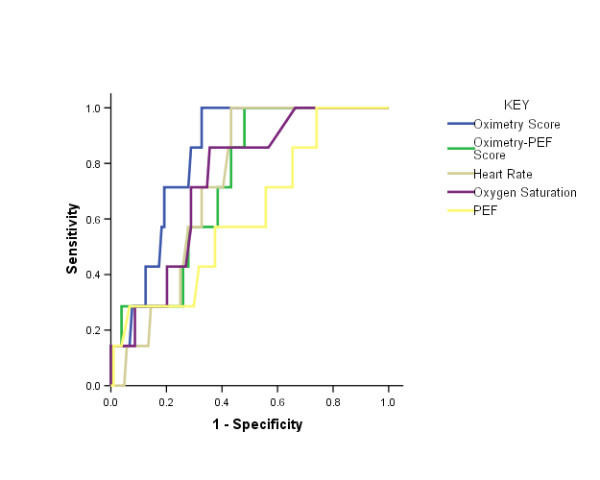
ROC Curves. ROC curves for the ability of the individual components, and Oximetry and Oximetry-PEF scores to differentiate exacerbation onset from day-to-day symptom variation (symptom days) in COPD. The data are reported in Table 4.

References

    1. Global Initiative for Chronic Obstructive Lung Disease. Global Strategy for the Diagnosis, Management and Prevention of Chronic Obstructive Lung Disease Updated. http://www.goldcopd.org/Guidelineitem.asp?l1=2&l2=1&intId=2180 December 2009. Available at: last accessed 10th February 2010. - PubMed
    1. Wilkinson TMA, Donaldson GC, Hurst JR, Seemungal TAR, Wedzicha JA. Early Therapy Improves Outcomes of Exacerbations of Chronic Obstructive Pulmonary Disease. Am J Respir Crit Care Med. 2004;169:1298–1303. doi: 10.1164/rccm.200310-1443OC. - DOI - PubMed
    1. Jones P, Higenbottam T. Quantifying of severity of exacerbations in chronic obstructive pulmonary disease: adaptations to the definition to allow quantification. Proc Am Thorac Soc. 2007;4:597–601. doi: 10.1513/pats.200707-115TH. - DOI - PubMed
    1. Hurst JR, Perera WR, Wilkinson TMA, Donaldson GC, Wedzicha JA. Systemic and Upper and Lower Airway Inflammation at Exacerbation of Chronic Obstructive Pulmonary Disease. Am J Respir Crit Care Med. 2006;173:71–78. doi: 10.1164/rccm.200505-704OC. - DOI - PubMed
    1. Hurst JR, Donaldson GC, Perera WR, Wilkinson TMA, Bilello JA, Hagan GW, Vessey RS, Wedzicha JA. Use of Plasma Biomarkers at Exacerbation of Chronic Obstructive Pulmonary Disease. Am J Respir Crit Care Med. 2006;174:867–874. doi: 10.1164/rccm.200604-506OC. - DOI - PubMed

Publication types