


Activation of p53 enhances apoptosis and insulin resistance in a rat model of alcoholic liver disease
- PMID: 20961644
- PMCID: PMC2994971
- DOI: 10.1016/j.jhep.2010.08.007
Activation of p53 enhances apoptosis and insulin resistance in a rat model of alcoholic liver disease
Abstract
Background & aims: Chronic ethanol consumption in the Long-Evans (LE) rat has been associated with hepatic p53 activation, and inhibition of the insulin/PI3K/AKT signal transduction cascade due to increased expression of PTEN. We hypothesize that p53 activation and altered insulin signaling may influence the susceptibility of rats to ethanol-induced liver damage. Furthermore, p53 not only activates programmed cell death pathways and suppresses hepatocellular survival signals, but also promotes gluconeogenesis to increase systemic insulin resistance due to a novel metabolic function.
Methods: Fischer (F), Sprague-Dawley (SD) and LE rats were fed ethanol-containing or control liquid diet for 8 weeks. Histopathological and biochemical changes were assessed.
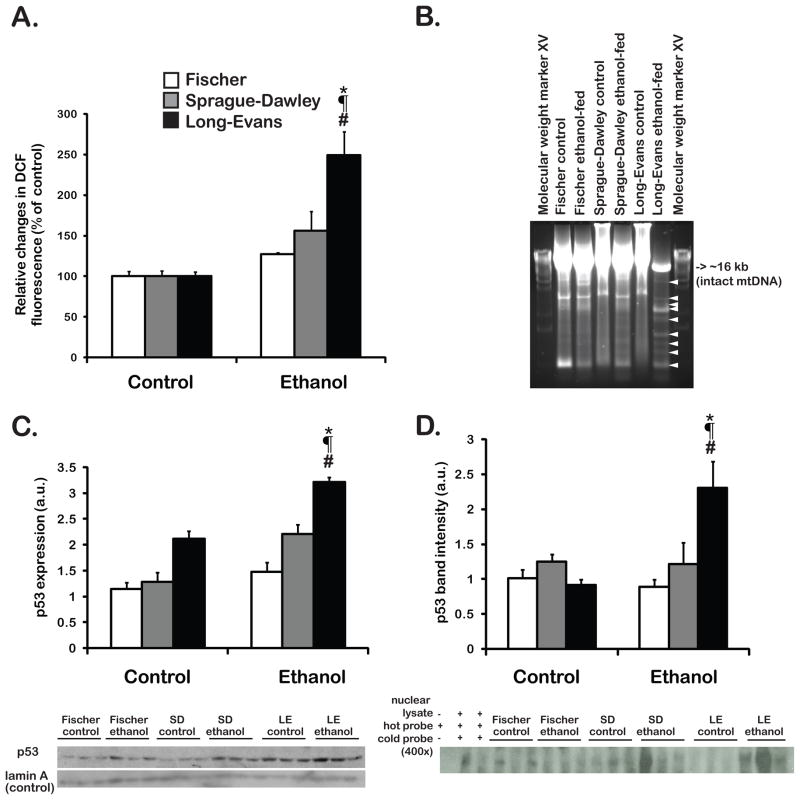
Results: Here, we demonstrate that chronic ethanol feeding in rats promotes p53 activation, hepatic steatosis, oxidative stress, PUMA, and PTEN expression, which contribute to hepatocellular death and diminished insulin signaling in the liver. Such changes are pronounced in the LE, less prominent in SD, and virtually absent in the F rat strain. More importantly, there is activation of Tp53-induced glycolysis and apoptosis regulator (TIGAR) in the ethanol-fed LE rat. This event generates low hepatic fructose-2,6-bisphosphate (Fru-2,6-P₂) levels, reduced lactate/pyruvate ratio and may contribute to increased basal glucose turnover and high residual hepatic glucose production during euglycemic hyperinsulinemic clamp.
Conclusions: p53 activation correlates with the susceptibility to ethanol-induced liver damage in different rat strains. p53 not only orchestrates apoptosis and suppresses cell survival, but by activating TIGAR and decreasing hepatic Fru-2,6-P₂) levels it promotes insulin resistance and therefore, contributes to the metabolic abnormalities associated with hepatic steatosis.
Copyright © 2010 European Association for the Study of the Liver. Published by Elsevier B.V. All rights reserved.
Figures



References
-
- Tsukamoto H. Conceptual importance of identifying alcoholic liver disease as a lifestyle disease. J Gastroenterol. 2007;42:603–609. - PubMed
-
- Wilfred de Alwis NM, Day CP. Genetics of alcoholic liver disease and nonalcoholic fatty liver disease. Semin Liver Dis. 2007;27:44–54. - PubMed
-
- Yeon JE, Califano S, Xu J, Wands JR, De La Monte SM. Potential role of PTEN phosphatase in ethanol-impaired survival signaling in the liver. Hepatology. 2003;38:703–714. - PubMed
-
- Stambolic V, MacPherson D, Sas D, Lin Y, Snow B, Jang Y, et al. Regulation of PTEN transcription by p53. Mol Cell. 2001;8:317–325. - PubMed
Publication types
MeSH terms
Substances
Grants and funding
- R37 AA011431/AA/NIAAA NIH HHS/United States
- R01 AA011290/AA/NIAAA NIH HHS/United States
- R37 AA011290/AA/NIAAA NIH HHS/United States
- R01 AA012908/AA/NIAAA NIH HHS/United States
- R56 AA011431/AA/NIAAA NIH HHS/United States
- R01 AA008169/AA/NIAAA NIH HHS/United States
- AA012908/AA/NIAAA NIH HHS/United States
- R01 AA002666/AA/NIAAA NIH HHS/United States
- AA008169/AA/NIAAA NIH HHS/United States
- R37 AA002666/AA/NIAAA NIH HHS/United States
- R01 AA011431/AA/NIAAA NIH HHS/United States
- AA11290/AA/NIAAA NIH HHS/United States
- AA002666/AA/NIAAA NIH HHS/United States
- AA011431/AA/NIAAA NIH HHS/United States
LinkOut - more resources
Full Text Sources
Molecular Biology Databases
Research Materials
Miscellaneous
