


Central sensitization: implications for the diagnosis and treatment of pain
- PMID: 20961685
- PMCID: PMC3268359
- DOI: 10.1016/j.pain.2010.09.030
Central sensitization: implications for the diagnosis and treatment of pain
Abstract
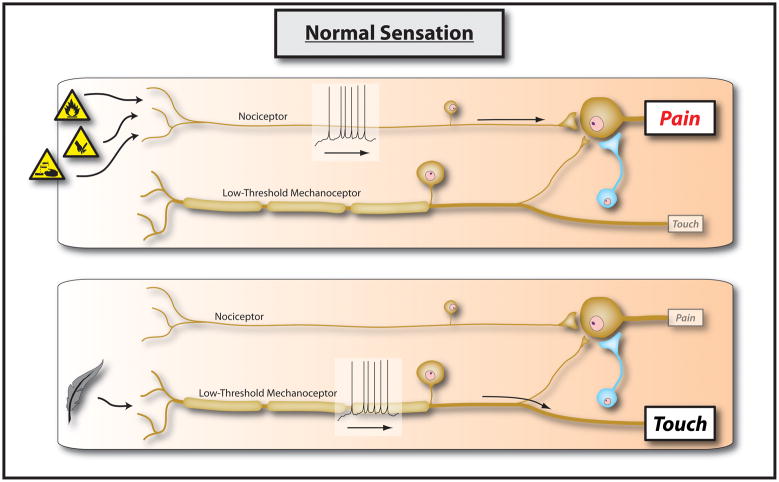
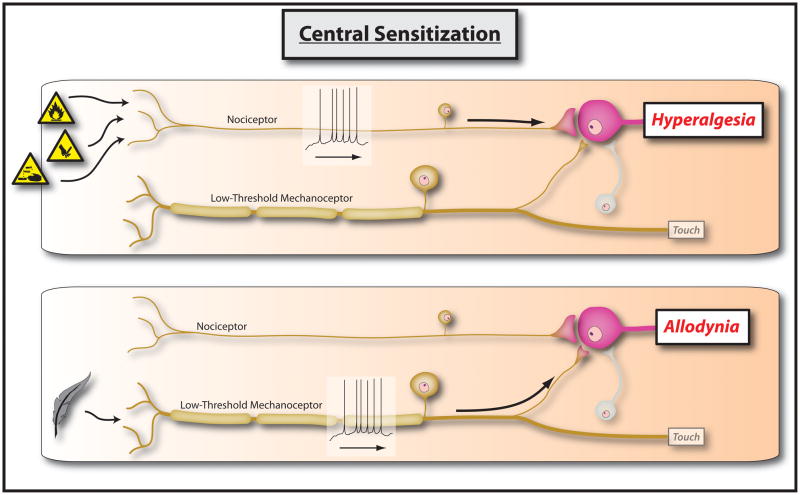
Nociceptor inputs can trigger a prolonged but reversible increase in the excitability and synaptic efficacy of neurons in central nociceptive pathways, the phenomenon of central sensitization. Central sensitization manifests as pain hypersensitivity, particularly dynamic tactile allodynia, secondary punctate or pressure hyperalgesia, aftersensations, and enhanced temporal summation. It can be readily and rapidly elicited in human volunteers by diverse experimental noxious conditioning stimuli to skin, muscles or viscera, and in addition to producing pain hypersensitivity, results in secondary changes in brain activity that can be detected by electrophysiological or imaging techniques. Studies in clinical cohorts reveal changes in pain sensitivity that have been interpreted as revealing an important contribution of central sensitization to the pain phenotype in patients with fibromyalgia, osteoarthritis, musculoskeletal disorders with generalized pain hypersensitivity, headache, temporomandibular joint disorders, dental pain, neuropathic pain, visceral pain hypersensitivity disorders and post-surgical pain. The comorbidity of those pain hypersensitivity syndromes that present in the absence of inflammation or a neural lesion, their similar pattern of clinical presentation and response to centrally acting analgesics, may reflect a commonality of central sensitization to their pathophysiology. An important question that still needs to be determined is whether there are individuals with a higher inherited propensity for developing central sensitization than others, and if so, whether this conveys an increased risk in both developing conditions with pain hypersensitivity, and their chronification. Diagnostic criteria to establish the presence of central sensitization in patients will greatly assist the phenotyping of patients for choosing treatments that produce analgesia by normalizing hyperexcitable central neural activity. We have certainly come a long way since the first discovery of activity-dependent synaptic plasticity in the spinal cord and the revelation that it occurs and produces pain hypersensitivity in patients. Nevertheless, discovering the genetic and environmental contributors to and objective biomarkers of central sensitization will be highly beneficial, as will additional treatment options to prevent or reduce this prevalent and promiscuous form of pain plasticity.
Copyright © 2010 International Association for the Study of Pain. Published by Elsevier B.V. All rights reserved.
Conflict of interest statement
There is no conflict of interest.
Figures
References
-
- Aasvang EK, Brandsborg B, Jensen TS, Kehlet H. Heterogeneous sensory processing in persistent postherniotomy pain. Pain. 2010;150(2):237–242. - PubMed
-
- Aggarwal VR, McBeth J, Zakrzewska JM, Lunt M, Macfarlane GJ. The epidemiology of chronic syndromes that are frequently unexplained: do they have common associated factors? Int J Epidemiol. 2006;35(2):468–476. - PubMed
-
- Amital D, Herskovitz C, Fostick L, Silberman A, Doron Y, Zohar J, Itsekson A, Zolti M, Rubinow A, Amital H. The premenstrual syndrome and fibromyalgia--similarities and common features. Clin Rev Allergy Immunol. 2010;38(2–3):107–115. - PubMed
-
- Amr YM, Yousef AA. Evaluation of efficacy of the perioperative administration of Venlafaxine or gabapentin on acute and chronic postmastectomy pain. Clin J Pain. 2010;26(5):381–385. - PubMed
-
- Amr YM, Yousef AA, Alzeftawy AE, Messbah WI, Saber AM. Effect of preincisional epidural fentanyl and bupivacaine on postthoracotomy pain and pulmonary function. Ann Thorac Surg. 2010;89(2):381–385. - PubMed
Publication types
MeSH terms
Grants and funding
LinkOut - more resources
Full Text Sources
Other Literature Sources
Medical
