


Why does lung function predict mortality? Results from the Whitehall II Cohort Study
- PMID: 20961971
- PMCID: PMC2998200
- DOI: 10.1093/aje/kwq294
Why does lung function predict mortality? Results from the Whitehall II Cohort Study
Abstract
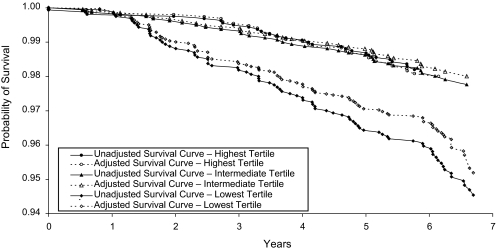
The authors examined the extent to which socioeconomic position, behavior-related factors, cardiovascular risk factors, inflammatory markers, and chronic diseases explain the association between poor lung function and mortality in 4,817 participants (68.9% men) from the Whitehall II Study aged 60.8 years (standard deviation, 5.9), on average. Forced expiratory volume in 1 second (FEV(1)) was used to measure lung function in 2002-2004. A total of 139 participants died during a mean follow-up period of 6.4 years (standard deviation, 0.8). In a model adjusted for age and sex, being in the lowest tertile of FEV(1)/height(2) was associated with a 1.92-fold (95% confidence interval: 1.35, 2.73) increased risk of mortality compared with being in the top 2 tertiles. Once age, sex, and smoking history were taken into account, the most important explanatory factors for this association were inflammatory markers (21.3% reduction in the FEV(1)/height(2)-mortality association), coronary heart disease, stroke, and diabetes (11.7% reduction), and alcohol consumption, diet, physical activity, and body mass index (9.8% reduction). The contribution of socioeconomic position and cardiovascular risk factors was small (≤ 3.5% reduction). Taken together, these factors explained 32.5% of the association. Multiple pathways link lung function to mortality; these results show inflammatory markers to be particularly important.
Figures
References
-
- Higgins MW, Keller JB. Predictors of mortality in the adult population of Tecumseh. Arch Environ Health. 1970;21(3):418–424. - PubMed
-
- Miller MR, Pedersen OF, Lange P, et al. Improved survival prediction from lung function data in a large population sample. Respir Med. 2009;103(3):442–448. - PubMed
-
- Schünemann HJ, Dorn J, Grant BJ, et al. Pulmonary function is a long-term predictor of mortality in the general population: 29-year follow-up of the Buffalo Health Study. Chest. 2000;118(3):656–664. - PubMed
Publication types
MeSH terms
Substances
Grants and funding
- R01 HL036310/HL/NHLBI NIH HHS/United States
- G19/35/MRC_/Medical Research Council/United Kingdom
- G0100222/MRC_/Medical Research Council/United Kingdom
- DH_/Department of Health/United Kingdom
- R01 AG034454/AG/NIA NIH HHS/United States
- R01 AG013196/AG/NIA NIH HHS/United States
- R01AG013196/AG/NIA NIH HHS/United States
- RG/07/008/23674/BHF_/British Heart Foundation/United Kingdom
- G8802774/MRC_/Medical Research Council/United Kingdom
- G0902037/MRC_/Medical Research Council/United Kingdom
- R01AG034454/AG/NIA NIH HHS/United States
- R01HL036310/HL/NHLBI NIH HHS/United States
