A compendium of the mouse mammary tumor biologist: from the initial observations in the house mouse to the development of genetically engineered mice
- PMID: 20961975
- PMCID: PMC3098677
- DOI: 10.1101/cshperspect.a003111
A compendium of the mouse mammary tumor biologist: from the initial observations in the house mouse to the development of genetically engineered mice
Abstract
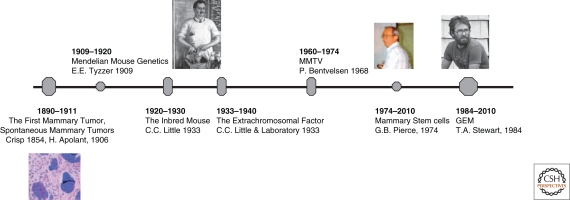
For over a century, mouse mammary tumor biology and the associated mouse mammary tumor virus (MMTV) have served as the foundation for experimental cancer research, in general, and, in particular, experimental breast cancer research. Spontaneous mouse mammary tumors were the basis for studies of the natural history of neoplasia, oncogenic viruses, host responses, endocrinology and neoplastic progression. However, lacking formal proof of a human mammary tumor virus, the preeminence of the mouse model faded in the 1980s. Since the late 1980s, genetically engineered mice (GEM) have proven extremely useful for studying breast cancer and have become the animal model for human breast cancer. Hundreds of mouse models of human breast cancer have been developed since the first demonstration in 1984. The GEM have attracted a new generation of molecular and cellular biologists eager to apply their skill sets to these surrogates of the human disease. Newcomers often enter the field without an appreciation of the origins of mouse mammary tumor biology and the basis for many of the prevailing concepts. Our purpose in writing this compendium is to extend an "olive branch" while simultaneously deepen the knowledge of the novice mouse mammary tumor biologist as they journey into a field rich in pathology and genetics spanning several centuries.
Figures
References
-
- Altrock BW, Cardiff RD, Puma JP, Lund JK 1982. Detection of acquired provirus sequences in mammary tumors from low-expressor, low-risk mice. J Natl Cancer Inst 68: 1037–1041 - PubMed
-
- Apolant H 1906. Die epithelialen geschwülste der maus. Arbeiten ad Koniglchn Inst F Expt Ther zu Frankfurt aM 1: 7–68
-
- Baltimore D 1995. Discovery of the reverse transcriptase. Faseb J 9: 1660–1663 - PubMed
-
- Bashford EF 1911a. The behaviour of tumor cells during propagation. Imperial Cancer Research Fund (Great Britain), Fourth Scientific Report, pp. 131–214
Publication types
MeSH terms
Grants and funding
LinkOut - more resources
Full Text Sources
Molecular Biology Databases
Research Materials