. 2011 Jan;85(1):357-65.
doi: 10.1128/JVI.01694-10. Epub 2010 Oct 20.

PB2 residue 158 is a pathogenic determinant of pandemic H1N1 and H5 influenza a viruses in mice

Affiliations

PB2 residue 158 is a pathogenic determinant of pandemic H1N1 and H5 influenza a viruses in mice

Bin Zhou et al. J Virol. 2011 Jan.

Abstract

Influenza A viruses are human and animal pathogens that cause morbidity and mortality, which range from mild to severe. The 2009 H1N1 pandemic was caused by the emergence of a reassortant H1N1 subtype (H1N1pdm) influenza A virus containing gene segments that originally circulated in human, avian, and swine virus reservoirs. The molecular determinants of replication and pathogenesis of H1N1pdm viruses in humans and other mammals are poorly understood. Therefore, we set out to elucidate viral determinants critical to the pathogenesis of this novel reassortant using a mouse model. We found that a glutamate-to-glycine substitution at residue 158 of the PB2 gene (PB2-E158G) increased the morbidity and mortality of the parental H1N1pdm virus. Results from mini-genome replication assays in human cells and virus titration in mouse tissues demonstrated that PB2-E158G is a pathogenic determinant, because it significantly increases viral replication rates. The virus load in PB2-E158G-infected mouse lungs was 1,300-fold higher than that of the wild-type virus. Our data also show that PB2-E158G had a much stronger influence on the RNA replication and pathogenesis of H1N1pdm viruses than PB2-E627K, which is a known pathogenic determinant. Remarkably, PB2-E158G substitutions also altered the pathotypes of two avian H5 viruses in mice, indicating that this residue impacts genetically divergent influenza A viruses and suggesting that this region of PB2 could be a new antiviral target. Collectively, the data presented in this study demonstrate that PB2-E158G is a novel pathogenic determinant of influenza A viruses in the mouse model. We speculate that PB2-E158G may be important in the adaptation of avian PB2 genes to other mammals, and BLAST sequence analysis identified a naturally occurring human H1N1pdm isolate that has this substitution. Therefore, future surveillance efforts should include scrutiny of this region of PB2 because of its potential impact on pathogenesis.


Figures
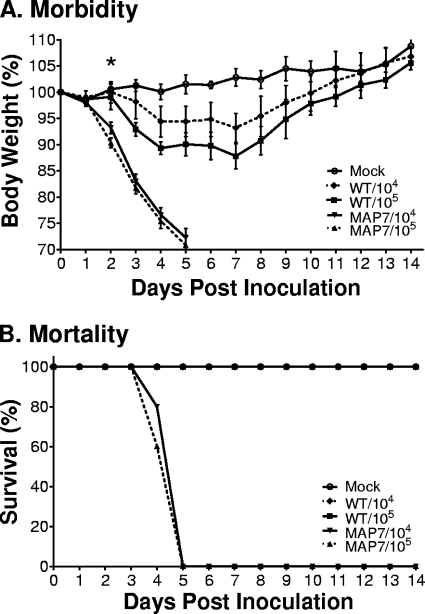
FIG. 1.
FIG. 1.
Pathogenicity of the parental H1N1pdm virus (rNY1682-WT) and the mouse-adapted variant (NY1682-MAP7) in mice. Six-week-old female BALB/cJ mice (n = 5/group) were inoculated intranasally with 50 μl containing 104 or 105 TCID50 of rNY1682-WT (WT) or NY1682-MAP7 (MAP7) viruses or mock inoculated (Mock; n = 4). (A) Morbidity was examined by recording the body weights of inoculated mice daily, and it is represented as a percentage of the weight on the day of inoculation (day 0). The average of each group is shown, and the error bars represent the standard deviations from the mean (SD). *, F tests indicated that MAP7 caused greater weight loss than the WT (P < 10−13). (B) Mouse mortality after inoculation with 50 μl containing 104 or 105 TCID50 of rNY1682-WT (WT) or NY1682-MAP7 (MAP7) or diluent (Mock).
FIG. 2.
FIG. 2.
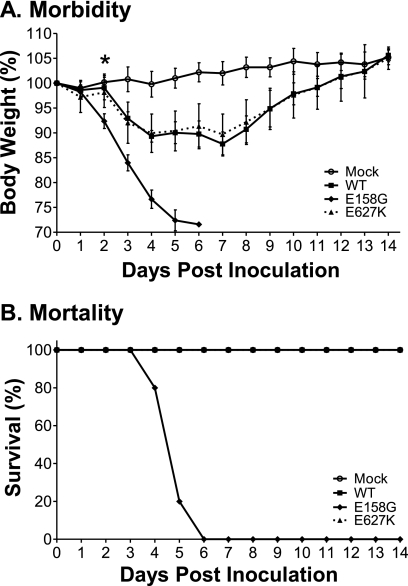
Pathogenicity of rNY1682-WT, rNY1682-E158G, and rNY1682-E627K viruses in mice. Six-week-old female BALB/cJ mice (n = 5/group) were inoculated intranasally with 50 μl containing 105 TCID50 of different recombinant viruses (rNY1682-WT [WT], rNY1682-E158G [E158G], or rNY1682-E627K [E627K]) or mock inoculated (Mock). (A) Morbidity was assessed by weight changes over a 14-day period and is graphed as a percentage of the animals' weights on the day of inoculation (day 0). The average body weight for each group is shown, with error bars representing the SD. *, an F test indicated that the weight loss caused by rNY1682-E158G was significantly greater than that caused by rNY1682-WT (P < 10−13). (B) Mortality associated with infection by the recombinant virus (rNY1682-WT [WT], rNY1682-E158G [E158G], or rNY1682-E627K [E627K]) was also examined.
FIG. 3.
FIG. 3.
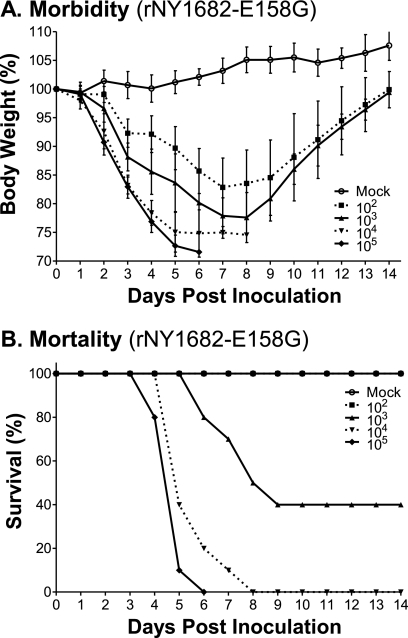
Determination of the mouse lethal dose of rNY1682-E158G. Six-week-old female BALB/cJ mice (n = 10/group) were inoculated intranasally with 50 μl containing 1 × 10², 1 × 10³, 1 × 10⁴, or 1 × 10⁵ TCID50 of rNY1682-E158G or mock inoculated. (A) Morbidity was assessed by weight changes over a 14-day period, and it is graphed as a percentage of the weight on the day of inoculation (day 0). The average body weight of each group is shown, with error bars representing SD. (B) Mortality of the mice was also monitored for 14 days postinoculation.
FIG. 4.
FIG. 4.
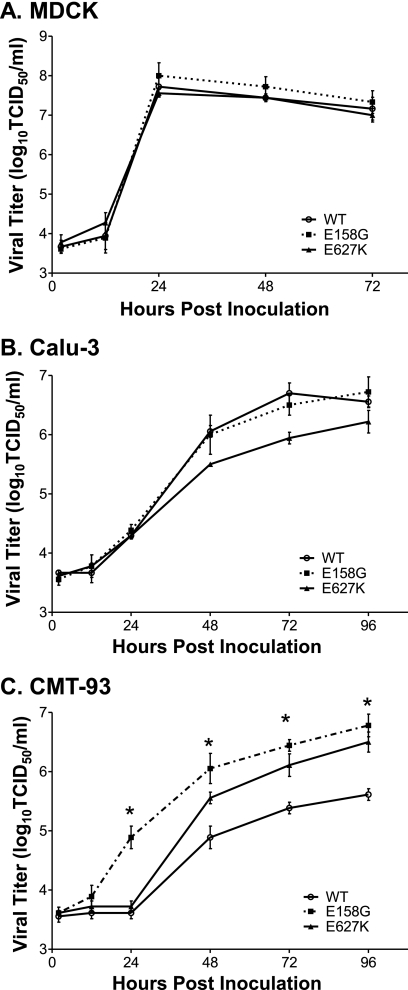
Replication kinetics of rNY1682-WT, rNY1682-E158G, and rNY1682-E627K in various cell lines. Confluent monolayers of the various cell lines were inoculated with the rNY1682-WT (WT), rNY1682-E158G (E158G), and rNY1682-E627K (E627K) viruses. Culture supernatants were harvested from MDCK cells at 2, 12, 24, 48, and 72 h p.i. (A) and from human lung epithelial cells (Calu-3) (B) or mouse rectal epithelial carcinoma cells (CMT-93) (C) at 2, 12, 24, 48, 72, and 96 h p.i. Viral titers were determined by TCID50 assay using MDCK cells. Averages of triplicate experiments are shown, with error bars representing SD. *, statistical analysis indicated that the titers of rNY1682-E158G were significantly greater than those of rNY1682-WT at 24 to 96 h p.i. (P = 2 × 10⁻¹⁰; F test).
FIG. 5.
FIG. 5.
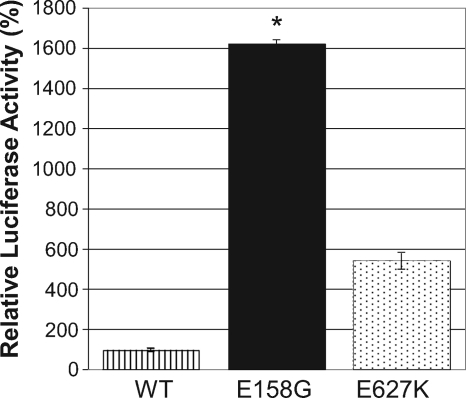
Viral RNA polymerase activity of PB2-WT, PB2-E158G, and PB2-E627K in human cells. HEK-293T cells were transfected with a pPolI-NS-Luc plasmid (pBZ81A36) that expresses negative-sense virus-like RNA encoding a destabilized firefly luciferase enzyme that can be transcribed by the viral RDRP. The HEK-293T cells were also cotransfected with plasmids expressing NY1682 PB1, PA, and NP and one of the PB2 clones (WT, E158G, or E627K) to generate different viral RDRPs. Cells were also cotransfected with a Renilla luciferase expression plasmid to control for transfection efficiency. Eighteen hours posttransfection, both firefly and Renilla luciferase production levels were measured, and Renilla expression was used to normalize the data. The averages of triplicate experiments are shown, with error bars that represent SD. *, PB2-E158G had significantly greater activity than either PB2-WT (P = 1.6 × 10⁻⁵) or PB2-E627K (P = 4.2 × 10⁻⁵) when analyzed using a t test with unequal variance and Bonferroni's correction.
FIG. 6.
FIG. 6.
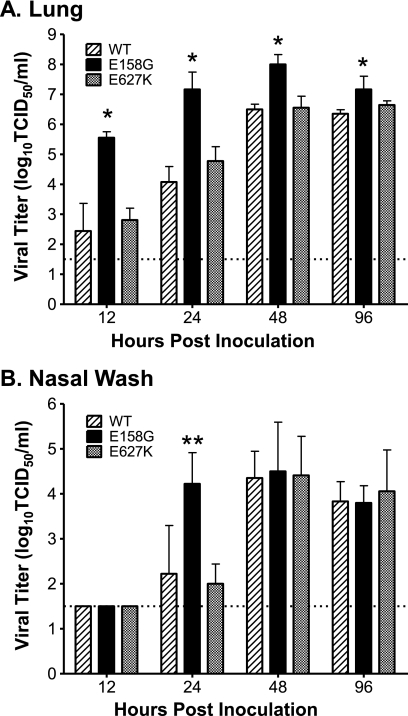
Analysis of viral replication efficiency in the respiratory tracts of mice. Six-week-old female BALB/cJ mice (n = 3/group/time point) were inoculated intranasally with 50 μl containing 103 TCID50 of rNY1682-WT (WT), rNY1682-E158G (E158G), or rNY1682-E627K (E627K). Animals were euthanized at 12, 24, 48, and 96 h p.i. An entire lung of each animal was homogenized in 1 ml of medium and clarified by centrifugation, and nasal washes were collected from each mouse in 1 ml of medium. Viral titers of the clarified lung homogenates (A) and nasal washes (B) were determined by TCID50 assay using MDCK cells. The average of each group is shown, with error bars representing the SD. *, rNY1682-E158G had significantly higher lung titers than rNY1682-WT at all of the time points (P = 6 × 10⁻¹⁰; F test). **, rNY1682-E158G had significantly higher titers than rNY1682-WT in the nasal wash at 24 h p.i. (P = 0.005; F test). The dotted line (1.5 log10 units) indicates the lower limit of detection of infectious virus.
FIG. 7.
FIG. 7.
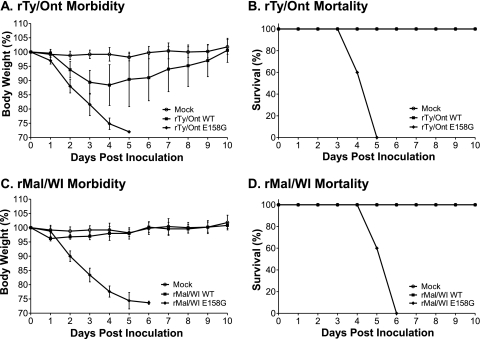
PB2-E158G radically alters the pathotypes of avian H5 viruses in mice. Six-week-old female BALB/cJ mice (n = 5/group) were intranasally inoculated with 50 μl of the recombinant avian H5 viruses created by reverse genetics. (A and B) Mice were inoculated with 5 × 10⁵ TCID50 of either rA/Ty/Ont/7732/66-wild type (rTy/Ont-WT) or rA/Ty/Ont/7732/66-E158G (rTy/Ont-E158G) virus or mock inoculated (Mock). (A) Morbidity was assessed by weight changes over a 10-day period and is graphed as a percentage of the animals' weights on the day of inoculation (day 0). (B) Mortality associated with infection by the recombinant A/Ty/Ont/7732/66 (H5N9) viruses was also examined. (C and D) Mice were inoculated with 1 × 10⁵ TCID50 of rA/Mal/WI/944/82-WT (rMal/WI-WT) or rA/Mal/WI/944/82-E158G (rMal/WI-E158G) or mock inoculated (Mock). The morbidity (C) and mortality (D) of mice infected with the recombinant Mal/WI (H5N2) viruses were recorded daily for 10 days. The average weight loss of each group (A and C) is shown, with error bars representing the SD.

References

    1. Basler, C. F., and P. V. Aguilar. 2008. Progress in identifying virulence determinants of the 1918 H1N1 and the Southeast Asian H5N1 influenza A viruses. Antiviral Res. 79:166-178. doi:10.1016/j.antiviral.2008.04.006. - DOI - PMC - PubMed
    1. Bautista, E., T. Chotpitayasunondh, Z. Gao, S. A. Harper, M. Shaw, T. M. Uyeki, S. R. Zaki, F. G. Hayden, D. S. Hui, J. D. Kettner, A. Kumar, M. Lim, N. Shindo, C. Penn, and K. G. Nicholson. 2010. Clinical aspects of pandemic 2009 influenza A (H1N1) virus infection. N. Engl. J. Med. 362:1708-1719. - PubMed
    1. Brown, E. G., H. Liu, L. C. Kit, S. Baird, and M. Nesrallah. 2001. Pattern of mutation in the genome of influenza A virus on adaptation to increased virulence in the mouse lung: identification of functional themes. Proc. Natl. Acad. Sci. U. S. A. 98:6883-6888. - PMC - PubMed
    1. Bussey, K. A., T. L. Bousse, E. A. Desmet, B. Kim, and T. Takimoto. 2010. PB2 residue 271 plays a key role in enhanced polymerase activity of influenza A viruses in mammalian host cells. J. Virol. 84:4395-4406. - PMC - PubMed
    1. Fornek, J. L., L. Gillim-Ross, C. Santos, V. Carter, J. M. Ward, L. I. Cheng, S. Proll, M. G. Katze, and K. Subbarao. 2009. A single-amino-acid substitution in a polymerase protein of an H5N1 influenza virus is associated with systemic infection and impaired T-cell activation in mice. J. Virol. 83:11102-11115. - PMC - PubMed

Publication types

MeSH terms