


Impact of health information technology interventions to improve medication laboratory monitoring for ambulatory patients: a systematic review
- PMID: 20962124
- PMCID: PMC3000763
- DOI: 10.1136/jamia.2009.000794
Impact of health information technology interventions to improve medication laboratory monitoring for ambulatory patients: a systematic review
Abstract
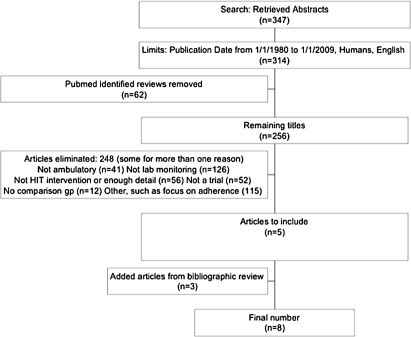
Medication errors are a major source of morbidity and mortality. Inadequate laboratory monitoring of high-risk medications after initial prescription is a medical error that contributes to preventable adverse drug events. Health information technology (HIT)-based clinical decision support may improve patient safety by improving the laboratory monitoring of high-risk medications, but the effectiveness of such interventions is unclear. Therefore, the authors conducted a systematic review to identify studies that evaluate the independent effect of HIT interventions on improving laboratory monitoring for high-risk medications in the ambulatory setting using a Medline search from January 1, 1980 through January 1, 2009 and a manual review of relevant bibliographies. All anticoagulation monitoring studies were excluded. Eight articles met the inclusion criteria, including six randomized controlled trials and two pre-post intervention studies. Six of the studies were conducted in two large, integrated healthcare delivery systems in the USA. Overall, five of the eight studies reported statistically significant, but small, improvements in laboratory monitoring; only half of the randomized controlled trials reported statistically significant improvements. Studies that found no improvement were more likely to have used analytic strategies that addressed clustering and confounding. Whether HIT improves laboratory monitoring of certain high-risk medications for ambulatory patients remains unclear, and further research is needed to clarify this important question.
Conflict of interest statement
Figures
References
-
- Institute of Medicine To Err is Human: Building a Safer Health System. Washington, DC: National Academy Press, 2000
-
- Gurwitz JH, Field TS, Harrold LR, et al. Incidence and preventability of adverse drug events among older persons in the ambulatory setting. JAMA 2003;289:1107–16 - PubMed
-
- Thomsen LA, Winterstein AG, Sondergaard B, et al. Systematic review of the incidence and characteristics of preventable adverse drug events in ambulatory care. Ann Pharmacother 2007;41:1411–26 - PubMed
-
- Simon SR, Andrade SE, Ellis JL, et al. Baseline laboratory monitoring of cardiovascular medications in elderly health maintenance organization enrollees. J Am Geriatr Soc 2005;53:2165–9 - PubMed
Publication types
MeSH terms
LinkOut - more resources
Full Text Sources
Medical
Miscellaneous
