


Impact of generic substitution decision support on electronic prescribing behavior
- PMID: 20962131
- PMCID: PMC3000753
- DOI: 10.1136/jamia.2009.002568
Impact of generic substitution decision support on electronic prescribing behavior
Abstract
Objective: To evaluate the impact of generic substitution decision support on electronic (e-) prescribing of generic medications.
Design: The authors analyzed retrospective outpatient e-prescribing data from an academic medical center and affiliated network for July 1, 2005-September 30, 2008 using an interrupted time-series design to assess the rate of generic prescribing before and after implementing generic substitution decision support. To assess background secular trends, e-prescribing was compared with a concurrent random sample of hand-generated prescriptions.
Measurements: Proportion of generic medications prescribed before and after the intervention, evaluated over time, and compared with a sample of prescriptions generated without e-prescribing.
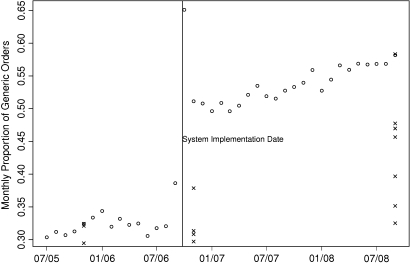
Results: The proportion of generic medication prescriptions increased from 32.1% to 54.2% after the intervention (22.1% increase, 95% CI 21.9% to 22.3%), with no diminution in magnitude of improvement post-intervention. In the concurrent control group, increases in proportion of generic prescriptions (29.3% to 31.4% to 37.4% in the pre-intervention, post-intervention, and end-of-study periods, respectively) were not commensurate with the intervention. There was a larger change in generic prescribing rates among authorized prescribers (24.6%) than nurses (18.5%; adjusted OR 1.38, 95% CI 1.17 to 1.63). Two years after the intervention, the proportion of generic prescribing remained significantly higher for e-prescriptions (58.1%; 95% CI 57.5% to 58.7%) than for hand-generated prescriptions ordered at the same time (37.4%; 95% CI 34.9% to 39.9%) (p<0.0001). Generic prescribing increased significantly in every specialty.
Conclusion: Implementation of generic substitution decision support was associated with dramatic and sustained improvements in the rate of outpatient generic e-prescribing across all specialties.
Conflict of interest statement
Figures
References
-
- IMS Health IMS Health Reports U.S. Prescription Sales Grew 3.8 Percent in 2007, to $286.5 Billion. Press Release 2008. March 12
-
- Keehan S, Sisko A, Truffer C, et al. Health spending projections through 2017: the baby-boom generation is coming to Medicare. Health Aff (Millwood) 2008;27:145–55 - PubMed
-
- National Association of Chain Drug Stores Table 151. Retail Prescription Drug Sales. NACDS Foundation Chain Pharmacy Industry Profile, 2007. http://www.census.gov/compendia/statab/tables/09s0151.xls (accessed 16 Jun 2009).
-
- IMS Health The United States is also the world's largest consumer of prescription drugs, accounting for almost half of global pharmaceutical sales in 2007. Global Pharmaceutical Sales by Region 2007, 2008
-
- Weisbart E. Taming pharmacy: driving out waste one consumer at a time. Express scripts, 2008. http://personnel.ky.gov/NR/rdonlyres/36B1DA8B-7F0B-4A48-BA1E-73D7BDC436B... (accessed 16 Jun 2009).
