


Comment
doi: 10.1038/467922a.
Metabolic disorders: Fathers' nutritional legacy
- PMID: 20962833
- PMCID: PMC5704915
- DOI: 10.1038/467922a
Item in Clipboard
Comment
Metabolic disorders: Fathers' nutritional legacy
Nature.
.
Abstract
A female can develop a diabetes-like disease due to a high fat content in her father's diet before she was conceived. Epigenetic modifications of the father's sperm DNA might underlie this peculiar observation. See Letter p.963
Figures
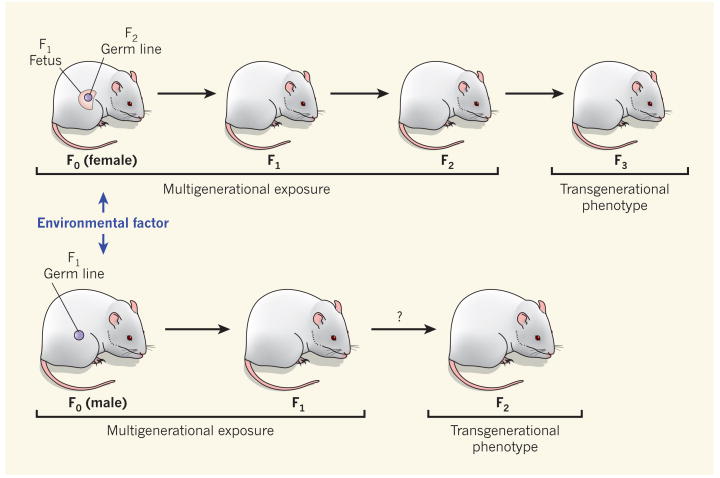
Whereas most environmental factors cannot alter an animal's DNA sequence,
many promote epigenetic alterations that influence somatic cells and so the
disease status of the individual exposed (F0 generation). In pregnant
females, environmental exposure could also cause epigenetic modifications in the
next two generations (F1 and F2) through the fetus and its
germ line. The effect of such multigenerational exposure in subsequent
generations (F3 and beyond) would be considered a transgenerational
phenotype. By contrast, multigenerational exposure in males is limited to the
F0 and F1 generations. Ng and colleagues'
observations fit well
into a multigenerational exposure. However, they did not explore whether the
high-fat diet of their male rats also causes a transgenerational phenotype in
the F2 generation.
Comment on
-
Chronic high-fat diet in fathers programs β-cell dysfunction in female rat offspring.Nature. 2010 Oct 21;467(7318):963-6. doi: 10.1038/nature09491. Nature. 2010. PMID: 20962845
References
Publication types
MeSH terms
Substances
Grants and funding
LinkOut - more resources
Full Text Sources
Medical
