


Non-invasive prenatal detection of achondroplasia using circulating fetal DNA in maternal plasma
- PMID: 20963478
- PMCID: PMC3059531
- DOI: 10.1007/s10815-010-9489-1
Non-invasive prenatal detection of achondroplasia using circulating fetal DNA in maternal plasma
Abstract
Purpose: To perform a reliable non-invasive detection of the fetal achondroplasia using maternal plasma.
Methods: We developed a quantitative fluorescent-polymerase chain reaction (QF-PCR) method suitable for detection of the FGFR3 mutation (G1138A) causing achondroplasia. This method was applied in a non-invasive detection of the fetal achondroplasia using circulating fetal-DNA (cf-DNA) in maternal plasma. Maternal plasmas were obtained at 27 weeks of gestational age from women carrying an achondroplasia fetus or a normal fetus.
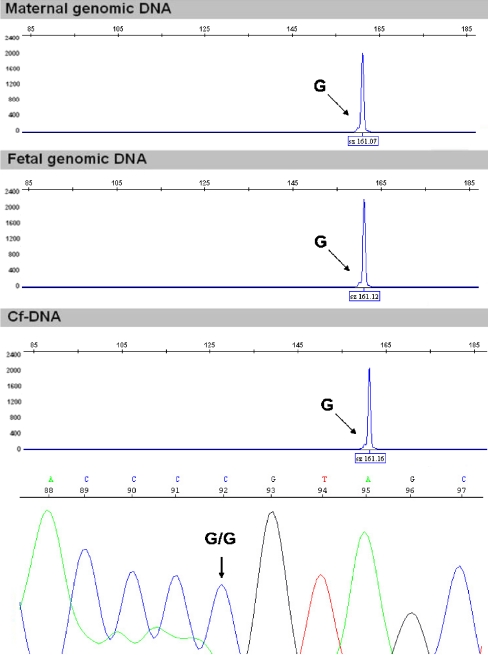
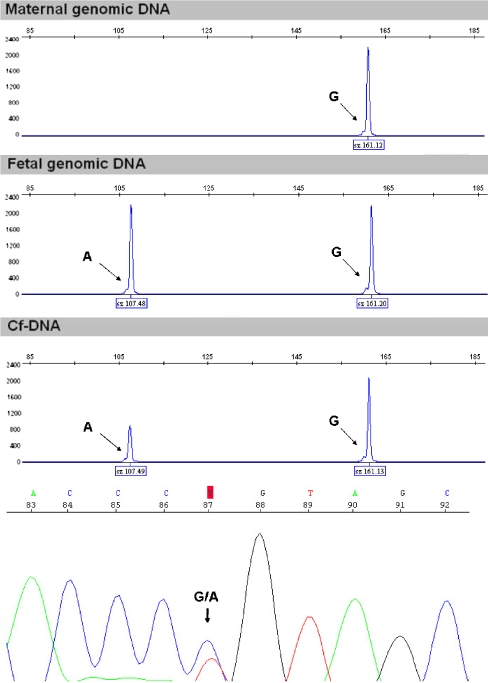
Results: Two percent or less achondroplasia DNA was reliably detected by QF-PCR. In a woman carrying a normal fetus, analysis of cf-DNA showed only one peak of the wild-type G allele. In a woman expected an achondroplasia fetus, analysis of cf-DNA showed the two peaks of wild-type G allele and mutant-type A allele and accurately detected the fetal achondroplasia.
Conclusions: The non-invasive method using maternal plasma and QF-PCR may be useful for diagnosis of the fetal achondroplasia.
Figures
References
-
- Trujillo-Tiebas MJ, Fenollar-Cortés M, Lorda-Sánchez I, Díaz-Recasens J, Carrillo Redondo A, Ramos-Corrales C, et al. Prenatal diagnosis of skeletal dysplasia due to FGFR3 gene mutations: a 9-year experience: prenatal diagnosis in FGFR3 gene. J Assist Reprod Genet. 2009;26:455–60. doi: 10.1007/s10815-009-9339-1. - DOI - PMC - PubMed
Publication types
MeSH terms
Substances
LinkOut - more resources
Full Text Sources
Medical
