


Exploring how symptoms of attention-deficit/hyperactivity disorder are related to reading and mathematics performance: general genes, general environments
- PMID: 20966487
- PMCID: PMC3708699
- DOI: 10.1177/0956797610386617
Exploring how symptoms of attention-deficit/hyperactivity disorder are related to reading and mathematics performance: general genes, general environments
Abstract
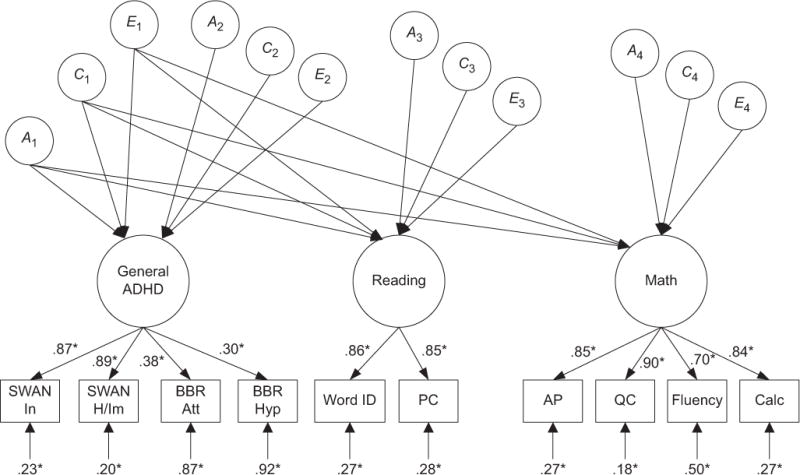
Children with attention-deficit/hyperactivity disorder (ADHD) tend to perform more poorly on tests of reading and mathematical performance than their typical peers. Quantitative genetic analyses allow for a better understanding of the etiology of ADHD and reading and mathematics outcomes, by examining their common and unique genetic and environmental influences. Analyses were conducted on a sample 271 pairs of 10-year-old monozygotic and dizygotic twins drawn from the Western Reserve Reading and Mathematics Project. In general, the results suggested that the associations among ADHD symptoms, reading outcomes, and math outcomes were influenced by both general genetic and general shared-environment factors. The analyses also suggested significant independent genetic effects for ADHD symptoms. The results imply that differing etiological factors underlie the relationships among ADHD and reading and mathematics performance. It appears that both genetic and common family or school environments link ADHD with academic performance.
Conflict of interest statement
The authors declared that they had no conflicts of interest with respect to their authorship or the publication of this article.
Figures
References
-
- American Psychological Association. Diagnostic and statistical manual of mental disorders. Washington, DC; Author; 2000. (text rev.)
-
- Barry TD, Lyman RD, Klinger LG. Academic under-achievement and attention-deficit/hyperactivity disorder: The negative impact of symptom severity on school performance. Journal of School Psychology. 2002;40:259–283.
-
- Bayley N. Bayley scales of infant development: Manual. San Antonio, TX: Psychological Corp; 1993.
-
- Capano L, Minden D, Chen SX, Schachar RJ, Ickowicz A. Mathematical learning disorder in school-age children with attention-deficit hyperactivity disorder. Canadian Journal of Psychiatry. 2008;53:392–399. - PubMed
-
- Doyle AE, Faraone SV, DuPre EP, Biederman J. Separating attention deficit hyperactivity disorder and learning disabilities in girls: A familial risk analysis. American Journal of Psychiatry. 2001;158:1666–1672. - PubMed
Publication types
MeSH terms
Grants and funding
LinkOut - more resources
Full Text Sources
Medical
