


Prepregnancy risk factors for antepartum stillbirth in the United States
- PMID: 20966697
- PMCID: PMC3326407
- DOI: 10.1097/AOG.0b013e3181f903f8
Prepregnancy risk factors for antepartum stillbirth in the United States
Abstract
Objective: To identify possible prepregnancy risk factors for antepartum stillbirth and to determine whether these factors identify women at higher risk for term stillbirth.
Methods: This retrospective cohort study of prepregnancy risk factors compared 712 singleton antepartum stillbirths with 174,097 singleton live births at or after 23 weeks of gestation. The risk of term antepartum stillbirth then was assessed in a subset of 155,629 singleton pregnancies.
Results: In adjusted multivariable analyses, African-American race, Hispanic ethnicity, maternal age 35 years or older, nulliparity, prepregnancy body mass index (BMI) 30 or higher, preexisting diabetes, chronic hypertension, smoking, and alcohol use were independently associated with stillbirth. Prior cesarean delivery and history of preterm birth were associated with increased stillbirth risk in multiparous women. The risk of a term stillbirth for women who were white, 25-29 years old, normal weight, multiparous, no chronic hypertension, and no preexisting diabetes was 0.8 per 1,000. Term stillbirth risk increased with the following conditions: preexisting diabetes (3.1 per 1,000), chronic hypertension (1.7 per 1,000), African-American race (1.8 per 1,000), maternal age 35 years or older (1.3 per 1,000), BMI 30 or higher (1 per 1,000), and nulliparity (0.9 per 1,000).
Conclusion: There are multiple independent risk factors for antepartum stillbirth. However, the value of individual risk factors of race, parity, advanced maternal age (35-39 years old), and BMI to predict term stillbirth is poor. Our results do not support routine antenatal surveillance for any of these risk factors when present in isolation.
Level of evidence: II.
Figures
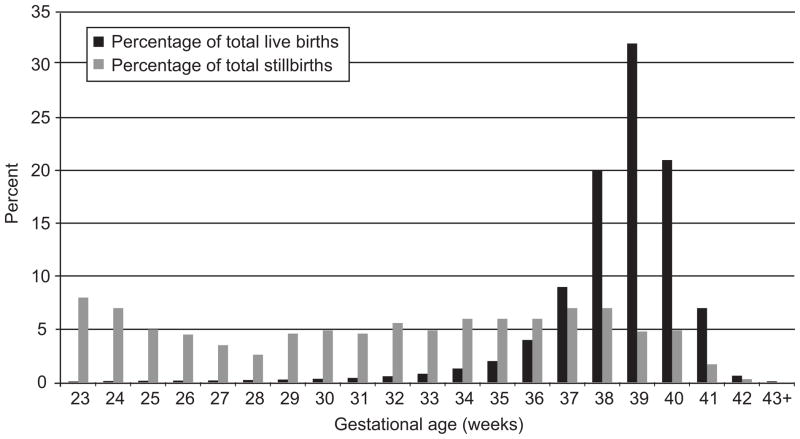
References
-
- MacDorman M, Kirmeyer S. The challenge of fetal mortality. NCHS data brief, no 16. Hyattsville, MD: National Center for Health Statistics; 2009. - PubMed
-
- Surkan PJ, Stephansson O, Dickman PW, Cnattingius S. Previous preterm and small-for-gestational-age births and the subsequent risk of stillbirth. N Engl J Med. 2004;350:777–85. - PubMed
-
- Reddy UM, Ko CW, Willinger M. Maternal age and the risk of stillbirth throughout pregnancy in the United States. Am J Obstet Gynecol. 2006;195:764–70. - PubMed
-
- Sharma PP, Salihu HM, Oyelese Y, Ananth CV, Kirby RS. Is race a determinant of stillbirth recurrence? Obstet Gynecol. 2006;107:391–7. - PubMed
-
- Raymond EG, Cnattingius S, Kiely JL. Effects of maternal age, parity, and smoking on the risk of stillbirth. Br J Obstet Gynaecol. 1994;101:301–6. - PubMed
Publication types
MeSH terms
Grants and funding
LinkOut - more resources
Full Text Sources
Medical
Research Materials
