


doi: 10.1038/nchem.885.
Molecular binding: Under water's influence
- PMID: 20966940
- PMCID: PMC3457629
- DOI: 10.1038/nchem.885
Item in Clipboard
Molecular binding: Under water's influence
Nat Chem.
2010 Nov.
Abstract
Hydration is known to affect molecular recognition processes, such as between protein and ligand. Now, theoretical simulations have provided thermodynamic insight into cavity–ligand binding, and revealed how it is predominantly driven by the behaviour of the few surrounding water molecules.
Figures
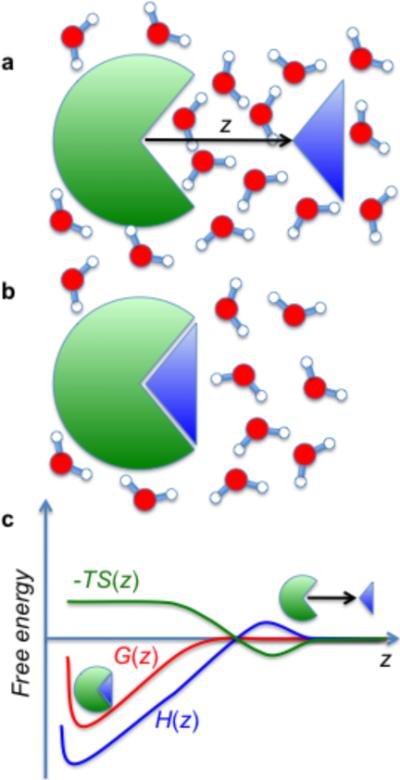
a, b, As the distance z of the ligand from the binding site shrinks, water is displaced and reorganized. c, Thermodynamics of the binding process. For an apolar ligand binding to an apolar pocket, it is the hydration contribution that dominates the binding. In particular, a surprising finding is that the free energy G(z) that drives such hydrophobic bindings can be dominated by gains in the enthalpy H(z) that outweigh losses in the entropy S(z),. These effects are associated with, respectively, an overall increase in water–water hydrogen bonds and the suppression of solvent fluctuations in the ligand-binding interface.
References
Publication types
MeSH terms
Substances
Grants and funding
LinkOut - more resources
Full Text Sources
