


Computer therapy for the anxiety and depressive disorders is effective, acceptable and practical health care: a meta-analysis
- PMID: 20967242
- PMCID: PMC2954140
- DOI: 10.1371/journal.pone.0013196
Computer therapy for the anxiety and depressive disorders is effective, acceptable and practical health care: a meta-analysis
Abstract
Background: Depression and anxiety disorders are common and treatable with cognitive behavior therapy (CBT), but access to this therapy is limited.
Objective: Review evidence that computerized CBT for the anxiety and depressive disorders is acceptable to patients and effective in the short and longer term.
Method: Systematic reviews and data bases were searched for randomized controlled trials of computerized cognitive behavior therapy versus a treatment or control condition in people who met diagnostic criteria for major depression, panic disorder, social phobia or generalized anxiety disorder. Number randomized, superiority of treatment versus control (Hedges g) on primary outcome measure, risk of bias, length of follow up, patient adherence and satisfaction were extracted.
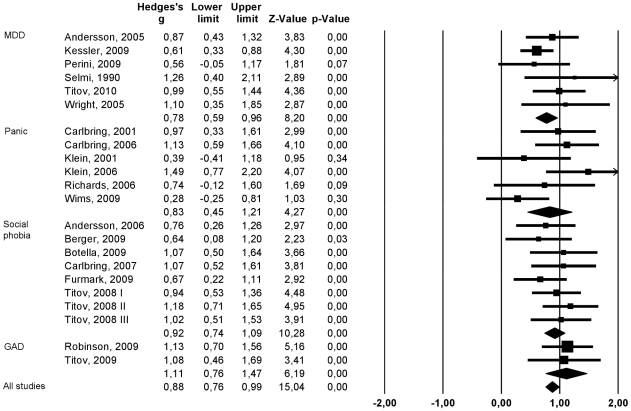
Principal findings: 22 studies of comparisons with a control group were identified. The mean effect size superiority was 0.88 (NNT 2.13), and the benefit was evident across all four disorders. Improvement from computerized CBT was maintained for a median of 26 weeks follow-up. Acceptability, as indicated by adherence and satisfaction, was good. Research probity was good and bias risk low. Effect sizes were non-significantly higher in comparisons with waitlist than with active treatment control conditions. Five studies comparing computerized CBT with traditional face-to-face CBT were identified, and both modes of treatment appeared equally beneficial.
Conclusions: Computerized CBT for anxiety and depressive disorders, especially via the internet, has the capacity to provide effective acceptable and practical health care for those who might otherwise remain untreated.
Trial registration: Australian New Zealand Clinical Trials Registry ACTRN12610000030077.
Conflict of interest statement
Figures
Comment in
-
Computerised cognitive behaviour therapy for major depression: a reply to the REEACT trial.Evid Based Ment Health. 2016 May;19(2):43-5. doi: 10.1136/eb-2015-102293. Epub 2016 Mar 18. Evid Based Ment Health. 2016. PMID: 26993366 Free PMC article.
References
-
- Goldberg DP, Krueger RF, Andrews G, Hobbs MJ. Emotional disorders: Cluster 4 of the proposed meta-structure for DSM-V and ICD-11. Psychol Med. 2009;39:2043–2059. - PubMed
-
- Andrews G, Issakidis C, Sanderson K, Corry J, Lapsley H. Utilising survey data to inform public policy: comparison of the cost-effectiveness of treatment of ten mental disorders. Br J Psychiatry. 2004;184:526–533. - PubMed
-
- Roy-Byrne PP, Cowley DS. Pharmacological treatments for panic disorder, generalized anxiety disorder, specific phobia and social anxiety disorder. In: Nathan PE, Gordon JM, editors. A guide to treatments that work. 3rd ed. New York: Oxford University Press; 2007. pp. 395–427.
-
- Butler AC, Chapman JE, Forman EM, Beck AT. The empirical status of cognitive-behavioral therapy: A review of meta-analyses. Clin Psychol Rev. 2006;26:17–31. - PubMed
Publication types
MeSH terms
LinkOut - more resources
Full Text Sources
Medical
Miscellaneous
