Review
. 2011 Jan;223(2):262-73.
doi: 10.1002/path.2789. Epub 2010 Oct 21.

Notch signalling in T-cell lymphoblastic leukaemia/lymphoma and other haematological malignancies

Affiliations
Review

Notch signalling in T-cell lymphoblastic leukaemia/lymphoma and other haematological malignancies

Jon C Aster et al. J Pathol. 2011 Jan.

Abstract

Notch receptors participate in a highly conserved signalling pathway that regulates normal development and tissue homeostasis in a context- and dose-dependent manner. Deregulated Notch signalling has been implicated in many diseases, but the clearest example of a pathogenic role is found in T-cell lymphoblastic leukaemia/lymphoma (T-LL), in which the majority of human and murine tumours have acquired mutations that lead to aberrant increases in Notch1 signalling. Remarkably, it appears that the selective pressure for Notch mutations is virtually unique among cancers to T-LL, presumably reflecting a special context-dependent role for Notch in normal T-cell progenitors. Nevertheless, there are some recent reports suggesting that Notch signalling has subtle, yet important roles in other forms of haematological malignancy as well. Here, we review the role of Notch signalling in various blood cancers, focusing on T-LL with an eye towards targeted therapeutics.


Conflict of interest statement

Conflict of Interest.

J.C.A., W.S.P., and S.C.B. have no conflicts to declare.

Figures
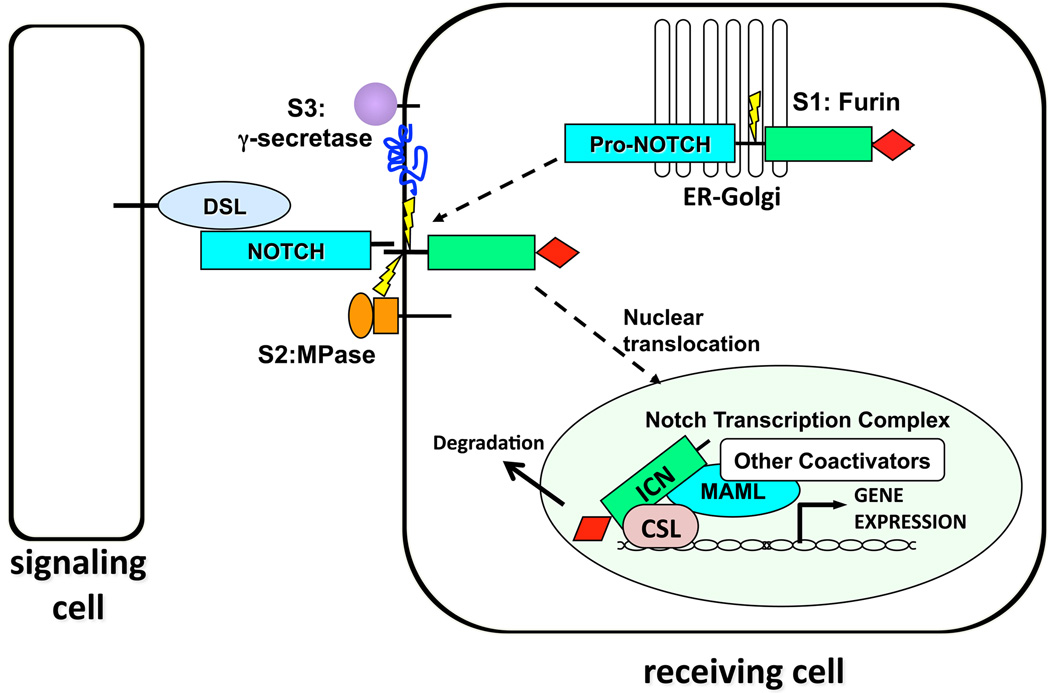
Figure 1
Figure 1
Canonical Notch Signalling. Notch receptors are processed in the ER/Golgi compartment by furin-like proteases at site S1 during trafficking to the cell surface, producing heterodimeric surface receptors. Engagement of Notch receptors with ligands of the DSL (Delta, Serrate, Lag-2) family expressed on neighbouring cells initiates two successive cleavages by the metalloproteinase ADAM10 at site S2, followed by intramembranous cleavage at site S3 by the mulitsubunit protease γ-secretase. This permits the intracellular domain of Notch (ICN) to translocate to the nucleus and form a Notch transcription complex (NTC) consisting of the DNA-binding protein CSL, ICN, and co-activators of the Mastermind-like (MAML) family. This NTC is normally short-lived due to the presence of a C-terminal PEST domain in ICN (shown as a red diamond).
Figure 2
Figure 2
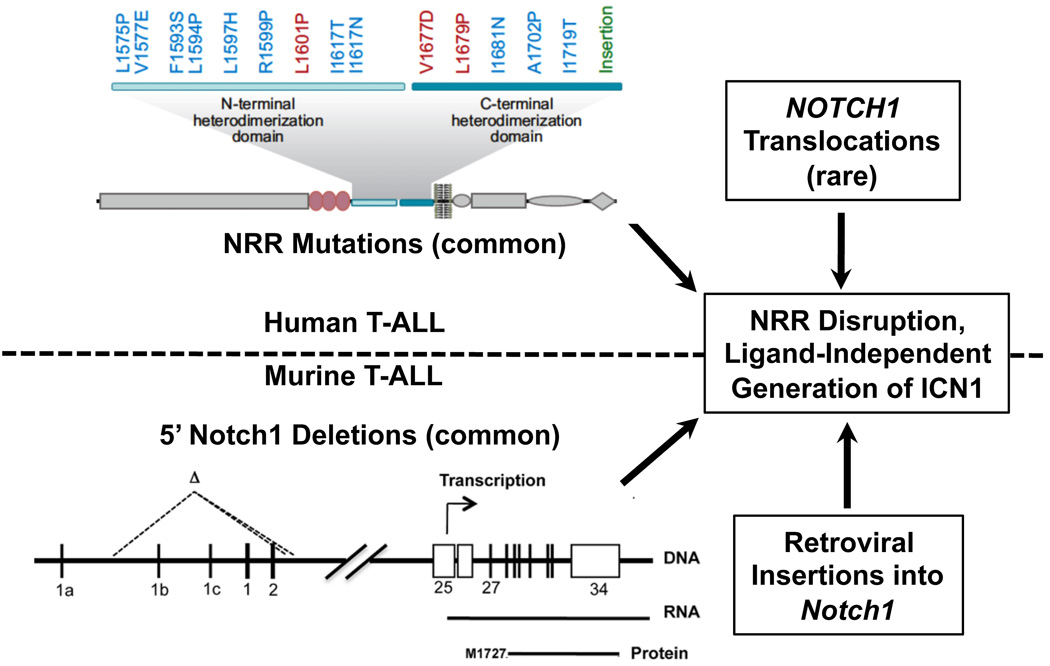
Mechanisms of ligand-independent Notch1 activation in T-LL. In human T-LL, the Notch negative regulatory region (NRR) is often disrupted by point mutations or less frequently by chromosomal translocations, whereas in murine T-LL the NRR is most commonly disrupted are 5’ deletions (most RAG mediated) followed by retroviral insertions. Examples of dissociative (red), destabilizing (blue), and insertional (green) Notch1 NRR mutations found in human T-LL are listed.
Figure 3
Figure 3
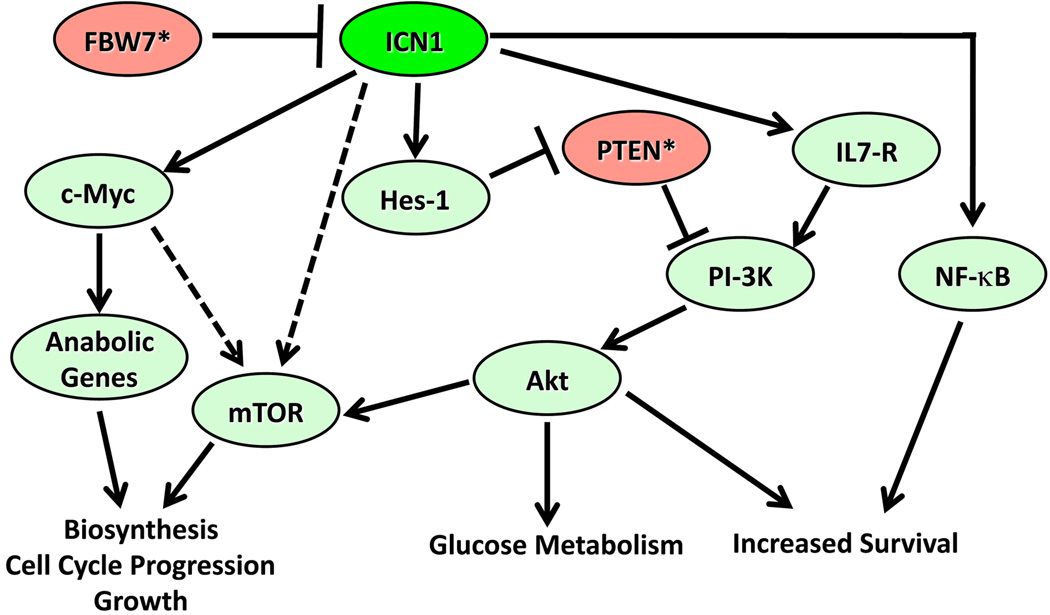
Oncogenic Notch1 Signalling. Signalling pathways downstream of activated Notch1 (ICN1) in T-LL cells are shown. Fbw7 and PTEN are tumour suppressors (*) whose function is often lost, events that increase the consequences of ICN1 signalling. In some tumours, there is evidence that ICN1 stimulates mTOR independently of effects on the PI3K/Akt pathway; this uncharacterized pathway is shown as a dashed line.
Figure 4
Figure 4
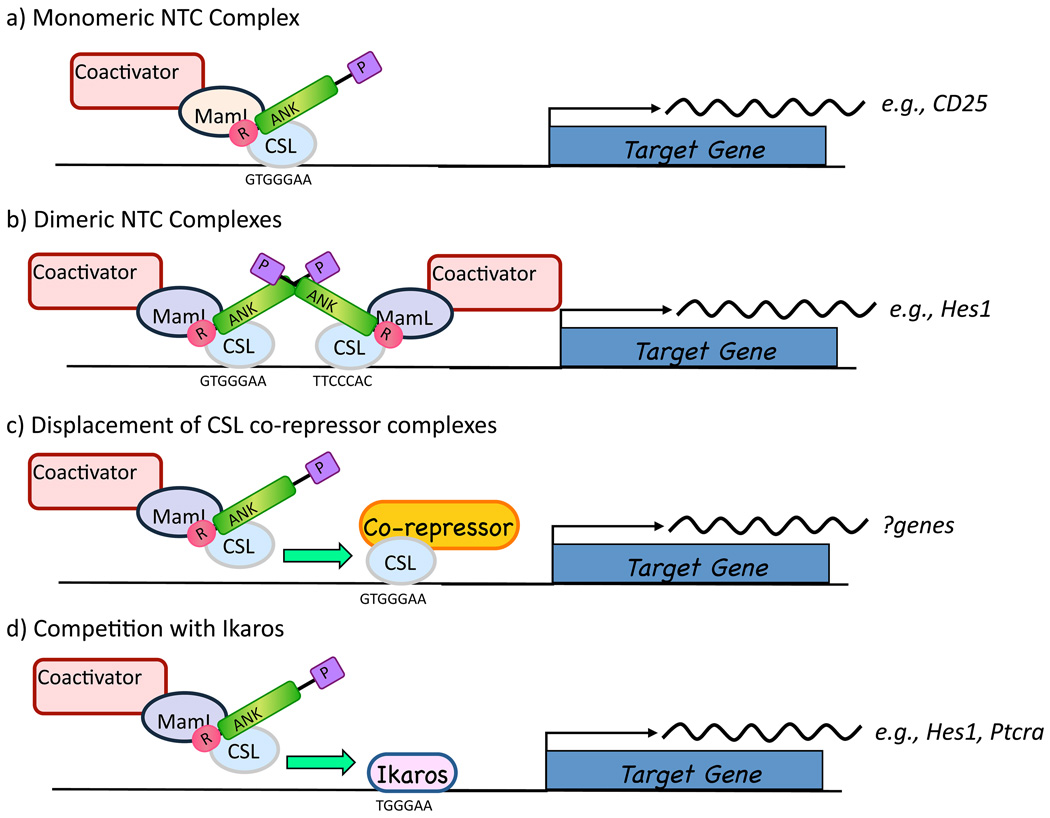
Notch transcription complexes. Evidence suggests that NTC complexes stimulate transcription on various promoters a) as monomers, b) as dimers, c) by competing co-repressor complexes off of CSL, or d) by competing with Ikaros, a zinc-finger protein and transcriptional repressor, for genomic binding sites in Notch responsive genes.

References

    1. Kopan R, Ilagan MX. The canonical Notch signaling pathway: unfolding the activation mechanism. Cell. 2009;137:216–233. - PMC - PubMed
    1. Gordon WR, Vardar-Ulu D, Histen G, et al. Structural basis for autoinhibition of Notch. Nat Struct Mol Biol. 2007;14:295–300. - PubMed
    1. Gordon WR, Vardar-Ulu D, L'Heureux S, et al. Effects of S1 cleavage on the structure, surface export, and signaling activity of human Notch1 and Notch2. PLoS ONE. 2009;4:e6613. - PMC - PubMed
    1. Logeat F, Bessia C, Brou C, et al. The Notch1 receptor is cleaved constitutively by a furin-like convertase. Proc Natl Acad Sci U S A. 1998;95:8108–8112. - PMC - PubMed
    1. Rand MD, Grimm LM, Artavanis-Tsakonas S, et al. Calcium depletion dissociates and activates heterodimeric notch receptors. Mol Cell Biol. 2000;20:1825–1835. - PMC - PubMed

Publication types

LinkOut - more resources