


Social support and survival in young women with breast carcinoma
- PMID: 20967848
- PMCID: PMC3036767
- DOI: 10.1002/pon.1863
Social support and survival in young women with breast carcinoma
Abstract
Purpose: Although previous evidence has shown increased likelihood for survival in cancer patients who have social support, little is known about changes in social support during illness and their impact on survival. This study examines the relationship between social support and survival among women diagnosed with breast carcinoma, specifically assessing the effect of network size and changes in social contact post-diagnosis.
Methods: A population-based sample of 584 women was followed for up to 12.5 years (median follow-up = 10.3 years). The mean age at diagnosis was 44 years, 81% were married, and 29% were racial/ethnic minorities. Cox regression analysis was used to estimate survival as a function of social support (changes in social contact and the size of social support), disease severity, treatment, health status, and socio-demographic factors.
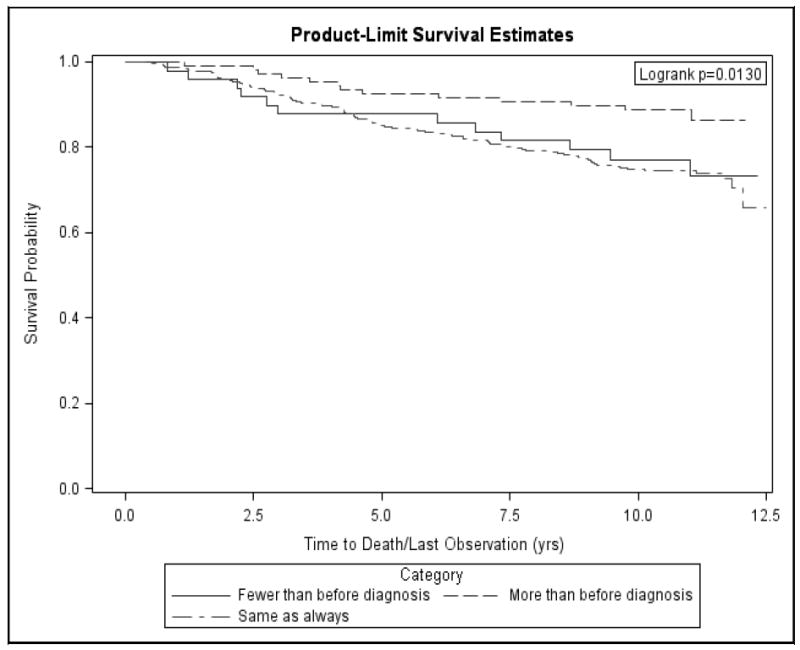
Results: Fifty-four percent of the women had local and 44% had regional stage disease. About 53% underwent mastectomy, 68% received chemotherapy, and 55% had radiation. Regression results showed that disease stage, estrogen receptor status, and mastectomy were associated with greater risk of dying. Although network size was not related to survival, increased contact with friends/family post-diagnosis was associated with lower risk of death, with a hazard ratio of 0.31 (95% CI, 0.17-0.57).
Conclusion: Findings from this study have identified an important aspect of a woman's social network that impacts survival. An increase in the amount of social contact, representing greater social support, may increase the likelihood of the women's survival by enhancing their coping skills, providing emotional support, and expanding opportunities for information-sharing.
Copyright © 2010 John Wiley & Sons, Ltd.
Figures
Comment in
-
Is it social support or depression that plays a role in survival of breast carcinoma?Psychooncology. 2012 Dec;21(12):1367. doi: 10.1002/pon.3097. Psychooncology. 2012. PMID: 23208840 No abstract available.
References
-
- Berkman LF, Syme SL. Social networks, host resistance, and mortality: A nine-year follow-up study of Alameda County residents. Am J Epidemiol. 1979;109:186–204. - PubMed
-
- Reynolds P, Boyd PT, Blacklow RS, et al. The relationship between social ties and survival among black and white breast cancer patients. National Cancer Institute Black/White Cancer Survival Study Group. Cancer Epidemiol Biomarkers Prev. 1994;3(3):253–259. - PubMed
-
- Goodwin J, Hunt W, Key C, Samet J. The effect of martial status on stage, treatment, and survival of cancer patients. JAMA. 1987;258:3120–3125. - PubMed
-
- Le Marchand L, Kolonel LN, Nomura A. Relationship of ethnicity and other prognostic factors to breast cancer survival patterns in Hawaii. J Natl Cancer Inst. 1984;73(6):1259–1265. - PubMed
-
- Funch D, Marshall J. The role of stress, social support and age in survival from breast cancer. J of Pscychosom Res. 1983;27:77–83. - PubMed
Publication types
MeSH terms
Grants and funding
LinkOut - more resources
Full Text Sources
Medical
